The High Life, animal species

In the last blog, we investigated the conditions and constraints of living at high altitudes, generally above 10,000 feet.  A few physiological adaptations listed included enhanced breathing and blood supply to get more oxygen to the body, internal temperature regulation allowing some mammals to adjust to a colder environment, and smaller plants requiring less moisture and having a short growing season. 

Common springtail, Orchesella cincta, by Mvuijlst, Feb 2009
Springtail, Isotoma caerulea, by Andy Murray, Jul 2014

The Himalayan jumping spider, Euophrys omnisuperstes, is generally found above 22,000 feet, living among rock crevices and feeding on stray insects blown upward by rising mountain winds.  The spider also feeds on springtails, Collembola, once considered an insect but now classified as a free-ranging hexapod.  These tiny organisms have antifreeze compounds in their blood, enabling them to live in higher, colder habitats. 

Reptiles from four lizard species have been found living in higher elevations.  Two species of iguana in the genus Liolaemus live in Bolivia; a third iguana species, Liolaemus tacnae, lives in Peru; and an Asian lizard, Phrynocephalus erythrurus, lives on the Tibetan plateau.  All were found between 16,000 feet and 18,000 feet, but very little is known about them since these areas are difficult to access for study.

Golden eagle, Aquila chrysaetos, by Giles Laurent, Dec 2021; Andean condor, Vultur gryphus, by Bastihitzi, May 2013; Alpine chough, Pyrrhocorax graculus, by Jim Higham, 2008

Birds can be found living near mountain tops year-round.  The Alpine chough, Pyrrhocorax graculus, lives in social flocks from the Alps to the Himalayas.  Standing 15″ high with a 30″ wingspan, they have black feathers with distinct yellow beaks and red legs.  They eat insects and berries in summer, but have become well-adapted to scavenging in winter, especially around ski resorts.  The Andean condor, Vultur gryphus, another social bird, roosts on cliffs and outcrops above 16,000 feet.  The steep terrain provides additional protection from potential predators.  Golden eagles, Aquila chrysaetos, are found world-wide in many habitats.  In the mountains, they hunt marmot, hare, and young goats at lower elevations, but nest in eyries, large cliff-hugging nests at higher elevations.  With wingspans up to seven feet, they can dive at speeds of up to 150mph over unsuspecting prey.

Left top to bottom: Common crane, Grus grus, by Savithri Singh, Feb 2020; Whooper swan,Cygnus cygnus, by KyoichiNarukami, Japan, Jan 2012; Bar-headed goose, Anser indicus, by J.M.Garg, India, Mar 2000; Ruppell’s Griffon Vulture, Gyps rueppellii, by Lip Kee, Kenya, Aug 2008

High altitude bird species with physiological adaptations for breathing and blood supply include those whose migration routes take them over the world’s highest mountain ranges.  Ruppell’s Griffon Vulture, Gyps rueppellii, with an 8-foot wingspan, has been observed at altitudes exceeding 36,000 feet over the Ethiopian Highlands of Central Africa.  The common crane, Grus grus, lives across eastern Europe and northern Asia, migrating over the Alps to Africa, India and southern China.  The bar-headed goose, Anser indicus, and the whooper swan, Cygnus cygnus, both live in south Asia and migrate over the Alps to central and sub-Arctic Asia to breed. 

Above: Large-eared pika, Ochotona macrotis,
by Karunakar Rayker, Ladakh India, Feb 2008
Right: Snow leopard, Panthera uncia, by Vassil, Aug 2007

The heights of the Himalayas support mammals that can concentrate their hemoglobin and allow the blood to carry more oxygen, avoiding issues with hypoxia, a shortage of usable oxygen in the body.  Species with this physiological adaptation include large-eared pika, Ochotona macrotis, living above 7,700 feet up to 20,000 feet; wild yak, Bos mutus, which have larger heart and lungs than domesticated yaks; and the snow leopard, Panthera uncia, living above 3,000 feet up to 18,000 feet.  The snow leopard has short, heavily furred limbs and a long, heavy tail for use as a blanket.  Its large nasal cavity and strong chest allows more oxygen to be taken in with each breath.

Ethiopian wolf, Canis simensis, by Charles J. Sharp, Ethiopia, Dec 2017; Mountain goat, Oreamnos americanus, by Darklich14, Colorado, Aug 2009; Tibetan argali, Ovis ammon, by DonArnold, Jurica-Suchy Nature Museum, Mar 2026; Guanaco, Lama guanicoe, by Charles J. Sharp, Chile, Oct 2025; Yellow-rumped leaf-eared mouse, Phyllotis xanthopygus, drawing by Charles Darwin, 1832

Mountain goats, Oreamnos americanus, can climb steep cliff faces with hooves that grip ledges and rock surfaces in the Rocky Mountains.  The yellow-rumped leaf-eared mouse, Phyllotis xanthopygus, feeds on grains, seeds, roots, and insects in the Andean Mountains of Chile, living at altitudes to 22,000 feet.  Guanaco, Lama guanicoe, a member of the camel family, lives in the Andes up to 13,000 feet and has about four times as many red blood cells as a human does.  The Ethiopian wolf, Canis simensis, is an endangered species living up to 15,000 feet in central Africa with populations fragmented by pressure from human farming activities.  Tibetan argali, Ovis ammon, is a wild sheep found in the Altai Mountains of Mongolia up to 19,000 feet.  The ewes and lambs prefer steep, treacherous slopes as protection against predators.

Scientists continue to study species in these habitats to learn more about their specific adaptations and survival abilities in a harsh environment.  You can learn more by visiting zoos or nature museums near you to investigate these fascinating species.

Venomous Snakes Of Illinois

There are 40 snake species native to Illinois, and they are found in all types of habitat from woodlands and prairies to wetlands and urban areas.  Of these, four species are venomous.  A venomous snake is one that uses a chemical toxin to kill its prey.  This internally developed chemical is delivered through a pair of hollow fangs in the upper jaw of the mouth.  When the snake opens its mouth, the fangs drop down and venom is injected into the prey as the snake bites.  The snake will then release the prey, waiting for the venom to kill it before swallowing the prey whole.  Juveniles will inject less venom, but with the same potency as adults.

Pit viper Fang and Jaw Structure drawn by M Moran at Encyclopedia Britannica

Venomous snakes in Illinois are all pit vipers, a sub-family of the Viperidae family of snakes.  The pit, a large opening between the eye and the nostril, just above the upper lip, can detect heat given off by warm-blooded prey species.  Their elliptically-shaped eyes is another characteristic that helps to identify venomous snakes.

Close-up of elliptical eye on Copperhead by Mark Dumont, Jun 2011
Close-up of pit above upper lip on pit vipers, by Scott Ballard, IDNR

Illinois venomous snakes are non-aggressive in nature, but will bite if cornered, harassed, or stepped on.  Bites are usually not fatal in humans, but they can be quite painful, often resulting in swelling and possible infection.  Vomiting, nausea, and tissue or nerve damage may also result.  Anyone that is bitten should seek immediate medical attention.

Eastern Copperhead, Agkistrodon contortrix, by Peter Paplanus, Aug 2018
Eastern Copperhead close-up, Agkistrodon contortrix, by Peter Paplanus, Apr 2021

The Eastern Copperhead, Agkistrodon contortrix, lives in the southern third of Illinois on wooded hillsides, river bluffs with sandstone or limestone outcroppings, and along forest edges.  During the hot summer months, they may also feed on the abundant rodent populations in meadows or near abandoned buildings.  The copperhead is  about four feet in length and has a light brown back with one to two dozen reddish-brown colored hourglass-shaped markings along the back.  The top of their head is a brighter red-brown.

Northern Cottonmouth, Agkistrodon piscivorus, by Virginia State Park Service, May 2016
Northern Cottonmouth flashing white, Agkistrodon piscivorus, by Peter Paplanus, Aug 2022

The Northern Cottonmouth, Agkistrodon piscivorus, resides in far southern parts of Illinois, living in swamps, sloughs, and oxbow lakes.  At five feet in length, this heavy-bodied snake is a uniform charcoal or dark olive color, with dark crossbands and a tan to gray belly.  When disturbed, its response is to face its attacker and open its mouth widely, displaying the bright white interior, earning the name of cottonmouth.

Timber rattlesnake close-up, Crotalus horridus, by Peter Paplanus, Apr 2023
Timber rattlesnake, Crotalus horridus, by Peter Paplanus, Apr 2023

Timber rattlesnakes, Crotalus horridus, live in both southern and northern areas along the Mississippi River and Illinois River valleys.  Usually found in heavy timber with rock outcrops or bluffs, this snake, up to six feet long, is marked by two dozen black crossbars down a gray-green-yellow back.  Its belly is light-colored with dark edges, and it shows a dark strip behind each eye.  Timber rattlesnakes will hunt in any areas where there is a large rodent population.  They are listed as threatened since we have seen sharp declines in the populations in recent years.

Massasauga Rattlesnake, Sistrurus catenatus, by Peter Paplanus, Apr 2021
Massasauga Rattlesnake close-up, Sistrurus catenatus, by Peter Paplanus, Apr 2021

The Massasauga Rattlesnake, Sistrurus catenatus, is found in small numbers scattered across the state, mainly in prairie wetlands and river floodplains.  Listed as endangered in the United States, it has become quite rare in Illinois with only a couple sightings annually for the past several years.  Massasaugas are about two feet in length, with a gray to light brown back and 30-40 dark, bow-tie shaped markings.  Four to seven darker rings cover the tail.  Their main prey is small rodents.

Venomous snakes have small ranges, staying close to home for hunting and mating.  Their main predators include humans, birds of prey, and other snakes.  Many have been killed by people with an unfounded fear of these creatures.  Although they play a major role in controlling rodent populations, there has been little concern shown over loss of habitat due to draining of wetlands and other urban development.  Plan a visit to the Jurica-Suchy Nature Museum or a nature center near you to learn more about these mysterious, yet wonderous species.

Heat Effects

The midwestern United States is experiencing a heat dome this week.  This is the result of a high pressure system hundreds of miles across and moving very slowly.  Air in the upper atmosphere of a heat dome is already warm, but is still cooler than the air below, and cooler sir sinks towards the Earth’s surface.  As the air moves downward, it compresses air molecules together releasing heat, making the lower layers even hotter and drying out the area as moisture evaporates.  With little or no moisture, no clouds form to relieve the heat and dry conditions.

Heat Dome over Eastern US by National Weather Service, Jun 26 2025

Humans have a variety of ways to cope with high heat including being less active, drinking plenty of fluids, and remaining in shady or air-conditioned areas.  Wildlife still has to get food and water every day and may have fewer opportunities available to them to avoid the high heat.  Let’s look at how the heat is affecting a few of the backyard species common in the Midwest.

Photinus pyralis, Big Dipper firefly by Terry Priest

Fireflies are cold-blooded, or ectothermic, and prefer warm and humid areas.  They come out in the early evening and as their bodies warm, they become more active, flying and flashing more frequently, communicating with other fireflies to find a mate.  Eggs are laid soon after mating, but these will perish if they do not remain hydrated.  Turning off outdoor lighting for a few hours in the evening and maintaining taller, well-watered vegetation will help fireflies during hot and dry conditions.

American Toad by Brad Carlson, Mar 2012; and Bullfrog at Waterfall Place by DonArnold, 2022

Frogs and toads are also ectothermic and require heat from the environment to live.  Species worldwide, including American toads and bullfrogs in our area, find temperatures in the 70s to be ideal.  As temperatures move into the mid-80s, these species and others are prone to dehydration and heat stress.  In addition, they normally look for shady and humid areas to regulate their body temperatures, but the lack of moisture in a heat dome does not make those niches easy to locate.  Maintaining shady, well-watered areas of the garden provides refuge for many amphibian species.

Goldfinch by DonArnold, 2024
Cardinal looking to stay in the shade by Don Arnold, 2023

Birds are often affected by extreme heat.  Most birds have lower body temperatures than the outside air.  This allows birds to easily dissipate heat from high energy activities, such as flight.  Once the outside air gets above a hundred degrees, birds cannot lose heat to the atmosphere and become severely compromised by heat and dehydration.  Rapid open-mouthed breathing, changing eating times to early or late in the day, sitting with wings outstretched, or exhibiting poor balance are all signs of heat stress in birds.  Providing shady, undisturbed areas and readily available water sources gives birds the opportunity to move around less and stay hydrated.

Song Sparrow by DonArnold, 2024

Wild animals have to deal with weather extremes just as we do.  Come to the Jurica-Suchy Nature Museum or a nature center near you to learn more about providing opportunities for wildlife to survive heat, drought, and other environmental conditions.

Sounds of Spring

Thunder and heavy rain, soft rain and light wind, birds in the early morning, frogs in the evening, and maybe a coyote howl deep into the night are some of the sounds of spring.  As cold temperatures ease into summer highs, walks through natural areas tend to be filled with many sights as well as opportunities to learn by being quiet and listening closely. 

Calls and songs are used by many species for a variety of purposes.  Thousands of birds are migrating through the area, especially on clear evenings, and calls help to keep birds together and establish who is the flight leader.  Year-round species are re-establishing territories, using calls to warn intruders to stay away or warn family members of approaching threats.  Frog species in particular are calling during evenings to find a mate, lay eggs, and begin the establishment of the next generation.

There are dozens of species active at this time of year, and as we have been taking nature walks on campus the last few days, here are some of the wildlife we are listening to (click on each picture to hear their call)โ€ฆ

Yellow-rumped warbler, Setophaga coronata, Mirceax, Getty Images

Yellow-rumped warbler, Setophaga coronata, by Valerie Heemstra, 2024

Red-winged blackbird, Agelaius phoeniceus, by KenCanning, Getty Images Signature

Red-winged blackbird, Agelaius phoeniceus, by Thomas Ryder Payne, 2022

Palm warbler, Setophaga palmarum, by Irving A. Gaffney, Getty Images

Palm warbler, Setophaga palmarum, by Christopher McPherson, 2021

Northern waterthrush, Parkesia noveboracensis, by Carol Hamilton, Getty Images

Northern waterthrush, Parkesia noveboracensis, by Lance A.M. Benner2017

Northern Parula, Setophaga americana, by Neil Bowman, Getty Images

Northern Parula, Setophaga americana, by Richard E. Webster, 2023

Chipping sparrow, Spizella passerina, by Irving A. Gaffney, Getty Images

Chipping sparrow, Spizella passerina, by David Tattersley, 2023

Blue-headed vireo, Vireo solitarius, Mirceax, Getty Images

Blue-headed vireo, Vireo solitarius, by Thomas Magarian, 2024

Blue Jay, Cyanocitta cristata, by Miguel Opacic, Getty Images

Blue Jay, Cyanocitta cristata, Sue Riffe, 2024

Bird songs have a structure and rhythm, and are repeated often to attract a mate, ward off rivals, or bond with a  family member.  Other calls give warning that danger is near, keep flocks together in flight, or create a pair bond, often between mother and chick.

Frogs and toads are mating and laying eggs in area ponds.  Each species has its own distinctive call, used by the males to attract a mate, warn of potential danger, establish a territory, or to signal distress.  Frog species being heard around campus at this time include the following (click on each picture to hear their call)โ€ฆ

American Toad, Anaxyrus americanus, by Mshake, Getty Images

American Toad, Anaxyrus americanus, by Thomas Margarian, 2024

Boreal chorus frog, Pseudacris maculata, by Derwyn, Getty Images

Boreal chorus frog, Pseudacris maculata, by Thomas Margarian, 2016

Spring peeper, Pseudacris crucifer by HuntImages, Getty Images Signature

Spring peeper, Pseudacris crucifer by Paul Marvin, 2012

Northern Leopard Frog, Lithobates pipiens, by Jennifer Seeman, Getty Images

Northern Leopard Frog, Lithobates pipiens, by Paul Marvin, 2015

Sometimes, coyote can be heard when walking in woodlands around campus late in the evening.  There are a lot of different calls used by these canines to provide information to other individuals.  You can listen below to a bark used to indicate a threat, a social call establishing an individual’s location, a begging call from a young one, and a howl audible over long distances to announce one’s presence.  Other calls may include a woof to signal a low intensity threat, a yip to claim territory, a growl to threaten another animal, and a whine or yelp to show subservience to a more dominant individual.

Coyote, Canis latrans, barking by TakenPix, Getty Images

Coyote, Canis latrans, bark by Paul Marvin, 2018

Coyote, Canis latrans, begging, by Keith Szafranski, Getty Images Signature

Coyote, Canis latrans, begging call by Matthew L. Brady, 2025

Coyote, Canis latrans, social interaction by Michel Viard, Getty Images

Coyote, Canis latrans, social call by Flor Sangermano, 2023

Coyote, Canis latrans, howling, by Keith Szafranski, Getty Images Signature

Coyote, Canis latrans, howl by Paul Marvin, 2012

Additional wildlife sounds can be heard on campus around Lake Benedictine or in nearby forest preserves.  Get out for a walk and be sure to listen throughout the day for bird species, and into the evening hours for frogs, toads, and coyotes.

Salamanders

Salamanders are in the order of amphibians named Caudata, which includes mudpuppies, newts, and sirens.  There are about 760 species of salamanders worldwide and 121 species are endangered.  With the exception of a few in the Amazon basin, they are found only in the northern hemisphere.  They live in habitats that provide sufficient humidity levels to keep their skin moist, from sea level to nearly 15,000 feet in altitude.

Northern zig-zag salamander, Plethodon dorsalis, by John P Clare, 2016
Marbled salamander, Ambystoma opacum, by Jupiterimages, PhotoImages

The smallest species are lungless salamanders of southern Mexico, growing to an inch in length.  The largest species are the Chinese great salamanders, about six feet in length.  They are often mistaken for lizards, having smooth or bumpy skin, but can be easily identified by their total lack of scales.  All salamanders have a tail which is rounded in terrestrial species but slightly flattened and often crested in aquatic species.  Most salamanders are grey, brown, or white, but a few terrestrial species are brightly colored.  Cave dwelling salamanders often lack all pigment and appear pinkish-white in daylight.

* Western lesser siren, Siren intermedia nettingi, by Peter Paplanus, 2013
Long-tailed salamander, Eurycea longicauda longicauda, by Meghan Alessi, Getty Images

Salamanders, other than cave-dwellers, tend to have well-developed eyes.  Research shows they are very attuned to differentiating brightness, but cannot see colors.  Their eyes are large and provide nearly 360 degrees of view.  Salamanders have no external ears, but can detect vibrations received through their jaw bones.  Although some species can emit small squeaks, salamanders have no vocal chords or voice box and do not use vocal communications.  Their sense of smell is well-developed and plays an important part in locating prey and mates. 

* Hellbender, Cryptobranchus alleganiensis
alleganiensis, by Jason Ondreicka, Getty Images
Cave salamander, Eurycea lucifuga, by Alfred Crabtree, 2012

Salamanders may have functional lungs, non-functioning lungs, or no lungs.  All species have the ability to exchange gases directly through their skin and the membranes inside their mouth and throat, but this also requires that the skin remain moist at all times.  Terrestrial salamanders depend on moisture found in deep leaf litter, holes in trees in temperate zones, or moisture collected in bromeliads growing on trees in tropical zones. 

Four-toed salamander, Hemidactylium scutatum,
by Jason Ondreicka, Getty Images

Salamanders have three sets of glands located under the skin, covering their entire body.  Mucous glands secrete a sticky liquid that is spread over their body keeping the skin from drying out.  When salamanders are in the water, the mucous acts as a lubricant, enhancing their swimming ability.  A second set, called the granular glands, produce toxins and odors unique to each species that helps to deter predators and attract mates.  A third set of glands is a mixture of the first two, doing a little bit of the work of each.

Small-mouthed salamander, Ambystoma texanum,
by Jupiterimages, PhotoImages
Tiger salamander, Ambystoma tigrinum tigrinum, by John P Clare, 2013

Salamanders are not as noticeable as many other species.  They prefer secrecy and out-of-the-way hiding places.  Most species are active at dusk and into the nighttime.  All salamanders are carnivorous, feeding on small crustaceans, insects, spiders, and their favorite food – worms.  Predators include snakes, lizards, fish, birds, and small mammals.  Salamanders defend themselves by exhibiting threatening poses and emitting toxins, many with a bad odor.  As a last defense, they may voluntarily lose their tails to a predator, a trait known as autotomy.  A new tail can be grown within a few weeks. 

Salamanders are easy to care for and their habitats are easily duplicated making them widely distributed in the pet trade and for use in laboratories.  Additional conservation impacts come from habitat fragmentation, or habitat degradation, or habitat loss due to draining of wetlands and forest clearing.

Northern slimy salamander, Plethodon
glutinosus glutinosus,
by Jason Ondreicka, Getty Images
Red-backed salamander, Plethodon cinereus cinereus, by Steve Byland, Getty Images

In Illinois, we have 20 species of salamanders, pictured throughout this blog.ย  Seventeen are terrestrial and three are aquatic (*).ย  Consider coming to the Jurica-Suchy Nature Museum or a nature museum near you to learn more about salamanders in your area.

  • Spotted salamander, Ambystoma maculatum, by Louisianatreefarmer, Getty Images
  • Blue-spotted salamander, Ambystoma laterale, by Jason Ondreicka, Getty Images
  • Central newt, Notophthalmus viridescens louisianensis, by Andrew DuBois, 2016
  • Dusky salamander, Desmognathus fuscus conanti, by Jason Ondreicka, Getty Images
  • * Mud puppy, Necturus maculosus maculosus, by Andrew Hoffman, 2010
  • Three-toed salamander, Amphiuma tridactylum, by Peter Paplanus, 2016
  • Southern two-lined salamander, Eurycea cirrigera, by Peter Paplanus, 2021
  • Mole salamander, Ambystoma talpoideum, by Andrew DuBois, 2016
  • Dark-sided salamander, Eurycea longicauda melanopleura, by Andrew Hoffman, 2010

Extinct & Endangered – pt.3

An endangered species is one that is likely to become extinct in the near future, either worldwide or locally in a known range.  In some instances, these species may be saved through habitat conservation, breeding assistance, and education.  This final installment on Extinct & Endangered will take a look at three species in North America that have benefited greatly from such efforts.

The Gila Monster, Heloderma suspectum, is the only venomous lizard native to the United States and is listed as near threatened.ย  Their ranges are quite small, covering 700 to 3000 square feet.ย  They spend most of their lives in underground burrows, and they are only regularly outside for a couple of hours each day during their mating season, from March to May.ย  Gila monsters hunt small animals, and prey is eaten alive, head first.ย  Venom is delivered through their saliva as the prey is chewed and acts to slow the prey’s reactions.ย  While venom is not deadly to humans, it can cause swelling and severe pain.ย 

Gila Monster, Heloderma suspectum by Erin Donalson, Getty Images
Gila Monster, Heloderma suspectum by Shoemcfly, Getty Images

Gila monsters pose no direct threat to humans, usually living in remote areas, but still have a fearsome reputation that contributes to illegal hunting of the species.  They were the first venomous animal in the United States to get legal protection from being collected, killed, or sold.  As development threatens areas where the Gila monster is found, conservationists are moving populations to preserves where there is minimal interactions with humans.  Breeding numbers in the wild are still robust, although captive breeding efforts have been started in zoos across North America.  Education and preservation of appropriate habitat has so far kept this species off the endangered lists.

The black-footed ferret, Mustela nigripes, is listed as endangered, but increasing in population.ย  Their native range includes southern Canada and the northern United States, but habitat loss and disease have reduced populations to only a few hundred.ย  They are a playful member of the weasel family, using several vocalizations for communication including barks, chattering, and chuckling.ย  They are nocturnal and rarely seen in the daytime.ย  Prairie dogs, hunted in underground burrows at night, are their exclusive food source.

Black-footed ferret, Mustela nigripes, portrait by Delecrouix, Getty Images Pro
Black-footed ferret, Mustela nigripes, at prairie dog burrow by kahj19, Getty Images

The species was declared extinct in the late 1960s until a dozen individuals were found in Wyoming in the early 1980s.  Deliberate extermination of prairie dog colonies, because they are considered a nuisance species, has had a significant impact on black-footed ferret populations.  Habitat protection and captive breeding programs have been successful at boosting population numbers.  There are now about 300 black-footed ferrets living in Wyoming and other sites in the north central and southwestern United States where individuals have been released.  Habitat loss and disease are still constant threats, and scientists estimate that about 3,000 individuals will be required to save the species from extinction.

The California Condor, Gymnogyps californianus, the largest bird in North America, formerly nested in caves in high cliff faces along the southern California coast until real estate development claimed all of their habitat.  In the 1980s, as the last 34 birds were captured, the species was declared extinct in the wild. 

California Condor, Gymnogyps californianus, tagged, in flight by OldFulica, Getty Images

Condors are slow flyers, soaring in great circles, searching for carcasses of dead animals to eat.  They eat until they are full, and can go about two weeks between meals.  Juveniles may take several months to learn to fly and land gracefully, without crashing.  Condors reach reproductive maturity at four to six years of age, and can live over fifty years.  After mating, females lay only one egg, and mating may not take place every year.

California Condor, Gymnogyps californianus, Grand Canyon by Blewulis, Getty Images Pro

Even with slow reproduction rates, efforts to expand the population by hand-rearing and re-introduction to unaffected habitat have resulted in close to 450 birds back in the wild in California, Utah, Arizona, and the Baja.ย  Still listed as an endangered species, the California condor is making great progress in rebuilding its population.

California Condor, Gymnogyps californianus by DonArnold, Mar 2024
Introduction to Extinct & Endangered at Jurica-Suchy Nature Museum by DonArnold, Mar 2024

Extinct and endangered species can be found in every habitat and location worldwide.  Many are being helped by direct action with hand-rearing and habitat protection.  Indirect action through new laws, conservation support, and education has also had a positive effect.  Many of these species are on display at various nature museums including the Jurica-Suchy Nature Museum.  Plan a visit soon to learn more.

Sea Turtles

Sea turtles live in every ocean environment around the world, nesting on tropical and subtropical beaches, and migrating long distances.  They spend their entire lives at sea except when females come ashore to lay their eggs.  They have been on earth for over 100 million years, surviving the period when most dinosaurs and other reptiles died out 65 million years ago.

Coral reef & hawksbill sea turtle by jakubgojda, Indian Ocean, Maldives

Sea turtles are large, air-breathing reptiles with upper (carapace) and lower (plastron) shells.  Six of the seven species are covered by hard scales called scutes.  Although none have teeth, jaws are suited to each species specific diet.  Sea turtles do not have ears, but there are eardrum openings covered by a flap of skin.  Their sense of smell is excellent as is their underwater vision, although they are nearsighted when out of the water.  Along with a streamlined body, they possess powerful legs and claws for swimming, diving, and catching food.

Green turtle eating seagrass by LauraDin, Getty Images
Green sea turtles, Chelonia mydas, on coral reef by Artush, Alam, Egypt

Sea turtles, along with manatees, are excellent caretakers of seagrass beds and coral reefs, habitats that are vital to the reproduction of fish, shellfish, and crustaceans.  Seagrass, one of their favorite foods, grows faster and stronger with daily trimming from turtle munching.  Coral beds, vulnerable to collapse and suffocation under mass quantities of sponges and small crustaceans, benefit from sea turtles that eat several hundred of these animals each day.

Olive ridley digging egg chamber by JHVEPhoto, Getty Images, Costa Rica
Green sea turtle hatchlings by Penny Britt, Getty Images

After reaching sexual maturity, which takes from 15 to 50 years, depending on the species, female sea turtles return every two to five years to the beach where they were born to lay their eggs.  On average, they dig three to seven nests and place about 100 eggs in each.  Baby sea turtles break out of their egg and instinctively flee for the lighter colored horizon where the ocean meets the beach.  They spend several years in the open ocean feeding and growing before venturing into shallower waters to eat, mate, and reproduce.  Only about one in a thousand babies will grow to be an adult.  Most are prey for birds, crabs and fish, but many are killed by humans for food, medicines, and religious ceremonies.  Nesting site habitat destruction and turtles caught as part of the fishing industry also play a part in population decline.

Females lay all of their eggs on land, but nesting sites and the best feeding sites may be thousands of miles apart.  Sea turtles are found throughout the world’s oceans following concentrations of jellyfish, sponges, and crustaceans found in coral reefs and seagrass beds.  Leatherback females have been tracked making migrations of over 12,000 miles between nest sites and the best annual feeding grounds during non-breeding seasons.

Read facts on each species in the sidebar, shown below.  Come to the Jurica-Suchy Nature Museum where we have loggerhead, hawksbill, and green sea turtles on display to learn more about these creatures and their hidden realms.


Sea turtle speciesโ€ฆ

There are seven species of sea turtles in the world.  All are experiencing dwindling populations from various threats.  Two are critically endangered: the hawksbill sea turtle and the Kemp’s ridley sea turtle.  Two are endangered: the green sea turtle and the flatback sea turtle.  Three are listed as threatened: the leatherback sea turtle, the olive ridley sea turtle, and the  loggerhead sea turtle.

Hawksbill sea turtles, Eretmochelys imbricata, have a narrow head allowing access to tight spaces in coral reefs, the usual spot to find sponges.ย  They consume 1,000 pounds of sponges annually, keeping coral reefs free from suffocation by the sponges.ย  These turtles are medium size at 2′-3′ and 100-200 pounds.ย  Females nest on beaches among rocky areas 3-4 times in a season and lay 140-200 eggs in each nest.

Kemp’s ridley sea turtles, Lepidochelys kempii, are the smallest species at 2′ in diameter and 75-100 pounds.ย  Kemp’s ridley turtles have made a huge recovery from the 1960s, when there were about 200 individuals left, to almost 9,000 today.ย  This is due to changes in Mexico’s laws, where 95% of their nesting takes place, to protect nest sites from disturbance.

Green sea turtles, Chelonia mydas, grow to 4′ and 500 pounds.ย  They are herbivores with a finely serrated beak for biting seagrass and scraping algae from hard surfaces.ย  This is the only species known to come onshore to bask in the sun.ย  They are named for the color of their fat, not their shell.

Flatback sea turtles, Natator depressus, have a flattened carapace, unlike other turtles.ย  They are medium sized at 3′ and 200 pounds.ย  Found only in Australia, they do not migrate.ย  Females lay only about 50 eggs in a nest, but nests are well spread out, helping to better protect their eggs.ย  Their biggest threat is being preyed upon by saltwater crocodiles.

Leatherback sea turtles, Dermochelys coriacea, are the largest species at 4′-8′ and 500-2,000 pounds.ย  They consume mostly jellyfish, daily eating their own weight in food.ย  They have no scutes, but are covered by a flexible, leathery skin that allows them to dive up to 4,000 feet deep searching for prey.ย  These turtles have thermoregulatory adaptations that allow them to hunt in very cold waters from Alaska to Chile, and they regularly make the longest migration of any vertebrate animal, traveling over 12,000 miles annually.

Olive ridley sea turtles, Lepidochelys olivacea, are small at 2′ and 75-100 pounds.ย  They are the most abundant of all species.ย  On certain beach sites, nesting females form an arribada, a grouping of all the females offshore who all come ashore at the same time to nest and lay eggs.ย  Females on other sites may nest alone.ย  Arribadas are particularly vulnerable to mass mortality events, but these are rare andย  population numbers remain consistent.

Loggerhead sea turtles, Caretta caretta, grow to 4′ and 200-400 pounds.ย  Their very large heads and jaws can easily crush hard shells, allowing them to eat crabs, conches, and whelks.ย  They have the largest concentration of nests annually, including 30,000 at a single Mediterranean location.ย  Their shells provide space for 50 to 100 epibionts: plants and invertebrates that live permanently attached to their shells.

Frog Calling

Spring has arrived bringing rising temperatures, warm winds, and spring rains to the upper Midwest.  This is the time of year when many amphibians, most notably salamanders, frogs, and toads, start their annual breeding periods.  Illinois has nineteen native frog species.  They are secretive and difficult to find most of the year; but spring is the season for mating, and males will leave their woodland homes and make their way to the nearest pond on nights when temperatures stay in the forties or above.

Hidden Lake by DonArnold, 2021

Frogs use a variety of different calls.  Advertisement calls, the loudest calls voiced by male frogs, advertises their presence and availability to potential mates.  The courtship call, a slight variation of the advertisement call, is used as a female gets close to direct her to the exact location where the male is waiting.  If a male mounts an unreceptive female, or mounts another male, which can happen by mistake in the dark, a release call is emitted to inform the male to stop and look for another potential mate.  Aggressive calls may be used by one male towards another who gets too close.  And if any frogs are attacked by a predator, a loud distress call is made.  This may be to startle the attacker or warn other frogs in the area.

Waterfall Glen gray tree frogs calling by DonArnold, 2022

Calls are created by filling the lungs with air, and then blowing out a steady stream of air over the vocal chords.  When calling, the mouth and nostrils are normally closed.  The air is passed from the lungs, over the vocal chords in the larynx and into the air sac under the mouth.  This air sac, shown in many frog pictures, amplifies the sound to help it carry farther.  Calling requires considerable energy and may increase the metabolic rate, the rate at which calories are used, from ten to twenty times the resting rate of an individual.  For frogs with breeding periods lasting many weeks, the expenditure of calories will cause a male to lose a significant amount of body weight.

NoName Marsh, Boreal Chorus & Spring Peeper by DonArnold, Mar 2022

Many different species of frogs lay their eggs in the same ponds.  Males arrive early in the evening and begin advertising, while females arrive a bit later and identify a potential mate based on his call.  When a gravid female approaches, the male clasps her from on top and holds on.  After a time, the female releases her eggs in the water, and the male immediately fertilizes them by releasing sperm into the water around the egg sac.  Depending on the species, all of the eggs may be deposited in one egg sac or in several separate egg sacs.  Egg laying can last several minutes to several hours.  After each group of eggs is laid, the male and female may separate or rest for a brief period and then move to another spot to deposit more eggs.

Their skin is moist and cool to the touch.  It is permeable, allowing air to pass directly through it into their circulatory system, helping to remove some of the workload from the lungs and heart.  This can be especially useful during inclement weather.  However, the skin’s permeability makes them susceptible to drying out, so they live in or close to water or high humidity environments.  Their lifestyle includes being active mostly at night or on overcast days when it is cooler and more humid.

From left: Spring peeper calling by Andrew Hoffman, Jan 2000; Ornate chorus frog calling by FWC Fish & Wildlife, Jan 2014; Green tree frog calling by Eyeweed, Dec 2009

Many frog populations have been impacted by losses of both wetland and forest habitat.  Wetlands are used for breeding and forests provide sheltered areas with shade, ground cover, and higher humidity than areas open to bright sunlight.  During spring evenings or overcast days, listen closely as you pass by these shady areas and nearby ponds to catch sound or sight of these wonderous small creatures.

Snake Defense

Snakes, with over 3,000 species worldwide, are one of the largest groups of reptiles.  They are found on every continent except Antarctica and live in every type of habitat including freshwater and saltwater.  They have numerous enemies and have developed defensive strategies enabling them to survive and prosper.

Catching a snake on the wing by CuriousLog, Jun 2007
Red-shouldered hawk with snake by Don Loarie, Mar 2018
Great Blue Heron eating snake by C Watts, Jan 2022

Snakes must deal with threats from a wide range of animals.  Bird species that prey on snakes include raptors, ravens, egrets , and storks.  Nocturnal hunters, including owls, have excellent sight in low-light conditions and often hunt by spotting movement among foliage.  Likewise, during daytime hours, red-tailed hawks and eagles can spot movement on the ground while soaring.  Snakes are normally line-of-sight hunters, and are often unaware of threats from above, giving avian predators a distinct advantage.

American crocodile, Crocodylus acutus by Florida Fish and Wildlife, Feb 2021; Wolverine by Maia C, Aug 2012; Skunk by D Fletcher, May 2016

Most mammal predators are larger, more agile, and faster.  Badger, wolverine, and racoon are all excellent climbers and may hunt from an elevated perch.  Wolverine and skunk are also burrowers that will dig out their prey from underground.  Snakes living in saltwater and freshwater environments are  eaten by predators such as crocodiles and snapping turtles.  In addition, some larger snake species regularly hunt smaller snakes.

Copperhead on dead leaves by Abbott Handerson Thayer, Mar 2022

Snakes use a number of non-aggressive strategies to avoid confrontation and escape.  Their best defense is to remain hidden, using colors and patterns to break up the outline of their body, allowing the snake to blend with the background foliage and be overlooked by any predators.  Another passive strategy is balling, involving compressing their body into a tight coil or ball, typically with the head tucked in to protect this most vulnerable area.  Playing dead is often an effective means to escape predation, honed to perfection by the Western hognose snake.  This snake convulses its body, rolls onto its back, and lets its tongue loll out of its mouth.  It may vomit or spew blood, release fecal matter or musk, all in its attempt to convince a potential predator that it is already dead and no longer appetizing.

Timber rattlesnake balled and hidden by Peter Paplanus, Apr 2022

Mimicry is a development that has taken place in some species over long periods of time.  Batesian mimicry is when a harmless species has evolved the coloration of a more dangerous species to fool a predator into leaving it alone.  Scarlet kingsnakes of the southeastern United States are quite harmless but look very much like Eastern coral snakes, a venomous species in that same area.  Auditory mimicry involves creating sounds used by more dangerous snakes.  Fox snakes, found in deciduous forests, often vibrate their tails in leaf litter, making a buzzing noise very similar to the sounds made by rattlesnakes living in the same area.

Scarlet kingsnake by FWC Fish & Wildlife Research Institute, May 2015
Eastern coral snake by FWC Fish & Wildlife Research Institute, Sep 2014

Snakes often use one or more methods of intimidation.  Bright display colors are found among many venomous species and serve as a warning to potential predators that this snake is dangerous.  Another form of intimidation involves a snake inflating its body or a body part to make it look bigger.  The puff adder inflates its whole body by filling its lung with air.  Cobras hold their heads high and flare out an extra fold of skin on either side of their heads, commonly called “hooding.”  Intimidation may also involve auditory cues including the rattling of a snake’s tail and the hiss emitted by cobras as they bring up their heads.

Cape Cobra, Naja nives by DonArnold

When the above strategies do not allow the snake to escape, most species will not hesitate to strike.  Several species do not bite, striking with the nose or an open mouth; however, all venomous snakes will bite in self-defense, although they may not inject venom.  A few species are able to spit venom, used purely as an act of self-defense, although if the venom targets an eye or nasal passage, the results can be extremely painful.

Snakes are some of the most interesting species with a lifestyle very different from our own.  They have many strategies for keeping themselves safe from wild predators, and will be around for us to observe, learn about, and be fascinated by.

Desert Habitat, pt.3

In the past two blogs, we have explored deserts and the plants which inhabit them.  Animals native to these habitats have general adaptations for coping with temperature extremes, aridity, and finding water, food, and shelter.  Strategies include hunting during cooler hours including at dawn, dusk, or overnight; obtaining water from sources other than standing water; burrowing underground to avoid temperature spikes and solar radiation; ability to conserve water in their body; ability to dissipate body heat; and being well-camouflaged.  Look for each of these adaptations in the following species that live in our desert regions.

Greater roadrunner, Geococcyx californianus, by Tony Cyphert, Sep 2018
Ord’s Kangaroo Rat, Dipodomys ordii, by Andy Teucher, Jun 2005

The greater roadrunner, Geococcyx californianus, can only fly for several seconds at a time, but can reach speeds up to 17mph when running.  They hunt early in the morning, retiring to shade when temperatures heat up mid-morning.  Water requirements are met from foods including grass and prickly pear cactus, plus prey that includes lizards, scorpions, and rattlesnakes.  Roadrunners do not urinate, but can excrete salt and save the water.  They have an un-feathered area under their chins used to dissipate body heat.  Ord’s kangaroo rat, Dipodomys ordii, is another species that gets all of their water requirements from the seed they eat.  Individuals live in underground burrows, coming out only at night to feed.  They conserve water in their bodies and do not sweat or pant.  They have many predators, but with a 9-foot jump and excellent hearing, they are hard to catch.  Seeds are collected and stored in their burrows, and they will gain 50% more water from the underground humidity before being eaten.

Horned Toad, Phrynosomasp., by TJFrom AZ, May 2009
Gila monster, Heloderma suspectum , by Karla Kishinami, Apr 2012

Horned toads, Phrynosoma spp., are small, ant-eating lizards with thick scales to conserve water and deter predators.  To escape a predator, these animals can squirt a directed stream of blood from their eyes up to five feet away.  They are sandy-colored with undefined outlines allowing them to easily hide amid rocky outcrops.  Normally active during the day, they can retreat to burrows or under rocks if temperatures become too hot.  During winter, horned toads will spend a period of inactivity, called brumation, in underground burrows.  The Gila monster, Heloderma suspectum, is another lizard with armor protected skin marked with black and pink coloration that camouflages them well in sandy soils.  They shelter from daytime heat under rocks and shrubs, emerging in early morning or evening to hunt small mammals, lizards, insects, and bird eggs.  One of only two venomous reptiles in North America, their venom adversely affects their prey’s nervous system.  The short, thick tail stores water in fatty tissue for use when needed.

Tarantula, Aphonopelma sp., by Saguaro National Park, Nov 2020
Western coral snake, Micruroides euryxanthus, by Ashley Wahlberg, Apr 2016

The tarantula, Aphonopelma spp., shelters in deep burrows lined with silk to prevent the sand from caving in.  They are nocturnal hunters of insects, arthropods, and small lizards with a bite that delivers a small amount of venom to stun their prey.  Venom immediately starts to break down tissue to liquify the meat, allowing the spider to use sucking mouth parts to draw in its meal.  The Western coral snake, Micruroides euryxanthus, is brightly colored with red-white-black-white banding and venom that is twice as deadly as most rattlesnakes.  They are very secretive, living under rocks or buried in the sand.  Coming out at night or on some overcast days, they hunt for lizards and other snakes.  Venom causes rapid paralysis and respiratory failure, although due to their small size and small amount of venom injected, they are not a threat to humans.

Sonoran Desert by K e v I n, Feb 2016

Like many environments, a healthy desert community exists when plants, animals, and habitat are all present and undisturbed.  With much of the life in deserts underground, walking off trails and driving off roads can negatively impact what is under the surface.  Removing plants and rocks used for water and shelter is equally damaging.  I encourage you to get out, observe, and enjoy this unique habitat, or research many of the fun and interesting adaptations at a local natural history museum.

Pictures above clockwise: Bark scorpion by Josh More, May 2014; Cactus wren by Mick Thompson, Feb 2019; Jackrabbit, by Mark Gunn, Mar 2014; Javelina, Sonora Desert, by Richard Bonser, Jan 2005; Tarantula hawk wasp by Jim Mulhaupt, May 2010; Sonoran mud turtle by Grigory Heaton, Sep 2022; Round tailed ground squirrel by Wendy Miller, May 2022; Hoary bat by Michael Pennay, Sep 2009; Cactus deermouse by J.N.Stuart, Oct 2011

Illinois State Symbols, pt.2

Last week, we learned about state symbols covering many of the natural wonders found in Illinois.  The following paragraphs describe the state symbols for the animals that have earned recognition.

Forst Preserve of Cook County seal
Bluegill by David Seibold, Jun 2021

In the early 1900s, the first forest preserves in the nation were in Chicago setting aside rare habitats that would protect animal and plant diversity.  Over 94% of Illinois land areas are considered rural, including 1.4 million acres of wetlands.  The Illinois State Fish, the Bluegill, Lepomis macrochirus, is found in lakes and ponds and was selected by schoolchildren in 1986.  Also known as bream or brim, the name refers to the bright blue gill covers sported by the male. 

Eastern tiger salamander, Ambystoma tigrinum, by John P Clare, Apr 2013

The State Amphibian is the Eastern Tiger Salamander, Ambystoma tigrinum, the largest terrestrial salamander in Illinois.  This State Amphibian and State Reptile were voted on by citizens in 2004 and approved by the Illinois General Assembly in 2005.  It has a large head and dark body with irregular yellow blotches. It can be found everywhere in the state, although it is uncommon in large agricultural areas. 

Painted turtle by Victoria Pickering, May 2020
Eastern Milk Snake, Lampropeltis triangulum, by Peter Paplanus, May 2019

There are two reptiles recognized in Illinois.  The State Reptile is the Painted Turtle, Chrysemys picta, a  species found in all aquatic habitats in Illinois.  It is dark olive with yellow, red, or orange markings covering the plastron, forelegs, and both sides of the head.  In addition, we have a State Snake, the Eastern Milk Snake, Lampropeltis triangulum triangulum.  Its body is gray covered with large brown blotches with black borders.  Milk snakes average 24″-43″ long, and live in fields, woodlands, and rocky areas.  When agitated, the snake will vibrate its tail and hiss before striking.  They are constrictors that feed on small mammals.

Monarch, Danaus plexippus, on swamp milkweed by Anita Gould, Aug 2005

Pollinator species are important to the agricultural industry.  Plants of all kinds require pollination in order to set seed.  Insects are one of the most important groups of pollinators.  Butterflies, bees, wasps, flies, ants, beetles and many more all feed on nectar offered by plants.  In the process, they collect pollen on their bodies, sometimes to eat and other times inadvertently as they push through the flower to obtain nectar.  Pollen is then transferred to other plants the insect visits.  The State Insect is the Monarch Butterfly, Danaus plexippus, chosen by schoolchildren in 1975.  Monarchs lay eggs and feed on many of the state’s native milkweed species.  The butterfly’s orange coloring is a warning to predators not to attempt to eat a monarch which consumes, processes, and stores toxins from milkweed plants for its own defense.

Cardinal, Cardinalis cardinals, by Marcel Milliard, Dec 2020
White-tailed deer in corn, Matthew Paulson, Jul 2014

The State Bird is the Northern Cardinal, Cardinalis cardinalis.  Selected by schoolchildren in 1929, the cardinal beat out several other choices including bluebird, meadowlark, bobwhite, and oriole.  The cardinal, a medium-sized songbird, is known for the males’ bright red feathers.  It prefers the forest edge where it can enjoy both prairie and woodland resources for hunting and shelter, but is often seen in backyards.  The State Animal, White-tailed Deer, Odocoileus virginianus, also enjoys living along the forest edge.  Selected in 1980, deer have some amazing abilities.  They are able to run at 40 miles per hour and jump over a 9-foot high fence.  They are excellent swimmers, traveling 13 miles-per-hour in the water.  Native Americans and settlers both heavily relied on deer for buckskin clothing and food.

State symbols are representative of items and species that are present in our state.  Take the opportunity to observe these natural wonders on your next outdoor adventure.

Backyard Sounds

A peaceful afternoon, broken only by the sounds of…

As I sit on the back deck, I listen to the myriad sounds in the backyard.  Bird, insect, and mammal visitors make daily forays among our many plants.  We have bird feeders and fresh water available each morning. 

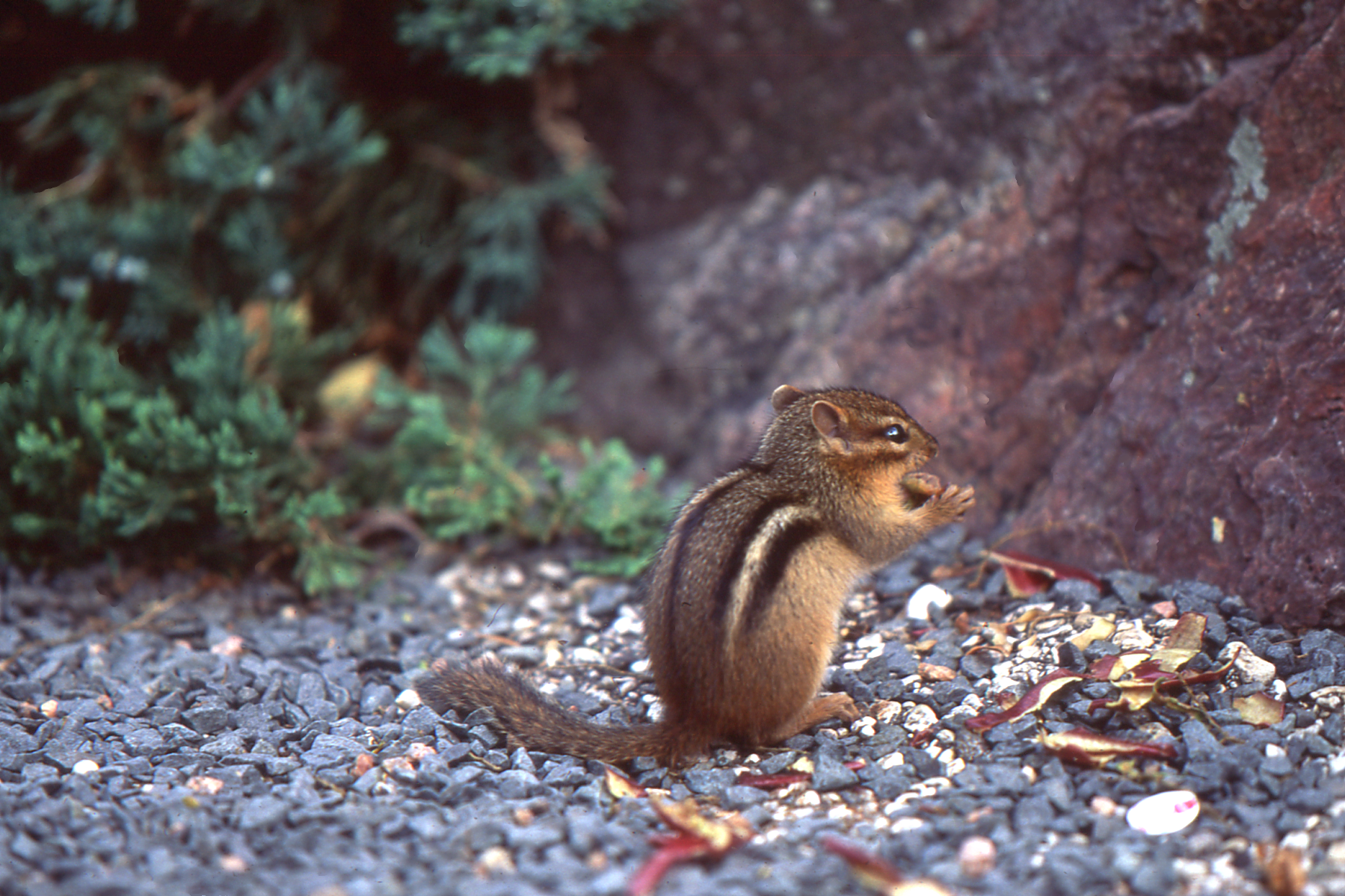
Chipmunk eating serviceberry fruit by Brian Gratwicke, 2013
Robin in Amelanchier tree by Deb Nystrom, 2016
Cedar waxwing on serviceberry by John Matthews, 2018

Many backyard visitors including robins, chipmunks, cedar waxwings, and sparrows have been keeping close watch on the Amelanchier tree.  Small green fruits appeared a few weeks ago, and ripened to a bright, cheery red after ten days.  However, the birds did not wait that long to test the taste.  Dozens of fruits ripen daily, but most are gone by the next day.  Amelanchier, also called serviceberry, is a sub-family of the Rosaceae family.  There are 28 species native to the United States.  Small, deciduous, multi or single stemmed trees, they bear pome, a fleshy fruit with several seed chambers, that is a favorite for many species. 

Cardinal by DonArnold, 2020

A cardinal has perched on the back fence next to our shade garden to “kip kip” at me about the lack of food.  I feed the birds every year, providing thistle in a hanging net feeder, suet in a cage, and woodpecker mix in an open tray.  Cardinals eat both early morning and late evening from the tray, but with the widespread reports of avian bird flu in May, we stopped feeding for several weeks.  I am sure my friend has read the calendar and thinks the time is right for resuming putting his treats out!

Elderberry by DonArnold, 2022
Sawfly larva by Andy Reago & Chrissy McClarren, 2019

Next to the cardinal, the foliage on an elderberry in the back of the shade garden looks green and lush.  This plant is a favorite food for sawfly larvae, which consumes the foliage leaving only the leaf ribs behind.  A sawfly larva appears as a short, fat, white worm, and can be picked off by hand and thrown into a bucket of water to dispose of them.  Be careful not to simply knock them off onto the ground, for they will quickly find their way back up the stems and into the foliage once again.

A natural pond surrounded by native forbs and grasses is at our yard’s back edge.  Red-winged blackbirds are everywhere along the edges.  This year we are watching two nests hidden deep in the foliage directly behind our house.  Known for being aggressive birds during breeding season, they are being chased away by the cardinals.  Cardinals are considered non-aggressive, but can be more than a match for the red-wing blackbirds when breeding territories between the two species overlap. 

Another bird bothersome to the blackbird is the great blue heron that come to the pond for the small fish.  Every time one shows up, the red-winged blackbird harasses it by flying directly at it and banging into it with a claw or beak.  Male redwings rarely show signs of tiring while performing guard duties, and the herons may put up with this for several minutes, but eventually leave the pond.

A house sparrow family, living in one of the shade garden birdhouses, is making a racket to drive away a fox squirrel that has gotten too close to their nest.  House sparrows are monogamous and mate for life.  In the central U.S., two batches of four to five eggs are typically laid during the summer.  In our birdhouse, the first batch of eggs hatched about a week ago.  The young birds will remain in the nest for two to three weeks.  During that time, the male and female share feeding and guard duty. 

They meetโ€ฆdefense on their minds (DonArnold 2021)
The faceoff (DonArnold 2021)
They tangle, andโ€ฆ. (DonArnold 2021)

I also hear bullfrogs calling, sounding a deep bass ‘jug-a-rum’ at any hour to attract a mate.  There are several males in our pond, and as the summer heats up, and we have less rain, the pond gets a little crowded.  Adults are solitary and a great splashing noise signals the meeting of two males, each aggressively defending their part of the pond.  After mating, females lay 10,000 to 20,000 eggs in a gelatinous mass on the pond’s surface.  Tadpoles hatch in four to five days, and those that survive will overwinter in the pond for one to two years before metamorphosizing into adults.

As the vanquished leavesโ€ฆ (DonArnold 2021)
The victor gloats! (DonArnold, 2021)

A Spring Walk

The weather has included a lot of rain in these past few days, and there is more coming.  Temperatures are still cool at night, but getting quite warm during the day, contributing to unstable air, thunderstorms, and tornado watches.  Vegetation in our area is green and lush, inviting for the many species that inhabit our area.  I hope you enjoy the sounds and pictures of spring and some of the inviting observations we can look forward to in the near future.

Boreal chorus frogs, Pseudacris maculata, are still out calling, even though it is near the end of their breeding season.

by DonArnold 2022

Another early spring species, white trout lily, Erythronium albidum, is still blooming.

by DonArnold 2010

And now that warmer weather is here to stay, both eastern garter snakes, Thamnophis sirtalis, and plains garter snakes, Thamnophis radix, are moving away from their winter dens and dispersing into woods and fields.

Garters emerging from winter den by DonArnold 2021
Garter snake baby by DonArnold 2021

Golden Alexanders, Zizia aurea, and celandine poppy, Stylophorum diphyllum, are making a bright yellow welcoming splash for the next several weeks. 

Golden alexanders by DonArnold 2020
Celandine poppy by DonArnold 2020

Weather always plays a large role in late spring in northern Illinois.  A good thunderstorm can bring wonderful, soaking rains or wind and lightning to drive us indoors. 

Thunderheads are a weekly happening by DonArnold 1986

Many species depend on water in ephemeral ponds at this time of year, including frogs, toads and salamanders.  First to call are chorus frogs, Pseudacris maculata, then gray tree frogs, Hyla versicolor, and finally bullfrogs, Lithobates catesbeianus, call well into summer. 

Gray tree frogs calling by DonArnold 2022

Bullfrog at Waterfall Place by DonArnold 2020

As spring moves into early summer, look for wood ducks, Aix sponsa, in woodland ponds

by DonArnold 2012

And mallards, Anas platyrhynchos, with puffball babies keeping close to mama

by DonArnold 2020

Green dragons, Arisaema dracontium, and their close relative, Jack-In-The-Pulpit, Arisaema triphyllum, are already standing tall 

Green Dragon by DonArnold 2012
Jack-in-the-pulpit by DonArnold 2021

Other species to begin to watch for in the coming weeks include bumblebees gathering pollen from flora of all species and Eastern black swallowtail caterpillars, Papilio polyxenes asterius, destined to fly away at summer’s end. 

Bumblebee collecting rose pollen by DonArnold 2020
Eastern Black Swallowtail larvae on fennel by SueOBrien 2020

I hope you are able to observe these and many other sights in the coming weeks on your neighborhood walk or in local forest preserves.

Crocodilians, pt. 3

Crocodilians make caring parents and contribute to their habitat

Crocodilians are some of the most aggressive and fiercest predators of the animal world.  The young of all species can swim and catch food as soon as they hatch, but will continue to feed on the yolk sac in the egg for at least the first several days.  As they grow, young eat insects, snails, and frogs.  Hunting mainly at night, adults eat mostly fish, but they will also attack anything that wanders by too closely, including birds, snakes, turtles, raccoons, zebra, cattle and horses.

Baby Alligators and Everglades alligator farm by Matthew Paulson, Mar 2021
Crocodile fishing, Crocodylus porosus, by Budak, Mar 2018

Crocodilians often sit quietly and wait for prey to come to them, although they can be active hunters.  Three methods of capturing food include lunging for prey on land; leaping out of the water to surprise an animal then pulling it under the water to subdue it; and sweeping their open mouths from side to side underwater to catch fish.  Crocodilians do not have the ability to chew, but will tear off pieces and swallow each chunk whole.  Every part of the prey, including bones, is eaten.

Juvenile American Alligator (Alligator mississippiensis) resting on an adult, by Zygy, Feb 2021

Crocodilians begin mating activities when they are about eight years old.  Females tend to be a little older, and males a little younger.  Unlike many reptiles that provide no family care, female crocodilians make gentle, caring parents, protecting eggs and young, assisting at feeding times, and staying with them for their first few years.  However, there are many predators on land and in the water, and even with adult supervision, only about 10% of babies will live past their first year.

American alligator, Alligator mississippiensis, leaving pond to bask by Bob Yellow, Jun 2021
Caiman floating in lake by Ronald Woan, Jan 2018

Crocodilians inhabit warmer climates, and most live in freshwater habitats, although a few live in saltwater.  They prefer shallow wetlands offering plenty of bottom rooted vegetation that attracts prey and keeps the hunter well hidden.  Gentle banks allow them to easily crawl out on land for basking and to reach egg laying sites.  Crocodilians save energy by moving around in water instead of overland because the water supports their heavy bodies.

Gator hole by BFS Man, Sep 2013
Alligator with heron by BFS Man, Apr 2013

Many animals provide vital services in their home habitats.  Alligators dig large holes in limestone river beds, called gator holes. In hotter weather, as rivers dry up, these holes stay full of water, providing water and cool places for animals to hide from the heat of the day.  Crocodilians are great scavengers.  They keep their range clean by eating any dead animals.

Alligator foot backscratch
Alligator foot keychain

Very few species threaten adult crocodilians, and one of their biggest threats are humans.  They are hunted for their skins for clothing and jewelry, and various body parts used for medicinal purposes.  Bones are ground into fertilizer and animal feed.  Meat and eggs are used for food.  Sex organs, musk and urine are all used in the perfume industry.

American Alligator, Alligator mississippiensis by DonArnold

Habitat preservation and education about their importance is needed.  Efforts to halt illegal poaching and smuggling and enhance captive breeding and wild release are being stepped up to conserve these species.  Several farms have been started to prevent the need for crocodilians to be taken from the wild, and to generate income, via tourism, for local economies.  You can visit your local natural history museum or zoo to learn more about these amazing animals.

Crocodilians, Pt. 2

Size, snout, and teeth make crocodilians top predators

There are between 20 and 30 recognized species of living crocodilians, who, along with birds, are the only two surviving groups of Archosauria, a group that has existed for 250 million years and includes the now extinct dinosaurs.  Key characteristics of crocodilians include an elongated, structurally reinforced skull, powerful jaw muscles, young born from eggs, and parents providing extensive care to young. 

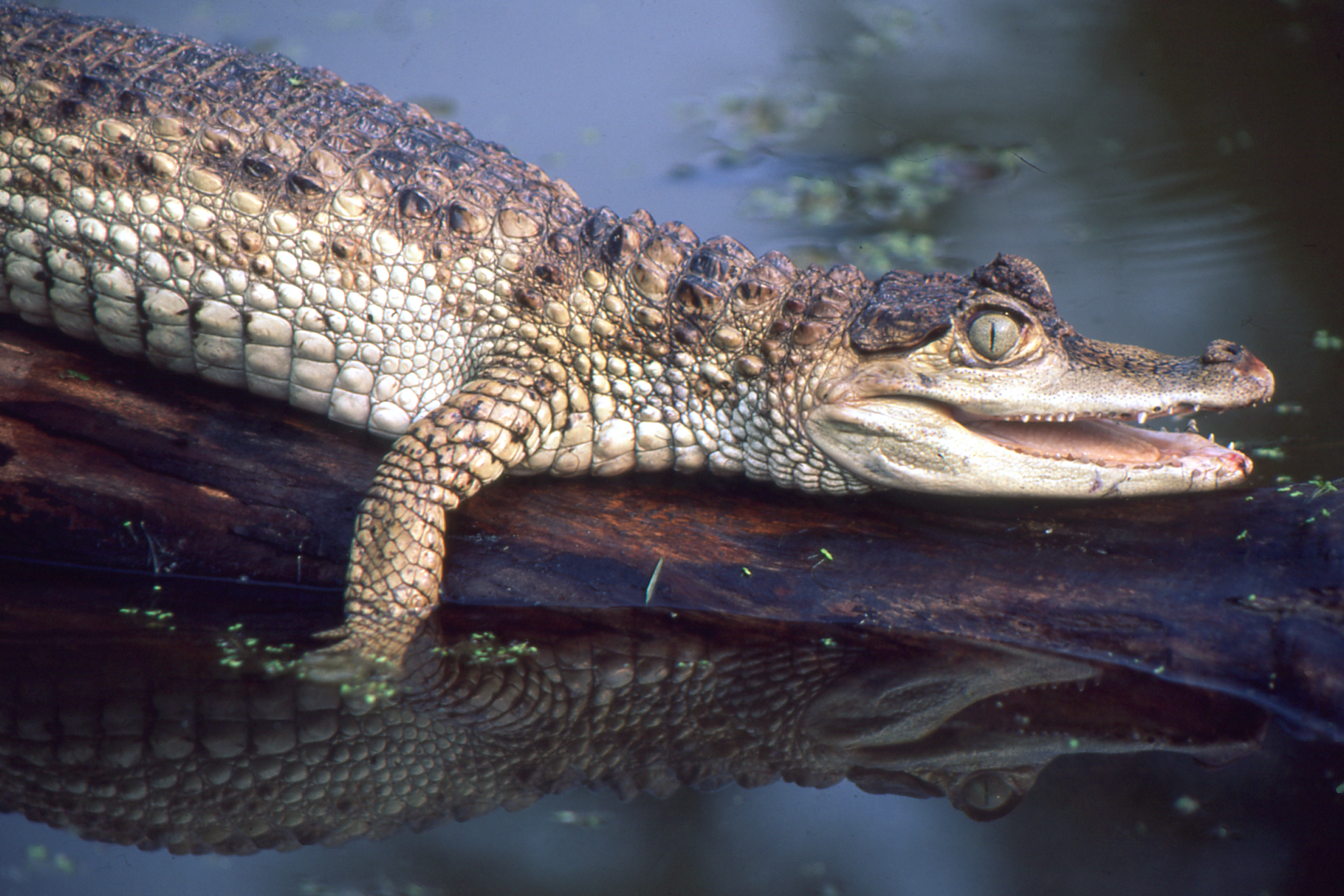
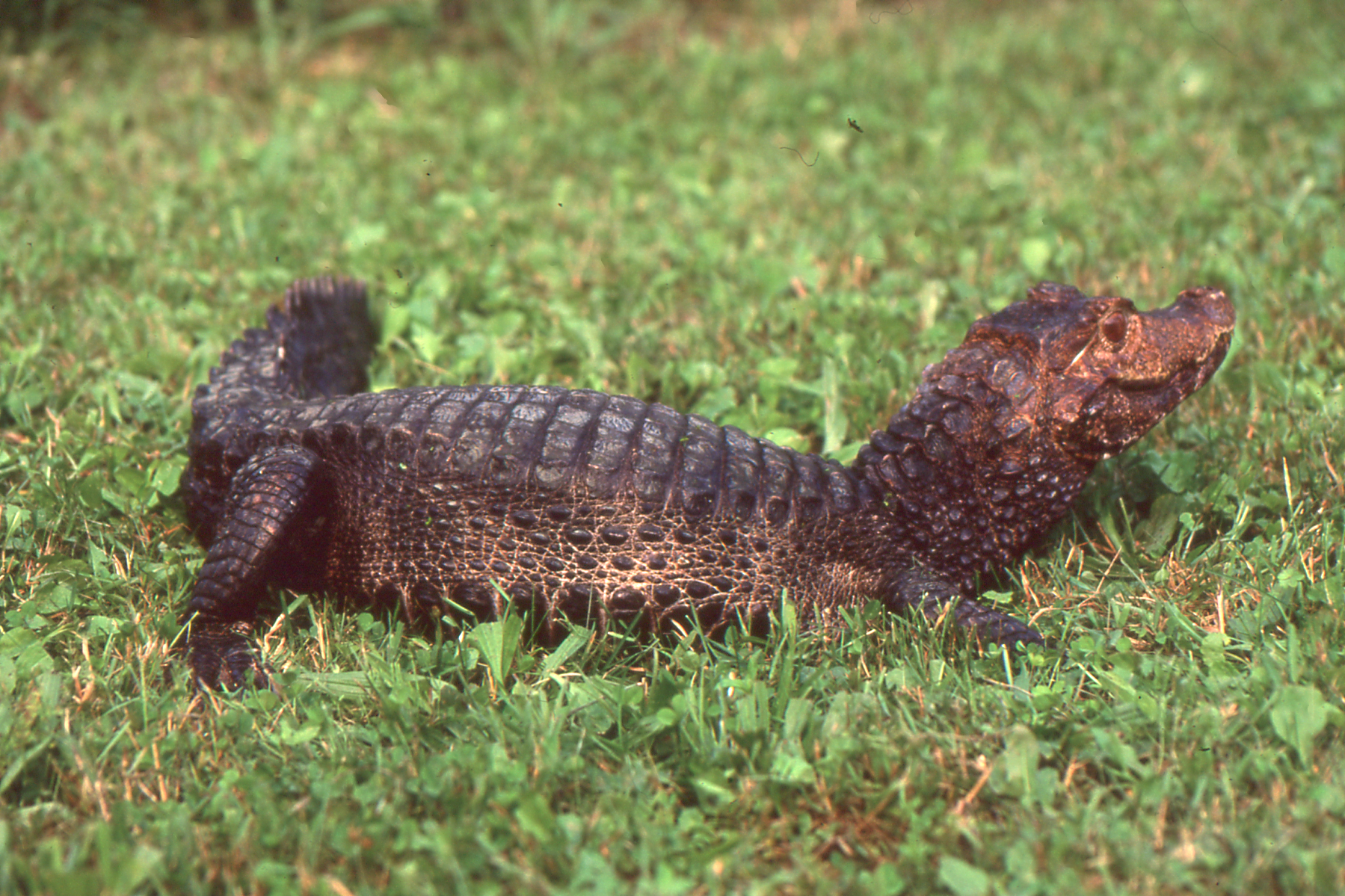
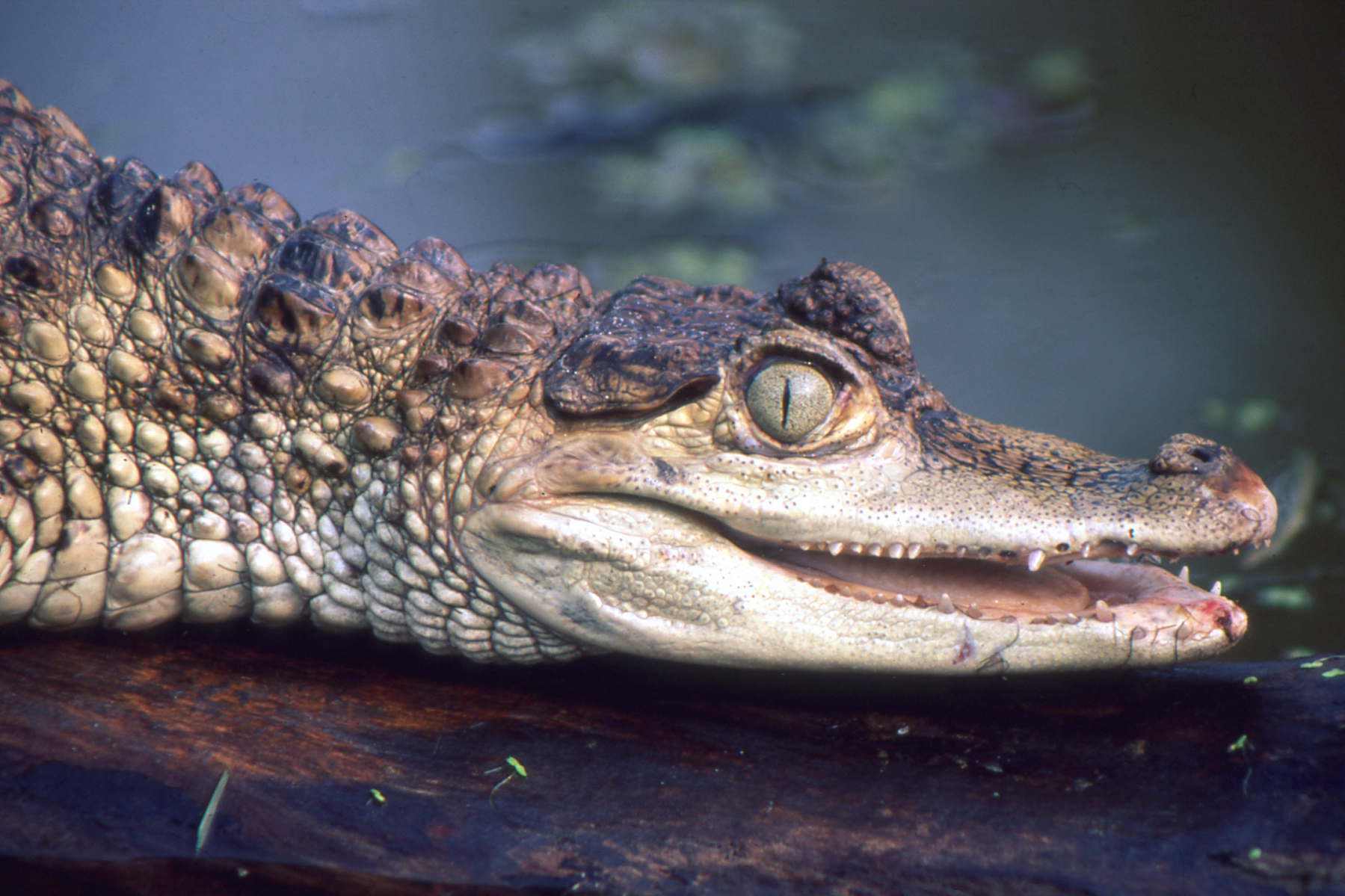
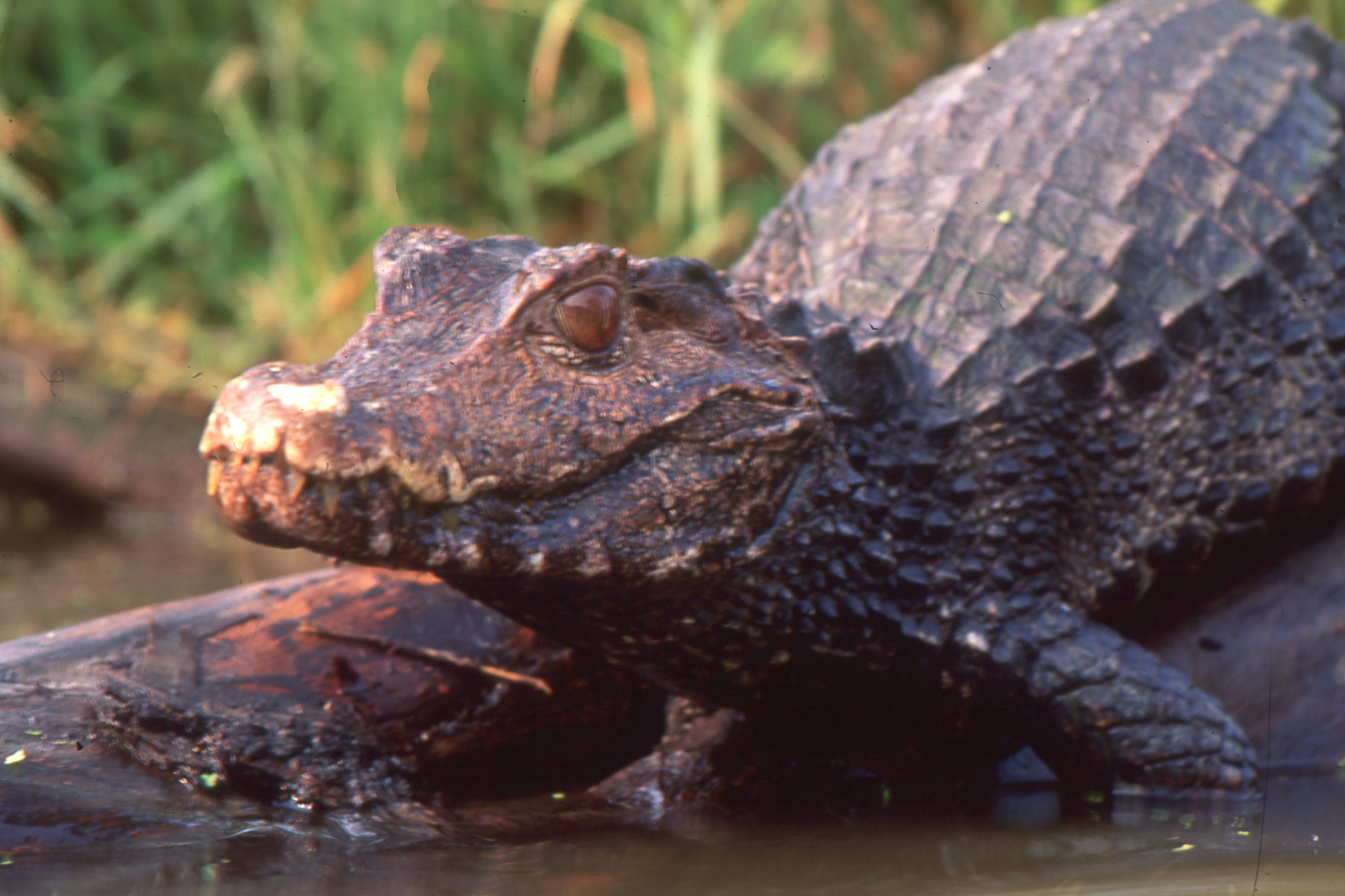
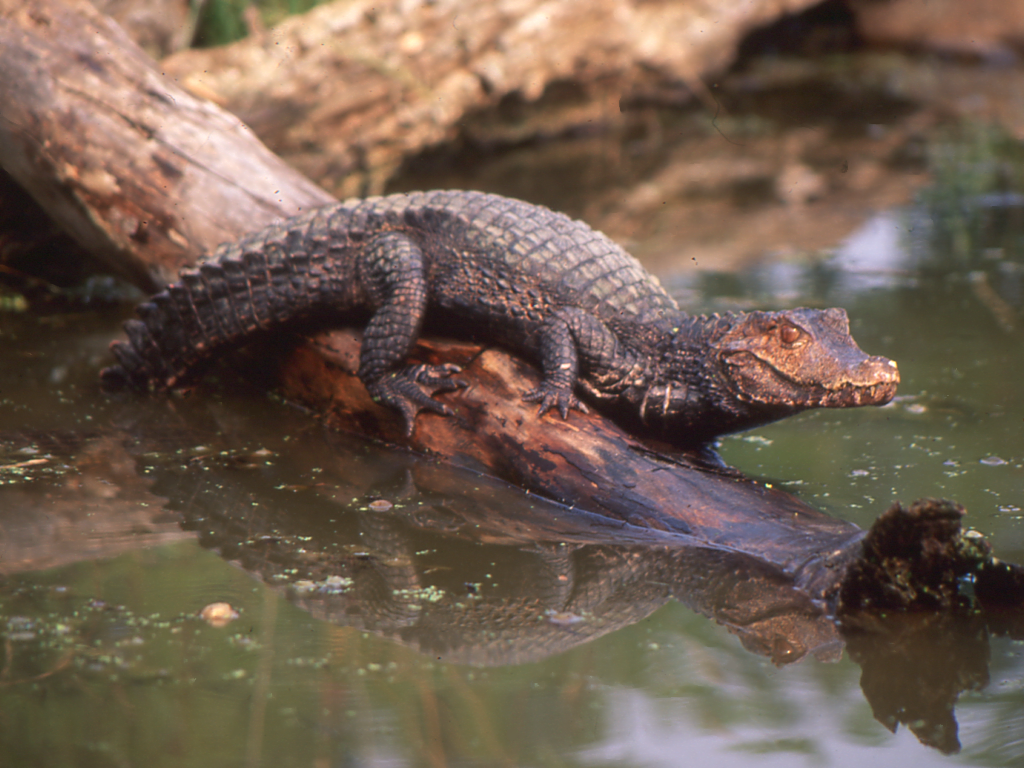
Dwarf Caiman, Paleosuchus palpebrosus, by DonArnold
Saltwater crocodile, Crocodylus porosus, by Geoff Whalan Aug 2021

Crocodilians vary greatly in size.  Cuvier’s Dwarf Caiman, living in northern South America, is one of the smallest species averaging four feet long and weighing 13 to 15 pounds.  The saltwater crocodile, living in brackish and saltwater habitats from southern India to northern Australia, may grow to 20 feet or more, and tip the scales at close to 3,000 pounds.  For those of us in the United States, the two commonly found species include the American alligator, living along the southeastern coastal states and averaging 12 to 16 feet and 1,000 to 1,300 pounds, and the American crocodile, found only on the southern tip of Florida, growing up to 20 feet and 2,000 pounds.

Skeleton and abdominal ribs of crocodile by Lydekker, R. 1879 The Royal Natural History. Volume 5

Bone structure, like the rest of the body, make crocodilians well-adapted to living in the water.  A strong, flexible spine starts at the base of the neck and runs to the end of the tail.  Tails are used to propel them through the water, and they are able to tuck their feet close to their sides, using them as rudders.  Crocodilians may look ungainly on land, but can get around easily.  Using the high walk, the animals can lift their entire torso off the ground to walk on all four legs.  Some species can also gallop on all fours at speeds up to 11 mph for short distances.  In muddy areas and when close to water, they slide on their belly, pushing off with their legs, able to quickly move into the water.

Broad snout of American Alligator, Alligator mississippiensis, by DonArnold
Broad snout of Dwarf Caiman, Paleosuchus palpebrosus, by DonArnold
Narrow snout of gharial, Gavialis gangeticus, by Josh More Feb 2012

Crocodilian snout shape, size, and dentition is influenced by their prey and how it is caught.  Gharials and crocodiles have long, slim snouts for sweeping through the water catching fish.  Alligators and caiman have shorter, broader snouts with powerful jaw muscles to overpower birds, mammals, and other prey, some even larger than themselves.  The bite force in crocodilians is the strongest of any living animal. 

Bone and muscle structure have changed very little over the last several million years.  Space for the jaw muscles inside the skull is very large.  Strong muscles are designed to clamp the jaws shut, allowing the quick capture and killing of prey.

Depending on the species, crocodilians have between 60 and 110 teeth.  Teeth grow constantly and are replaced individually about every two years.  Worn teeth simply fall out as a new one grows in immediately.  Each animal can grow up to fifty sets of teeth in its lifetime.

Nile Crocodile, Crocodylus niloticus, trying to swallow a big Tilapia, Oreochromis sp. by Bernard Dupont Jan 2014

Front teeth are sharp for piercing and holding prey.  Molars towards the rear of the mouth are used for crushing prey.  Crocodilian jaws cannot move from side to side, a requirement for chewing, so prey is swallowed whole or in large chunks.

Crocodile teeth exposed by Derek Keats Jul 2009
Dwarf Caiman, Paleosuchus palpebrosus by DonArnold

One way to distinguish crocodiles from alligators is to look at their jaws when closed.  The fourth tooth on a crocodile is outside the jaw, fitting into a pocket on the upper lip.  Alligators and caiman exhibit no teeth when the jaw is closed.

Next week, we’ll wrap up with food, family, and conservation.

Crocodilians pt.1

Crocodilians, well-adapted to their habitats, have tough armor and excellent senses.

Dwarf Caiman, Paleosuchus palpebrosus by DonArnold

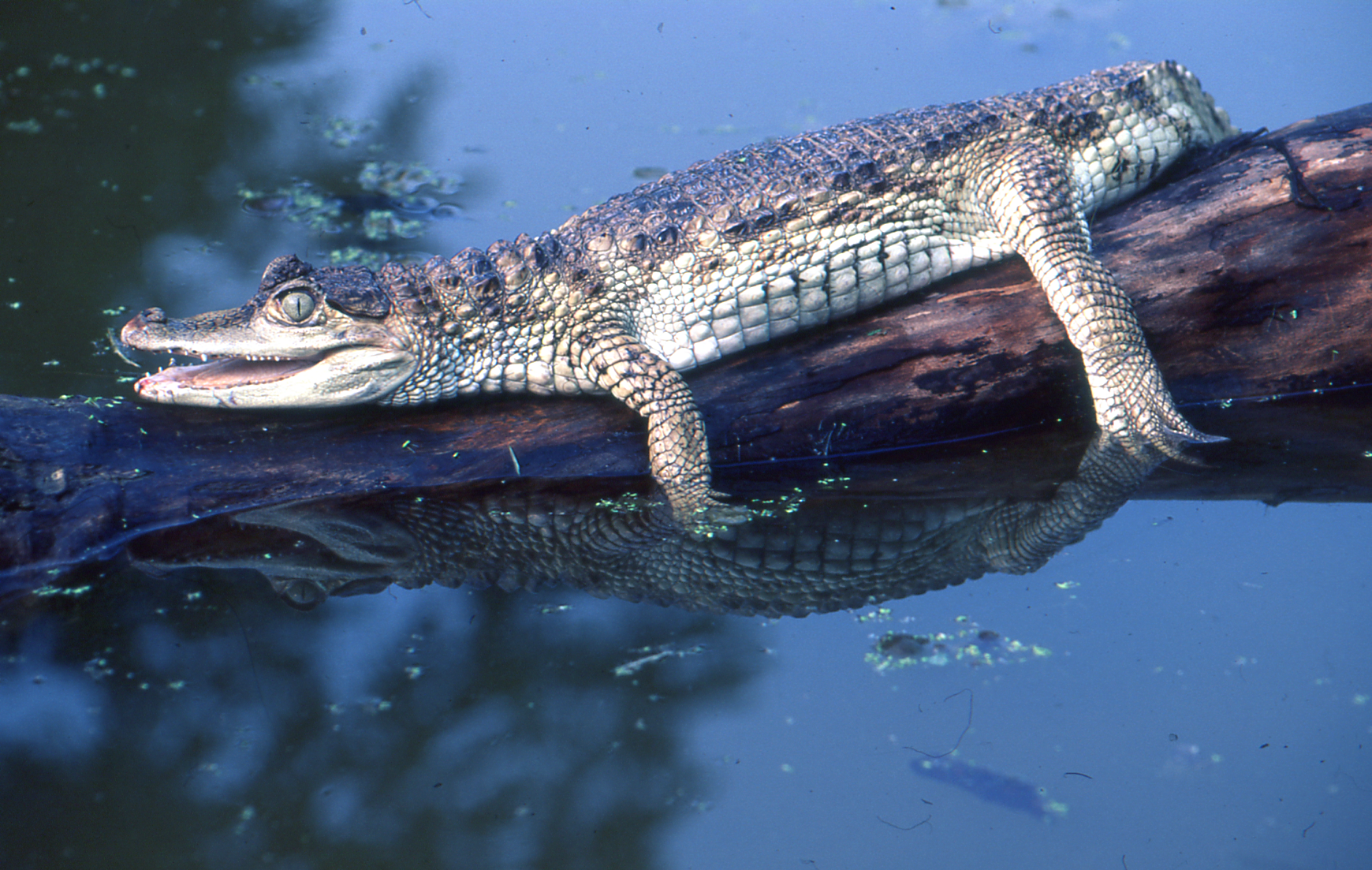
Crocodilians, a group of reptiles that have been living since before the age of dinosaurs, include alligators, crocodiles, gharials, and caiman.  For over 200 million years they have adapted to changes in their habitat and food sources.  Considered highly intelligent animals, capable of complex communication, they make attentive parents and are fierce predators.  Two hundred million years ago, before dinosaurs, these reptiles were small land animals with long legs and short snouts.  As dinosaurs took over and ruled the land, crocodilians lived in the seas.  Growing in size, some as long as fifty feet, they still hunted dinosaurs on shore.  As the age of large mammals evolved to smaller species, so did the crocodilians.  They are still considered to be some of the largest species of animals inhabiting our world, today.

American Alligator, Alligator mississippiensis by DonArnold

Gharial, Gavialis gangeticus by Josh More, Feb 2012

American crocodile, Crocodylus acutus by Florida Fish and Wildlife, Feb 2021

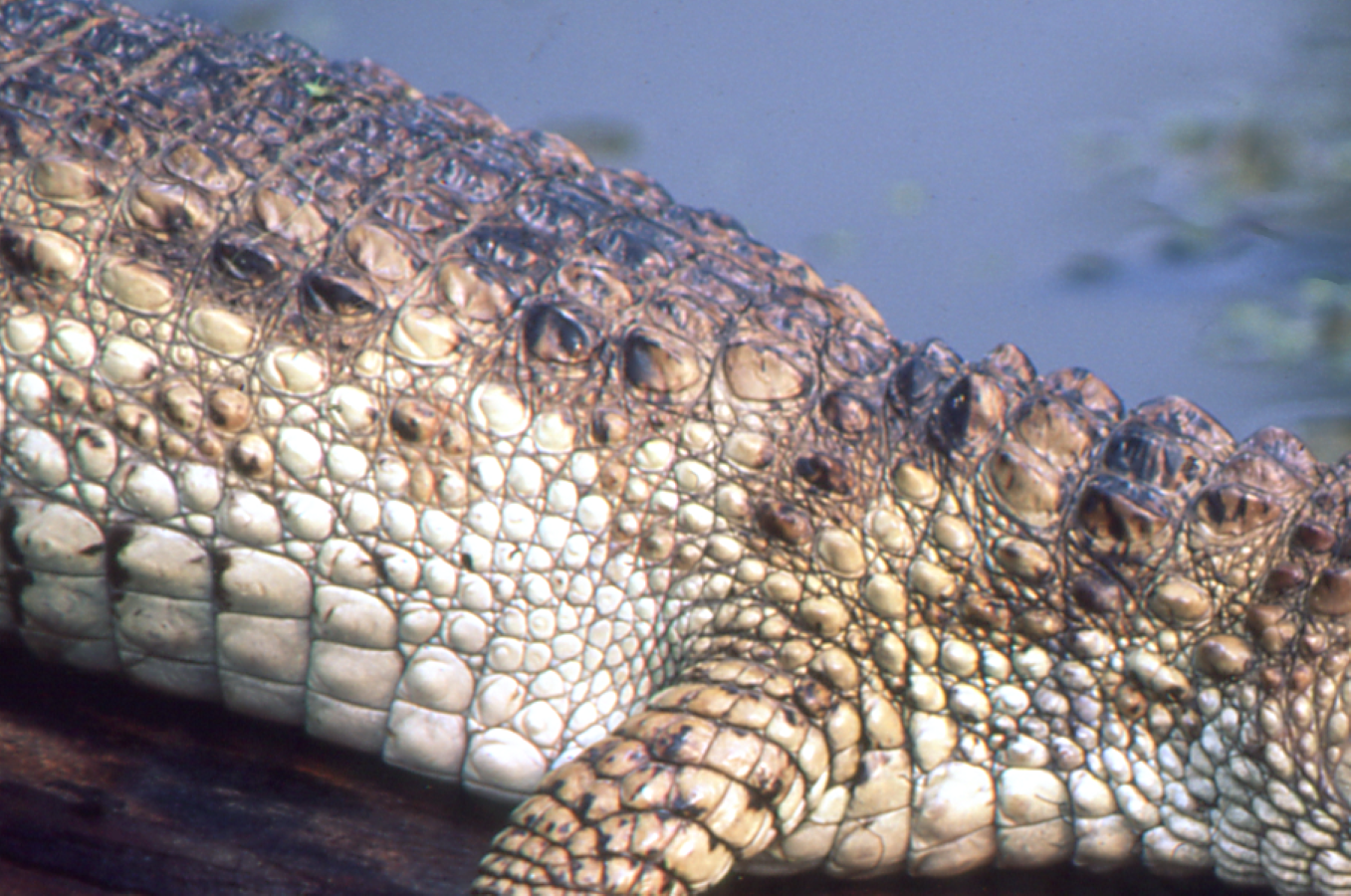
Scales cover the outer layer of skin on all reptiles.  The scales on crocodilians are called scutes.  With the density of bone, they are arranged in rows set into the thick, leathery skin.  This provides great flexibility while also creating a well-armored outer covering.  Belly scutes tend to be smooth, allowing for easier movement.  Scutes down the back are heavier and contain small bony disks for extra protection. 

American Alligator, Alligator mississippiensis close-up of scutes by DonArnold

Individual scutes are replaced as old ones wear out.  A new, larger scute grows underneath the old one which falls off when the new one is fully developed.  Skin and scute coloration blend in with the animals’  surroundings.  Patterns and color break up the animal’s outline, making it harder for predators to identify them.  Most baby crocodilians are brightly colored and grow darker as they age.

Skin & scute colors help hide a Nile crocodile in grass, American alligators on a sandy shore, and saltwater crocodiles on a rocky beach.

All reptiles are ectotherms, regulating their body heat from their surroundings.  As the sun rises each day, crocodilians come out of the water and head for shore to lay out and get warm.  When they get too hot, they may move to a shadier area, or back into the water.  Another popular method for cooling down is to sit with mouths agape, letting the breeze blow across the moist inner surfaces to draw out excess heat.  At night, they return to the water, which cools down slower than the land.

Caiman cooling off by Tambako the Jaguar, Jul 2012

American crocodile in mud wallow by agrego2, Feb2012

Mud wallows are another favorite place for crocodilians to spend the day.  The mud keeps the animal’s body from heating up rapidly, as well as keeping insects and parasites away from the skin.  Scutes along their tails can be flexed open to expose the skin underneath and allow excess body heat to escape.

American Alligator, Alligator mississippiensis by DonArnold

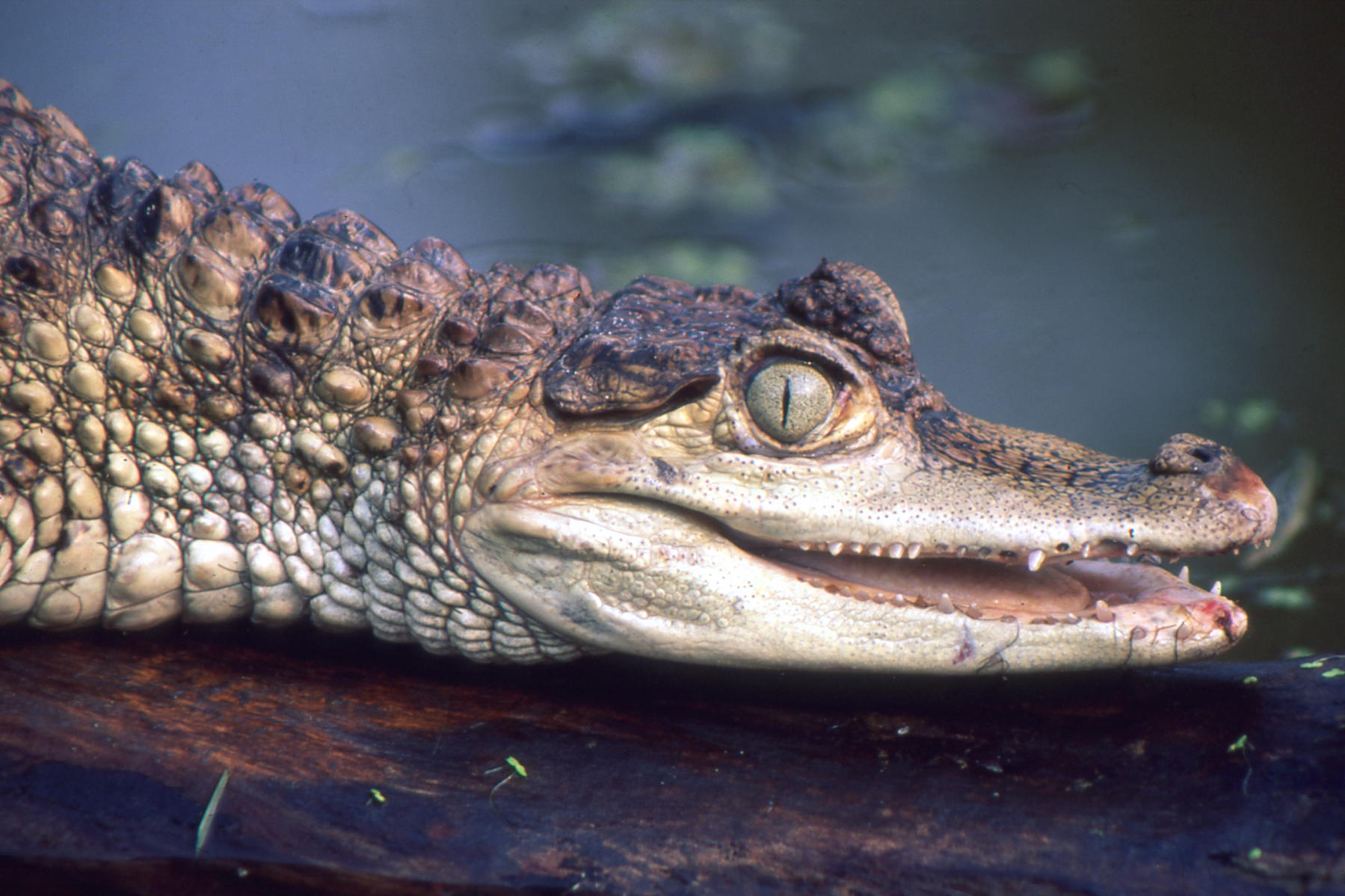
Crocodilians have well developed senses.  Eye pupils shaped as slits can be narrowed to keep bright light from hurting the inner eye.  The tapetum lucidum, a layer at the back of their eyes, reflects light forward, allowing for excellent night vision.  Immediately behind each eye is a small ear opening that is covered when swimming.  Crocodilians have acute hearing, able to detect both prey and predator from several yards away.  They can easily hear and distinguish sounds from their own young, as well.

American Alligator, Alligator mississippiensis by DonArnold

Nostrils on the top tip of their snouts allow normal breathing while swimming with most of their body submerged just below the surface.  Sensitive receptors can smell food at distances of over two miles.  Their tongues are wide and attached to the bottom of their mouths, so they are not used when catching prey.  Lined with taste buds, they can distinguish sweet, sour, and salt.  Crocodilians, especially in salt water habitats, accumulate salt in their bodies over time.  Special glands on the tongue allow them to rid this excess salt from their bodies.

Crocodilians are well-adapted to the habitats they live in.  We will investigate further aspects of these remarkable animals next week.

Frogs of Spring

The snow and ice of winter has disappeared, and temperatures are starting to warm.  Amphibian monitoring is one of the earliest conservation activities of spring.  Thirteen species of frogs and toads are found in the Chicago Wilderness region (southeastern Wisconsin, northeastern Illinois east of the Fox River, Northern Indiana, and southwestern Michigan).

Spring Peeper, Pseudacris crudifer, by Fyn Kynd, Aug 2014
Spring Peeper, Pseudacris crudifer, by Peter Paplanus, Nov 2018
Spring Peeper call

Frogs and toads form a critical link in the food chains for both aquatic and terrestrial habitats.  They are prey for snakes, birds, mammals, and fish.  In addition, they are predators of invertebrates, insects, eggs, and small birds. 

Northern Water Snake eats Bullfrog by Vicki DeLoach, Apr 2012

The Calling Frog Survey, started in 1960, is a citizen science opportunity for volunteers to help identify the species of frogs in an area and gather information about them.  Results from several years of collected data identifies increases and decreases in population sizes and movement of large groups. 

Boreal Chorus frog, Pseudacris maculata, by J.N. Stuart, Jun 2010
Boreal chorus frog call
American Toad, Bufo americanus, by John Munt Aug 2012
American toad call

All frogs and toads breed by laying eggs in an aquatic habitat.  Only males call, to attract a mate.  Various species start breeding at different times, the earliest are starting now and calling will continue  until the latest species ends its breeding season in mid-summer.  The frogs and toads of the Chicago Wilderness region are pictured below, along with links to listen to each species’ breeding call.

Wood frog & eggs by Judy Gallagher, Feb 2017
Wood frog, Rana sylvatica, by Christa R, Sep 2013
Wood frog call

Listen for these wonderful songs when near any wetland habitat this spring.  If you would like to become a monitor, or want more information about monitoring or frogs in general, take a look at the frog calling survey’s website at Frog Calling Survey, and consider joining a monitoring group near you.

Pickerel frog, Rana palustris, by Peter Paplanus, Apr 2018
Pickerel frog call
Northern Leopard frog, Lithobates pipiens, by Charles Peterson, May 2016
Northern leopard frog call
Plains Leopard Frog, Rana blairi, by Andrew Hoffman, Oct 2013
Plains leopard frog call
Green frog, Rana clamitans, by designwallah, Aug 2020
Green frog call
Bullfrog, Rana catesbeianus, by Craig Stanfill, May 2007
Bullfrog call
Cope’s Gray Treefrog, Hyla chrysoscelis, by Andrew DuBois, May 2014
Cope’s Gray treefrog
Eastern Gray treefrog
Cricket frog, Acris crepitans, by Kara Jones, May 2015
Cricket frog call
Fowler's toad call
Fowler’s toad, Anaxyrus fowleri, by Billtacular, Sep 2010
Fowler’s Toad call

Salamanders

Spotted salamander eggs, Ambystoma maculatum, by Vicki DeLoach, Feb 2022

Salamanders are currently active in the very early days of spring, sometimes before the ice has left the ponds.  They are already leaving their burrows and heading to nearby ponds to mate.  After finding a mate, males will deposit one to two spermatophores, a large gelatinous glob capped with sperm, into a quiet patch of water in a woodland pond.  His mate will crawl over it, taking up sperm into her cloaca and storing it for a few days up to a year until she uses it to internally fertilize her eggs.  Egg sacs containing one to several hundred eggs are attached to vegetation near the bottom of a quiet patch of water.  Eggs hatch into aquatic, gilled larvae called tadpoles that spend four to six months growing in the pond.  They will transform into adults near the end of summer and leave the aquatic habitat to live in woodland areas, returning to ponds to breed each year.

Ambystoma maculatum, Spotted salamander by James Harding, MSU

Spotted salamanders, Ambystoma maculatum, are abundant over the entire Great Lakes region, although they are rarely seen after the spring breeding season.  They live in burrows dug by other animals, under logs, or under leaf litter.  Feeding on snails, slugs, and  small invertebrates, they prefer to forage in woods adjacent to semi-permanent wetlands.  Populations will quickly disappear if woodland habitats are disturbed by clearing, grazing, or human activities.

Ambystoma laterale, Blue-spotted salamander by James Harding, MSU

Blue-spotted salamanders, Ambystoma laterale, are more cold-tolerant and are among the first species in our area to move to the ponds in late February and early March as temperatures warm and snow disappears.  They prefer moist woodlands and they are not bothered by woodland disturbances.  They can also be found in drier upland woods, backyards, and urban areas as long as there is nearby water.  During the warmer months, blue-spotted salamanders can sometimes be found hunting during the day, especially during rainstorms.

Ambystoma tigrinum, Tiger salamander by James Harding, MSU
Eastern Tiger Salamander larva, Ambystoma tigrinum, by John P. Clare, Apr 2013

Tiger salamanders, Ambystoma tigrinum, are one of the more aggressive species of salamander, readily eating larger prey including other salamanders.  They live near vernal streams, ponds, and marshes.  Unlike other salamanders that live in abandoned  animal burrows, tiger salamanders will dig their own burrows, up to two feet deep.  They prefer permanent bodies of water, preferably without fish, but can also be found in prairies, woodlands, and backyards.  They are active year-round, avoiding periods of temperature extremes by staying deep underground.

Notophthalmus viridescens louisianensis, Central newt by Andrew DuBois, Nov 2016
Necturus maculosus, Common mudpuppy by Andrew Hoffman, June 2012

The central newt, Notophthalmus viridescens louisianensis, and the common mudpuppy, Necturus maculosus, are two other species found in this area in the salamander order Caudata.  Both of these species have life cycles that differ from the other salamander families.  Newts hatch as tadpoles, then metamorphose into juveniles, called efts, and metamorphose a second time to an aquatic adult, returning to live underwater in local wetlands.  Mudpuppies hatch as a fully grown adult and live their whole lives in a permanent wetland, never leaving the water.  They are mostly nocturnal, but may move about in deeply shaded areas.  Mudpuppies can swim like a fish, folding their legs flat against the sides of their body, or  walk on the bottom.  They can be easily identified by the large red gills directly behind their heads.

All species of salamanders can secret a toxin along their backs and tails that is deadly to some predators and makes them taste terrible to others.  They are harmless to people, but are threatened by loss of wetlands, road building, and woodland clearing activities.  The best conservation for all species is protection of our existing wetland habitats.  They are small and hard to spot, but keep your eyes open in early spring as you venture out to walk among the forest preserve ponds. 

Notophthalmus viridescens louisianensis, Central newt juvenile by DonArnold, May 2018

A Drought of Amphibians

This year we are experiencing drought conditions in northeast Illinois.  A drought, defined as a period of little or no rain, can have major impacts on the amphibian populations of an area.  At the end of winter, as snow melts and expected spring rainstorms move into the area, many ephemeral wetlands fill with water.  These pools, marshes and ponds contain water for only short periods ranging from several weeks to a few months.  But they are an important link in the chain of amphibian reproduction.

Leopard frog egg sac by Renee Grayson

Many frogs and toads live in woodland areas, but depend on wetlands for breeding and habitat for their young.  Male frogs and toads return to local ponds each spring to find a mate by calling.  Most calling is done in the evening, but sometimes individuals call during the day.  Females will find their way to their favorite singer, then lay a gelatinous egg sac, which the male fertilizes.  Eggs may be located on floating vegetation, hanging under rocks or logs, or laid on the bottom.  Eggs have no shell and must remain wet to live.  Eggs hatch into tadpoles in a week or less.  Tadpoles may transform to adult form in as little as two weeks or as long as the following year.

Tadpoles by Eli Duke

Wetlands of all types are showing changes due to the drought conditions.  Shallow ponds and marsh areas are dry or retaining only enough moisture to have wet soil, and are no longer a usable wetland for many species.  Deeper ponds are down several inches in depth.  A difference of only a few inches in depth can add several feet of shoreline where banks gradually slope into the water.  Exposed rocks and logs used by turtles for basking are high enough over the water’s surface that they may no longer be accessible to these species.  Creeks and rivers are lower and slower.  Turtles and water snakes that depend on depth and fast flow for protection may find these are no longer a means of escape.

Turtles on a log by Bruce Fingerhood

Shrinking permanent wetlands put pressure on the species that already live there.  Ponds are habitat for newts, tadpoles, crustaceans, frogs, toads, turtles, birds,  naiads and insects, and microscopic life.  As the amount of water decreases, habitat in the pond is reduced.  Shallows where a bank slowly submerges may have a steeper drop-off.  Logs once laying at surface level may be several inches higher than the surface, eliminating areas underneath, once used for protection.  Less water means less available oxygen and food for the animals already sharing the pool.  Den and nest sites in banks at the water’s edge become more exposed.

Rain during the early part of May has helped alleviate some of these issues, but more rain is needed, continuing into the summer.   Maintaining your own backyard wet areas with shade and consistent watering provides good habitat for many animals that live among us.  You can watch many of these species in area wetlands on trails and in local parks this spring.

Hibernation

Days are getting shorter and temperatures are starting to cool.  We are well into autumn, and it is time for animals to prepare for winter when it will become difficult for them to keep warm and find food.  There are several approaches to living through winter: growing thicker fur coats, travelling south to follow the quickly retreating warmer temperatures, and sleeping in until warmer, sunlit mornings prevail.  Animals that “sleep-in” are actually going through a period of dormancy.  It can last from a few weeks to several months, but there are some general conditions that must be met.  Almost all species will need a home that consistently stays above freezing, and each animal must have enough energy to last through the dormancy period.  There are four categories of dormancy including hibernation, torpor, brumation, and diapause.  Let’s take a look at these methods and some species that use each.

Hibernation is a process that involves a significantly lower body temperature, and decreased heart, respiration, and metabolic rates.  Species that are true hibernators can live for long periods of time with very low energy use.  Woodchucks, also known as groundhogs, hibernate up to five months each year in the northern areas of the eastern U.S.  They have a normal heartbeat of 80 beats per minute which is reduced to about 5 beats per minute; their normal body temperature is reduced from 98ยฐF to 38ยฐF; and their breathing rate goes from 16 times per minute to twice a minute.  The woodchuck also exhibits reductions in other growth areas including teeth, which normally grow 1/16″ weekly and are kept under control by the grinding action when they eat. 

Eatern Chipmunk, Tamias striatus, by DonArnold, c-1999

Species are either obligate or facultative hibernators depending on when they enter a period of dormancy.  Obligate hibernators use seasonal cues.   When days start to shorten, indicating a change in season, these species will enter hibernation regardless of outside temperatures or amount of available food.  Facultative hibernators use environmental cues.  When it becomes too cold or food starts to become scarce, these species will enter hibernation to conserve on their energy use.  All species that spend time in hibernation eat larger amounts of food in autumn to build up brown fat.  These fat reserves provide the quick energy needed for activities upon awakening.

Skunk by Christa Gampp, c-2012

Species in hibernation may waken occasionally.   Animals have been observed waking to use a toilet area and/or to nibble on cached food supplies.  Chipmunks can be observed with fat cheeks in autumn, busily creating food caches located in burrows found under the frost line in the same area where their summer nest is located.  Although this reason for waking is not well understood, one theory is that waking may stimulate energy use followed by the ability to sustain a longer sleep period.  Another theory postulates that periodic eating of small amounts of food sustains the immune response system.

Woodchuck by Paul VanDerWerf, c-2015

Torpor is a similar process that involves the same physical modifications as hibernation, but in smaller quantities.  Body temperatures and heart rates will be lower by ten to fifteen percent, and animals using this strategy will wake more often, engaging in activities several times throughout the cold period.  Skunks enter their dens as daytime temperatures sink below freezing, and their heart and respiration rates slow.  Their sleep may last from a few days to a few weeks.  They will leave the den to forage for food in between these naps.  Many birds enter torpor on a daily basis, at night or on very cold days.  Their decreased physiological activity allows them to conserve body fat overnight so it is available for quick energy production the following morning to continue daily foraging activities.  On cold nights, black-capped chickadees can maintain body temperatures twelve degrees lower than normal.  This allows the body to use 30% less stored fat.

Wood Frog by Tom Benson, c-2015

Brumation is the term used for torpor in ectotherms.  Ectotherms obtain their body heat from the environment and include reptiles, amphibians and fish.  Most of these species must live where the temperatures always stay above freezing.  Many frogs and turtles bury themselves in mud at the bottoms of ponds, or dig holes deep into the ground, well below the frostline.  Their breathing and heart rate slow and they can get oxygen from air trapped in the cavity or surrounding mud.  Snakes will often den together in groups of a dozen to several hundred individuals in a den below the frostline.  The wood frog is an exception because it can tolerate freezing temperatures.  A chemical contained in each cell in its body  acts as antifreeze to protect the cell from damage that could be incurred if solid ice should form inside the body.  Thirty five to forty five percent of the body may freeze, stopping the heart and respiration, but it will thaw with warming temperatures.  The wood frog may freeze and thaw several times in one season.  All ectotherms may wake on warmer days in mid-winter and leave their dens to find water and nutrients.

Yellow-Jacket Wasp by Dog-WalkDigital, c-2011

In late autumn, before temperatures turn cold, some insect species enter diapause, a period of suspended development.  Some spend winter here in underground burrows, under bark or leaf litter, or in holes drilled into woody plants.  Many have the same cellular chemistry as wood frogs, with each cell having a  chemical antifreeze to prevent damage from ice formation.  For bumblebees and yellow jacket wasps, only the new queens survive, spending the winter in an underground burrow until spring.  Bees spend the longest time in any form of hibernation, often five to six months underground.

Bumblebee by DonArnold, c-2020

Strategies to survive cold periods are important as parts of the normal annual cycle.  Zoos attempt to provide habitat that can accommodate these needs.  Cold-adapted animals in northern climates  remain outdoors for winter as part of a healthy life cycle.  The risks involved with cold periods include the need to meet nutrient demands by storing fat or food caches, having energy in reserve to forage when warm weather arrives, and having enough water to hydrate throughout the cold period.  Climate change and warm days in the middle of winter are another threat that is not easily quantifiable.  Animals may wake and start to move about during warming episodes, but may not find any food available, wasting energy and water. 

We can help by following some simple guidelines: leave animals and habitats undisturbed during cold months; offer food sources for animals during warmer periods (i.e. extra seed if temperatures get above  freezing); learn more about the habitats in your neighborhood to protect them from disturbance and fragmentation and learn more about climate change and the negative effects caused by it.  Here are a few books you may find interesting: “Animals That Hibernate”, a children’s pictorial by Larry Dane Brimner;  “Do Not Disturb”, a children’s reader by Margery Facklam;  “Winter World” by Heinrich Bernd.

Wildlife Photographer

At one time, I wanted to be a professional wildlife photographer.  But not just any wildlife.  After all, I like snakes.  Several years ago, Joe & Mary Ann McDonald offered an ‘advanced’ workshop, inviting just five photographers to come to their farm for three days to shoot pictures of some very unusual reptile species.  Most of the subjects were either venomous or large and difficult to handle, or both.  It was educational, fun, a little wild and very exciting.

The animals were flown in from all over the world and brought out to the farm by a professional handler.  They were kept in pens, boxes or cages in the McDonalds’ basement for the week while they rested, before continuing their travels to zoos and other institutions worldwide.  Each day, seven of us, Joe, Mike (the handler), and five photographers would head out to Joe’s studio located in a separate 40’x40′ building out back.  The studio had racks of equipment in back, room for everyone to sit, whiteboards and a large area in front for a lecturer or for someone to demonstrate equipment and techniques.

Egyptian Banded Cobra, Naja haje by DonArnold
Transpecos Copperhead, Agkistrodon contortrix by DonArnold
Formosan Cobra, Naja naja by DonArnold

A display area was created by placing an eight foot square table in the front of the room.  As each new animal was brought out, the table was swept clean and then filled with plants, soil, rocks and/or sand representative of the natural areas where you would find that animal in the wild.  Each animal was placed into the scene and given some time to get comfortable.  For each subject, the first round of shots lasted 5 minutes, and everyone was to shoot from across the room with long lenses.  For the second round, each photographer would have 2 minutes to shoot from as close up or as far away as he wanted from the scene. 

Puff Adder, Bitis arietans, by DonArnold
Massassauga Rattlesnake, Sisturus catenatus by DonArnold

There were a few tortoises and some lizards, but the exciting part of the shoot was the rattlesnakes, vipers, and cobras.  One of our discussions was about what to do in case an animal got off the table.  We learned that tortoises and lizards would generally head for the nearest dark corner to hide from us.  But the snakes might have other ideas about defense and escape.  Rattlesnakes and most vipers strike horizontally, just a few inches off the ground, so climbing the equipment racks at the back of the room was a good escape route.  Adders and cobras strike upward, which was where the rooms windows came in handy.  As Joe said, “remember to tuck and roll when you hit the ground outside”.  Fortunately, there were no incidents during any of the more than twenty times Joe offered this workshop.

This workshop provided the opportunity to get my dream shot, a picture that I had always wanted as a wildlife photographer, but thought I would never have a ‘safe’ opportunity to get.  Outside of the studio, Joe had a small pond, about 30 x 40 feet, that was from several inches to about six feet deep.  There were logs and rocks at one corner and plenty of swimming room.  I lay on my belly in the pond with my camera on a tripod in front of my face so the lens was no more than an inch above the water surface.  There were a couple Dwarf Caiman, a Spectacled Caiman, and an American Alligator in the pond with me.  As they swam by me and toward me, I was able to get the shot with only the nose and eyes of the predator coming right at me.  They swam around me as well, and were just as curious about me as I was about them.  They bumped their noses along the length of my body as I lay underwater, starting at my ankle and continuing all the way to my shoulder.  Alligators, crocodiles and caiman have thousands of touch-sensitive organs, called integumentary sensory organs, in their faces and all along the rest of their body.  Their snout is much more sensitive than human fingertips allowing the animal to investigate objects as well as detecting different levels of water pressure.  These were well fed, Mike told me when he let them go in the pondโ€ฆ

Dwarf Caiman, Paleosuchus palpebrosus by DonArnold
American Alligator, Alligator mississippiensis by DonArnold

There are dozens of photography workshops offered online, in schools, and by private photographers and studios.  Whether you are an aspiring professional or a weekend hobbyist, I highly encourage you to try one or more of these.  Start small with a single day or go big on a multi-week nature adventure.  Get online and learn a few new techniques that you can take out to your backyard and have fun with on your own.  There are many exciting opportunities waiting for all.

Bullfrogs

Bullfrog in shallows, by DonArnold

Croak! Croak! Croooooak!  I live on a pond, and for the last week has it has belonged to the bullfrogs, Rana catesbeiana. The bullfrog is the largest species of frog in North America, and the ones in my pond are no exception.  Bullfrogs are green, yellow-green or brown with dark splotches on the back and dark leg bands.  The tympanum, or eardrum is immediately behind their eye.  On male bullfrogs, the tympanum is larger than the eye, and their throats are pale turning to dark yellow when breeding; on female bullfrogs, the tympanum is the same size as the eye and their throats are whitish.
 

Their preferred habitat is still, permanent bodies of water, with plenty of submerged and emergent vegetation.  Bullfrogs hibernate over the winter in the mud at the bottom of these permanent pools.  They like warmer water and generally will not emerge in spring until water temperatures are in the 15^C (60^F) range.   

Bullfrog in submerged vegetation, by DonArnold

Breeding, mating & calling activities start in late May and extend well into July.  Bullfrogs are normally active from early evening all through the nighttime hours, and may extend activities into the daytime.  They are most active on warm nights.  Males sit in the shallows or along the banks and create a low-pitched brrr-rum call to find a mate.  Males are territorial establishing an area roughly 5′ to 20′ in diameter that they actively defend from encroachment by other males.  Within the same pond, several males may have bordering territories, and neighbors will also aggressively object to a new frog attempting to take over an existing territory.  Larger males will establish themselves in the choicest sites hoping to lure females to an area good for egg-laying. 

Bullfrogs – The Confrontation, by DonArnold
Bullfrog wrestling, by DonArnold

The female deposits from 5,000 to 20,000 eggs in a thin-mucus covered, floating mass that may be from a foot to three feet in diameter.  Eggs will hatch in three to six days into tadpoles.  Tadpoles spend from one to two years living in the pond, feeding on algae or decaying material until metamorphosing into froglets in their second or third summer.  Bullfrogs become sexually mature in two to four years, and their lifespan is six to eight years.

Bullfrogs will eat nearly anything they can swallow including fish, snakes, turtles, other frogs, birds and small mammals, but the majority of their diet consists of invertebrates including dragonflies, beetles, insects, spiders, snails and crayfish.  Bullfrogs are also prey for fish, snakes, turtles, herons, otters, racoons and mink.  They are extensively hunted by man for the food industry, especially frog legs.  If threatened, they are equally comfortable on land and water and may flee to either habitat.  When caught, they emit a loud wailing scream that often times startles the predator and allows the bullfrog to escape.

In recent years, the pond behind my house has been naturalized with native vegetation.  The bullfrog population as well as many other species have responded very favorably to these efforts.  However, in many other areas, habitat loss, water pollution and  pesticide runoff have all been factors in the declining populations of bullfrogs and other amphibians.  Removal of shoreline vegetation for real estate or recreational development has damaged a number of breeding sites.  You can help by supporting efforts to keep local ponds, lakes and other wetland sites natural and undisturbed.

Male bullfrog in breeding colors, by DonArnold

Snake Monitoring

Some days I spend hours grabbing snakes!  As a snake monitor, I am one of several stewards in this area leading groups that monitor snakes.  Our goals are to learn what species live here, their population size, and what areas they inhabit.  We are using this data, as well as other related information, to assist in making habitat management decisions. 

Capturing a garter snake, by DonArnold

Wildlife monitoring activities for any species are designed based on prior knowledge of when and where a species may be found and what kinds of activities we might observe. For snakes, we identify possible sites based on several factors: being away from human activities, having access to food, water, and shelter for overnight and bad weather.  We set out numerous snake boards. A snake board is a piece of rubber, wood or metal approximately two square feet in size and heavy enough that it will not be moved by wind or animals.  A line of these are laid out in the observation area, about one every 8-10 yards.  I use three boards at each of my dozen or so sites, but there can be 1 to many used. 

Storeria dekayi, Midland Brown Snake by Janice Sommer, 2018

Snakes are ectotherms, meaning they must obtain heat from their surroundings.  Snakes require heat to perform any action including moving, hunting and digestion.  Snake boards are generally placed in sunny areas.  This creates a spot where a snake can spend a few safe and sheltered hours absorbing heat that will allow them to hunt, eat and digest a meal.  When they are warm enough, they will leave the board area, complete their hunting or other movements.  They usually spend the night under rocks or logs in a close-by and safe place and return again the next day.

Snake Monitoring Entry

Monitors usually work in pairs.  When we visit a site, we will record date, time, and weather conditions.  One monitor lifts the board and both monitors capture any snakes that are present, placing them into a soft, cloth bag.  As each snake is removed from the bag, we record the species, weight, length and any identifying marks.

Several pictures are taken of each one, and then they are released.  They usually disappear quickly into the underbrush, but may not go far and may return to the board after we are gone.  Observations are made at least weekly, and are varied by time of day or weather conditions in order to have data across a wide spectrum of factors.

We have a wide variety of questions, and we are always adding more to the list.  Identifying what data to collect to provide answers, helps determine and refine our procedures.  Questions range from statistical to curious such as what snakes do we find in DuPage County, where do they live, what do they eat, can they swim, what restoration activities affect them and how, what management practices need to take them into consideration.  Collected data is used by scientists, teachers and stewards as we learn more about our own environment and how to manage its health.

American Toad

As you are out walking at this time of year, whether in neighborhoods or natural areas, you may hear a musical trilling in the background.  This is the call of Bufo americanus, the American Toad, as it returns to the banks of local streams and ponds.  Male toads emit a high pitched trill that may last 30 seconds or more, as they actively seeking mates for breeding.  They call constantly during the daytime and early evening, and are often heard as part of the background sounds of the neighborhood.

American Toad, Tanya Dewey, Animal Diversity Web

The American Toad has a compact body with dry, warty yellowish-brown backs and sides.  They have short hind legs that allow them to walk or hop, but not take long leaps as do frogs. Adults are typically 2″ to 4″ with the females slightly larger than the males, but larger sizes up to 7″ have been observed in some localized areas.  These toads are found from the Mississippi River to the East Coast and from middle Canada to southern Georgia.

As in all frog and toad species, only the males call, hoping to attract a female by song alone.  American Toads like shallow, quiet waters with scant to moderate amounts of fully to partially submerged vegetation.  The male will select a stationary position in a desirable habitat, call, and after a female joins him, they will mate.  The female then lays her eggs in the water.  Breeding is often initiated by rainy days and warm evening temperatures.  A female will deposit between 2,000 and 20,000 eggs contained in two gelatinous strings of mucus several inches under the water’s surface and they may be attached to nearby vegetation. 

American Toad eggs by Judy Gallagher

Eggs hatch in 2 to 14 days depending on water conditions.  Tadpoles are black in color, and they will change into tiny toadlets in six to ten weeks.  Large groups of toadlets can be observed leaving the ponds for the open woodlands, prairies, marshes and your backyard.  The American Toad reaches sexual maturity in two to three years and may live ten years, although mortality from predators and human impact is high.

At this time of year, you may observe toads in your own backyard.  If you try to sneak up on a toad, especially in the evening, it will immediately stop calling if it hears you.  However, if you wait quietly at the edge of a pond for four to five minutes, the toads in the area will resume their singing.  Species are distinguishable by their song, and you can hear the different songs including the American Toad at the Illinois Natural History website: INHS Frog & Toad Calls.

If you should find a toad, see if you can observe some of the unique characteristics of these animals.  Do you see its ears?  They do not stick out from the head, as ours do.  Toads have a round patch positioned right behind their eye that is a tympanic membrane, able to detect and identify various sounds.  Can you observe it catching any prey?  Their tongues, which are long and sticky, are attached at the front of their mouths, not the back as ours are.  As insects fly by, a toad can flick its tongue out at an amazing speed to snare a meal.  You can watch this behaviors at Discovery News.

Garter Snakes

At this time of year, as soon as the daytime temperatures start to reach into the forties and above, we begin to see snakes coming out of their winter dens.  Two common snakes in DuPage County are both garter snakes, from the genus Thamnophis which includes 30 species worldwide. 

The Eastern Garter Snake, Thamnophis sirtalis and the Plains Garter Snake, Thamnophis radix  spend the winter in underground dens containing several dozen to several hundreds of individuals.  Winter is a period of dormancy where these snakes enter brumation, an extreme slowing down of their metabolism. 

Eastern Garter Snake, Thamnophis sirtalis, by DonArnold

A garter can be up to 30″ long, black/brown backs, yellow stripes on their sides and a gray-green belly.  Usually found in meadows, light forests, marshes and vacant lots, they enjoy a warm spot such as open rocky/paved surfaces warmed by sunlight or hanging out in bushes or logs in the sun. Their meals include insects, earthworms, slugs and fish.  Nights are spent under logs, rocks or leaf litter protected from wind and rain.

There are a variety of methods used to study snake species, one of which involves using cover boards. Boards are approximately two square feet, made of plywood, aluminum siding or heavy rubber. These are placed in likely spots where snakes will be found. The snakes use the boards during the day for shelter, rest and warmth. When snakes are found under the boards we identify each snake, weigh and measure it, take lots of pictures and note any markings or injuries. We also record location, weather, time of day and any activity observed. Finding a variety of individuals helps to establish population numbers; finding the same individuals more than once helps to identify  whether snakes are moving to different locales during the year. 

Spring Peepers

Spring Peeper – a lyrical name for a wonderful little singer in the woods at this time of year.  Most often heard in the late evening or through the night, these small frogs have some interesting traits.

Pseudacris crucifer, Spring Peeper by DonArnold

They are hard to find due to their small size, 20mm-25mm or .8″-1″ when fully grown.  A little large than an adult’s thumbnail!  And their coloration provides wonderful camouflage from shades of brown, gray or olive skin.  The belly is cream or white, and the back is marked with a dark cross as well as darker bands marking the legs.

Spring Peepers are native to our area and can be found in marshy areas or light woods near freshwater ponds.  They are good climbers but prefer to stay near the ground, burrowing into leaf litter whenever it is available.  At this time of year, larger populations can be found near their preferred breeding habitat which is clear, clean freshwater ponds with no fish. 

Peepers breed in early spring time when males start to call for females in the early evening and on into early morning.  Only the males call.  And their call is a high pitched note which can be heard for several hundred yards in the woods.  And they are loud!  It is near impossible to have a conversation between two people when standing on the edge of a pond where a chorus of 8 or more of these tiny frogs are singing.  Click on the attached audio file to listen.

As you are out walking this spring, take a moment to stop by your favorite pond and listen closely for the sounds of spring.