Spring Migration

Meteorological spring starts Sunday, and we are already starting to hear the calls of early migratory birds, heading north from southern wintering grounds, working to establish territory their among the best nesting sites available. 

Red-winged blackbird, Agelaius phoeniceus, singing by Rhododendrites, May 2023

Some birds, including red-winged blackbirds, Agelaius phoeniceus, get their cue to start spring migration as temperatures get warmer.  These species head to prairies, forests, and wetlands to claim a location they can protect, call for a mate, and establish a nesting site with good protection and food sources.  Other birds, including many warbler species, return in spring when daylight hours lengthen.  Generally flying at night, they use star positions and the Earth’s magnet field to guide them.  If nights are stormy or heavily overcast, early morning may find hundreds of them waiting in fields for clear skies.  Birds may also stop for a day or two in areas located on the southern shores of any large body of water to rest and feed before crossing.

Red-winged blackbird, Agelaius phoeniceus, flock at sunset by Jerry Segraves
North America flyway map by USFWS

Bird species around the world generally follow established flyways, established routes over specific locations between their southern and northern territories.  Many migration routes do not follow a straight path.  Some species have historical stopover or feeding locations that provide a rest point along the way.  Other species may not be able to cross a mountain range; or a large body of water can act as a barrier for land birds, but may be a required food source for wetland birds.

Arctic tern, Sterna paradisaea, adult & juvenile by Charles J Sharp, Aug 2025
Arctic tern, Sterna paradisaea, in flight by Charles J Sharp, Aug 2025

Long distance migration routes are most common for birds wintering in subtropical and tropical areas and breeding in the northern hemisphere.  Long migrations in the southern hemisphere are far less common because there is less land near the South Pole to support breeding activities.  The record holder for migration distance is the Arctic tern, Sterna paradisaea, overwintering in Antarctica and breeding in Arctic locations, a round trip between 30,000 and 55,000 miles.  Some shorter migrations are between upper and lower altitudes in mountainous regions.

Penguin migration map by Fred Cooke
& Jenni Bruce, Aug 2011
Dusky grouse male, Dendragapus obscurus, displaying by US NPS

Most birds migrate in flocks, which reduces the energy needed to fly long distances and provides added protection against predators.  Penguins migrate without flying.  Most penguin species swim between locations, covering up to 1,000 miles round trip.  A few species cover long distances on foot, including dusky grouse, Dendragapus obscurus, in the Rocky Mountains which walk from lower to higher elevations.  However, a flock may encounter unfavorable weather or flying conditions that causes a large number of birds to stall in one location, introducing other risks including depleted food sources and predation by land-based animals.

At the Jurica-Suchy Nature Museum, we host a nature walk every other week to observe changes in our campus including the birds that are moving through the area.  There are many birding groups worldwide that provide opportunities to observe and learn about migratory birds in every location.  Consider joining a group, or take your own bird walk as we have clear days and warming temperatures and see who’s on the move in your area.

Bird Beaks

Beaks or bills?  Two interchangeable words naming the horny part of the jaw of a bird.  They have numerous uses including gathering food, feeding, preening, and display, and are often used for functions that would be accomplished by arms and hands on other animal species.  Let’s take a closer look at their structure and how birds use them for feeding.

Beaks come in a variety of sizes, and most are proportionate to the size of the bird’s head.  Two or more of the bones comprising the lower jaw in birds are often fused together, increasing the strength of the overall structure.  Birds do not have teeth, allowing the jaw bones to be lightweight, making it easier for a bird to hold its head out in front of its body while flying. 

Barn owl, Tyto alba, skull showing fused jaw bones by Didier Descouens, Jul 2010

Beaks are made from bone covered with keratin, a structural protein providing strength and rigidity.  Yet beaks have some flexibility which adds to their dexterity when in use.  The inner surface of the keratin layer is constantly growing while the outer surface is equally being worn away by use.  Both upper and lower jaws are jointed where they attach to the skull, allowing for extended movements including the ability of a bird to open its jaws wider than most other animal species.

Great white pelican, Pelecanus onocrotalus, by Craig Adam, Feb 2013; Red-headed woodpecker, Melanerpes erythrocephalus, by Mark Moschell, May 2016; Evening grosbeak, Hesperiphona vespertina, by Fishhawk, Feb 2021

A beak is specialized for every species depending on diet and food gathering methods.  Cone-shaped beaks, found among cardinals, grosbeaks, and finches, can trap, cut, and crush seeds.  Scoop-shaped beaks allow skimmers, spoonbills, and pelicans to slide their lower jaw under slippery prey, then catch and hold onto it .  Beaks tipped with a chisel-like point are used by woodpeckers probing into crevices in hard materials.  Along with a reinforced skull, keratin reinforces the beak’s toughness, standing up to repeated hammering and prying movements.

From upper left: Blue-gray gnatcatcher, Polioptila caerulea, by Dave Wendelken, Jul 2023; Pied flycatcher, Ficedula hypoleuca, by Edward Anderton, Jun 2012; Ruby-throated hummingbird, Archilocus colubris, by Mark Moschell, Jun 2019; Great-horned owl, Bubo virgianus, by Kevin Milazzo, Feb 2021

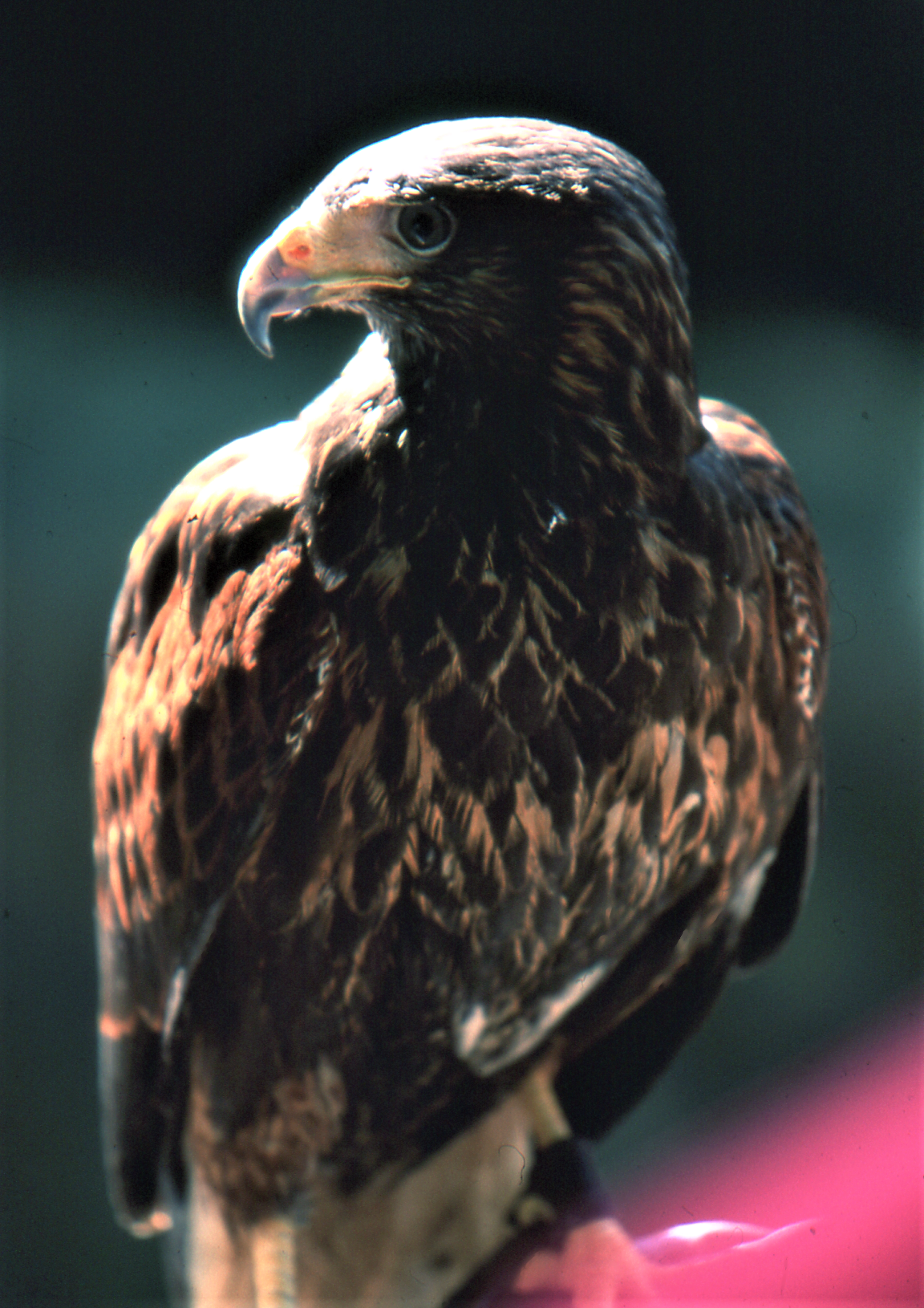
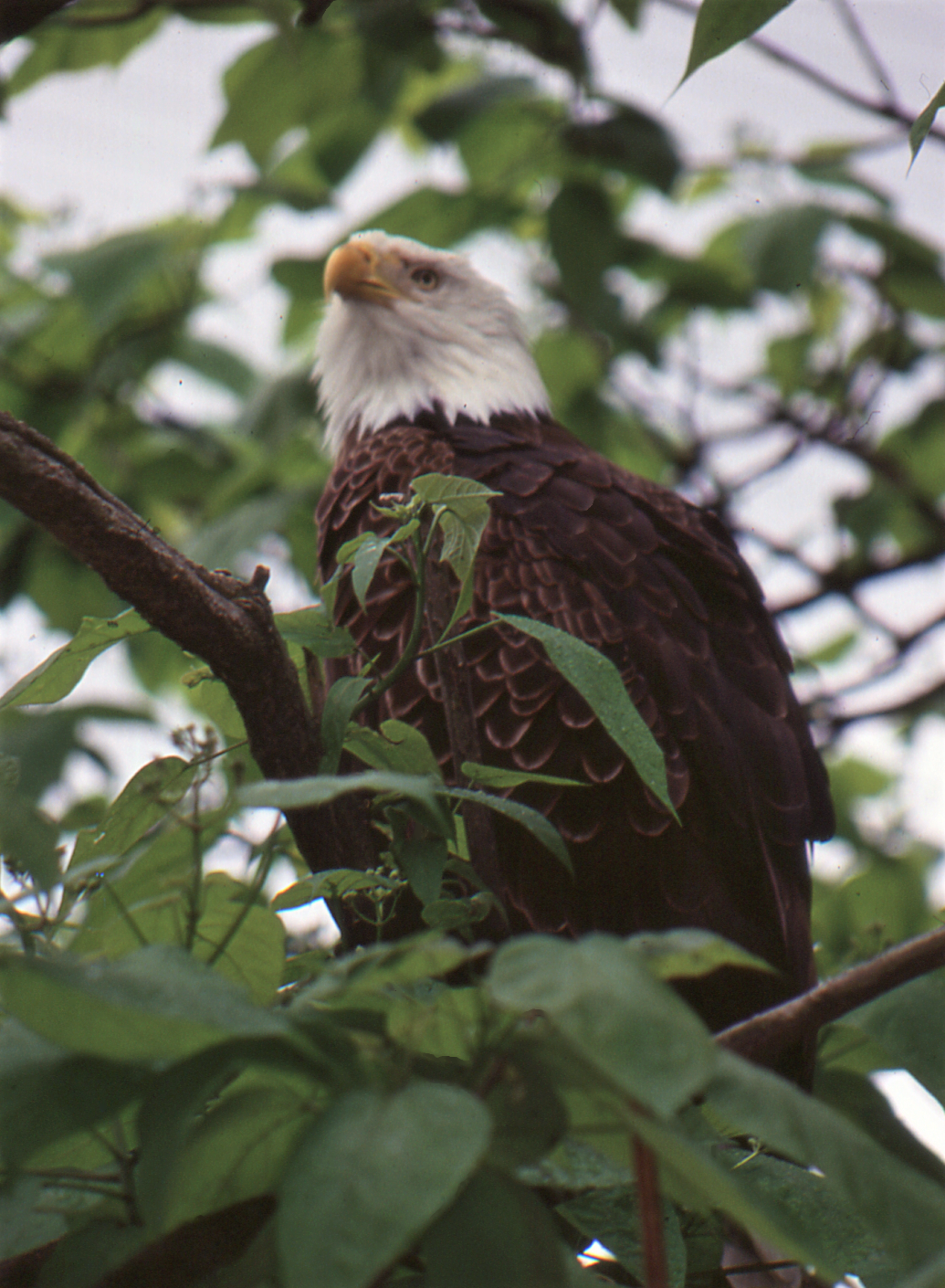
Narrow tweezer-like beaks, used by gnatcatchers, warblers, and wrens, stab or seize small insects from branches.  Wider and flatter tweezer-shaped beaks on purple martins and flycatchers can snatch an insect in flight.  Long, slender beaks on hummingbirds are made for sucking nectar from the deep recesses of long, tubular flowers as well as catching tiny insects, such as fruit flies.  Sharply pointed, hooked beaks are used by eagles, owls, hawks and shrikes to stab prey and hold on while pulling the meat apart into mouthful-sized chunks.

Many beaks serve more than one feeding function, as species change their diet from one type of food to another as seasons change.  Tongues are an important addition to the mouth, manipulating food items for beaks to be more effective.  Different sizes and colors of beaks convey information to other individuals about a birds sex and maturity level.  This essential body part provides birds with many of the same capabilities as other animal species.  Come to the Jurica-Suchy Nature Museum, or a nature center near you, to learn more about the many adaptations of birds.

Greene Valley Trail

As the heat abated a little bit, we decided to take a hike at the DuPage County  Greene Valley Forest Preserve in Naperville, Illinois, this past weekend.  On the east side, in the central part of the preserve, a 2.25 mile trail loops from the south parking lot to the Southern DuPage County Regional Trail and the Valley Trail.  Trails are well-marked, wide limestone paths, with plenty of room for walkers and bicycles.

We found a pleasant, open vista that was great for birdwatchers and prairie enthusiasts alike.  The Valley Trail runs alongside the east branch of the DuPage River, which makes it attractive to bird species, although there is no view of the river for hikers.  While it was an overcast day making bird identification difficult, we were able to observe those seen below: 

Vegetation varies greatly, providing good protection for many of the small mammals plus lots of perches for birds.  Many plant varieties could be seen and identified without leaving the trails, including those pictured below.

The area supported plenty of small mammals such as rabbit, shrew, deer, coyote, and both gray and fox squirrels.  We saw lots of pollinators including bees, moths, butterflies, and dragonflies.  Greene Valley Forest Preserve offers a wide range of hiking trails, a scenic overlook, camping and picnicking facilities, a model airplane field, and many events, including night sky observations throughout the year.  Consider catching some of the amazing sights in natural areas near you.

Heat Effects

The midwestern United States is experiencing a heat dome this week.  This is the result of a high pressure system hundreds of miles across and moving very slowly.  Air in the upper atmosphere of a heat dome is already warm, but is still cooler than the air below, and cooler sir sinks towards the Earth’s surface.  As the air moves downward, it compresses air molecules together releasing heat, making the lower layers even hotter and drying out the area as moisture evaporates.  With little or no moisture, no clouds form to relieve the heat and dry conditions.

Heat Dome over Eastern US by National Weather Service, Jun 26 2025

Humans have a variety of ways to cope with high heat including being less active, drinking plenty of fluids, and remaining in shady or air-conditioned areas.  Wildlife still has to get food and water every day and may have fewer opportunities available to them to avoid the high heat.  Let’s look at how the heat is affecting a few of the backyard species common in the Midwest.

Photinus pyralis, Big Dipper firefly by Terry Priest

Fireflies are cold-blooded, or ectothermic, and prefer warm and humid areas.  They come out in the early evening and as their bodies warm, they become more active, flying and flashing more frequently, communicating with other fireflies to find a mate.  Eggs are laid soon after mating, but these will perish if they do not remain hydrated.  Turning off outdoor lighting for a few hours in the evening and maintaining taller, well-watered vegetation will help fireflies during hot and dry conditions.

American Toad by Brad Carlson, Mar 2012; and Bullfrog at Waterfall Place by DonArnold, 2022

Frogs and toads are also ectothermic and require heat from the environment to live.  Species worldwide, including American toads and bullfrogs in our area, find temperatures in the 70s to be ideal.  As temperatures move into the mid-80s, these species and others are prone to dehydration and heat stress.  In addition, they normally look for shady and humid areas to regulate their body temperatures, but the lack of moisture in a heat dome does not make those niches easy to locate.  Maintaining shady, well-watered areas of the garden provides refuge for many amphibian species.

Goldfinch by DonArnold, 2024
Cardinal looking to stay in the shade by Don Arnold, 2023

Birds are often affected by extreme heat.  Most birds have lower body temperatures than the outside air.  This allows birds to easily dissipate heat from high energy activities, such as flight.  Once the outside air gets above a hundred degrees, birds cannot lose heat to the atmosphere and become severely compromised by heat and dehydration.  Rapid open-mouthed breathing, changing eating times to early or late in the day, sitting with wings outstretched, or exhibiting poor balance are all signs of heat stress in birds.  Providing shady, undisturbed areas and readily available water sources gives birds the opportunity to move around less and stay hydrated.

Song Sparrow by DonArnold, 2024

Wild animals have to deal with weather extremes just as we do.  Come to the Jurica-Suchy Nature Museum or a nature center near you to learn more about providing opportunities for wildlife to survive heat, drought, and other environmental conditions.

Sounds of Spring

Thunder and heavy rain, soft rain and light wind, birds in the early morning, frogs in the evening, and maybe a coyote howl deep into the night are some of the sounds of spring.  As cold temperatures ease into summer highs, walks through natural areas tend to be filled with many sights as well as opportunities to learn by being quiet and listening closely. 

Calls and songs are used by many species for a variety of purposes.  Thousands of birds are migrating through the area, especially on clear evenings, and calls help to keep birds together and establish who is the flight leader.  Year-round species are re-establishing territories, using calls to warn intruders to stay away or warn family members of approaching threats.  Frog species in particular are calling during evenings to find a mate, lay eggs, and begin the establishment of the next generation.

There are dozens of species active at this time of year, and as we have been taking nature walks on campus the last few days, here are some of the wildlife we are listening to (click on each picture to hear their call)…

Yellow-rumped warbler, Setophaga coronata, Mirceax, Getty Images

Yellow-rumped warbler, Setophaga coronata, by Valerie Heemstra, 2024

Red-winged blackbird, Agelaius phoeniceus, by KenCanning, Getty Images Signature

Red-winged blackbird, Agelaius phoeniceus, by Thomas Ryder Payne, 2022

Palm warbler, Setophaga palmarum, by Irving A. Gaffney, Getty Images

Palm warbler, Setophaga palmarum, by Christopher McPherson, 2021

Northern waterthrush, Parkesia noveboracensis, by Carol Hamilton, Getty Images

Northern waterthrush, Parkesia noveboracensis, by Lance A.M. Benner2017

Northern Parula, Setophaga americana, by Neil Bowman, Getty Images

Northern Parula, Setophaga americana, by Richard E. Webster, 2023

Chipping sparrow, Spizella passerina, by Irving A. Gaffney, Getty Images

Chipping sparrow, Spizella passerina, by David Tattersley, 2023

Blue-headed vireo, Vireo solitarius, Mirceax, Getty Images

Blue-headed vireo, Vireo solitarius, by Thomas Magarian, 2024

Blue Jay, Cyanocitta cristata, by Miguel Opacic, Getty Images

Blue Jay, Cyanocitta cristata, Sue Riffe, 2024

Bird songs have a structure and rhythm, and are repeated often to attract a mate, ward off rivals, or bond with a  family member.  Other calls give warning that danger is near, keep flocks together in flight, or create a pair bond, often between mother and chick.

Frogs and toads are mating and laying eggs in area ponds.  Each species has its own distinctive call, used by the males to attract a mate, warn of potential danger, establish a territory, or to signal distress.  Frog species being heard around campus at this time include the following (click on each picture to hear their call)…

American Toad, Anaxyrus americanus, by Mshake, Getty Images

American Toad, Anaxyrus americanus, by Thomas Margarian, 2024

Boreal chorus frog, Pseudacris maculata, by Derwyn, Getty Images

Boreal chorus frog, Pseudacris maculata, by Thomas Margarian, 2016

Spring peeper, Pseudacris crucifer by HuntImages, Getty Images Signature

Spring peeper, Pseudacris crucifer by Paul Marvin, 2012

Northern Leopard Frog, Lithobates pipiens, by Jennifer Seeman, Getty Images

Northern Leopard Frog, Lithobates pipiens, by Paul Marvin, 2015

Sometimes, coyote can be heard when walking in woodlands around campus late in the evening.  There are a lot of different calls used by these canines to provide information to other individuals.  You can listen below to a bark used to indicate a threat, a social call establishing an individual’s location, a begging call from a young one, and a howl audible over long distances to announce one’s presence.  Other calls may include a woof to signal a low intensity threat, a yip to claim territory, a growl to threaten another animal, and a whine or yelp to show subservience to a more dominant individual.

Coyote, Canis latrans, barking by TakenPix, Getty Images

Coyote, Canis latrans, bark by Paul Marvin, 2018

Coyote, Canis latrans, begging, by Keith Szafranski, Getty Images Signature

Coyote, Canis latrans, begging call by Matthew L. Brady, 2025

Coyote, Canis latrans, social interaction by Michel Viard, Getty Images

Coyote, Canis latrans, social call by Flor Sangermano, 2023

Coyote, Canis latrans, howling, by Keith Szafranski, Getty Images Signature

Coyote, Canis latrans, howl by Paul Marvin, 2012

Additional wildlife sounds can be heard on campus around Lake Benedictine or in nearby forest preserves.  Get out for a walk and be sure to listen throughout the day for bird species, and into the evening hours for frogs, toads, and coyotes.

Great Horned Owls

The great-horned owl, Bubo virginianus, is native to much of the Americas, including most of North America and Central America and about half of South America.  It is the second heaviest owl in North America, right behind the snowy owl, Bubo scandiacus, weighing up to five-and-a-half pounds with a wingspan between three and five feet.

Great-horned owl, Bubo virginianus, by Andy Reago&Chrissy McClareen, Aug 2012
Range and distribution of Great-Horned Owl, Bubo virginianus by BirdLife International, 2014

Feathers cover the entire body, including their feet, and are varying shades of browns and grays.  Their backs and heads are mottled or barred in several patches.  This coloration, especially when coupled with mostly nocturnal activities, provides excellent camouflage.  Their ‘horns’ are actually feathers sticking upwards on either side of their heads.  These are called plumicorns, but their function is not well understood.  The feather structure of the wing allows owls to fly silently and includes a serrated leading edge to disrupt turbulence and softer feathers behind to help deaden sound.

Great horned owl plumicorns by Jean-pol Grandmont, Aug 2013
Great horned owl wing structure by Peter K. Burian, Aug 2015

The owl’s ears are covered by feathers, but are not symmetrical with one being higher on the side of the head than the other.  This arrangement provides the owl with the ability to triangulate sounds and precisely locate prey in the dark or when prey is hidden, such as when an animal is moving about under a layer of snow.  Their flattened face, shaped as a round disc, also helps to direct sound to their ears.  Like all owls, their eyes are fixed in the sockets, but the bird can swivel its head almost 180° to either side allowing it to see in all directions.

Great horned owl talons by Curtis Bouvier, May 2010

Great horned owls hunt from a perch, observing the area below them before diving swiftly and silently from far above.  Their diet consists of small mammals, birds, amphibians, and a variety of snakes.  Their talons are powerful and deadly, with a grip comparable to much larger birds such as golden eagles.  Most prey is killed by being pierced or crushed in the talons.  Owls may hunt and kill for more than their immediate needs and will cache their kills for future meals.

Great horned owls are not migratory.  When an owl is ready to mate, courtship occurs in late fall and pairs mate for life, establishing a territory together in which they will live their entire lives.  Most territorial defense is through hooting at a transgressor, but rare physical confrontations have been observed.  If an owl cannot establish its own territory, it will live in silence among the fringes of other territories.

Great-horned owl juveniles, Bubo virginianus, by Alan Vernon, Jun 2010
Great horned owl female & juvenile on nest by John Kees, Apr 2012

Males are responsible for picking a nest site, almost always taking over a nest constructed by another species.  Mated pairs breed once every two to three years, laying from one to six eggs.  Egg laying occurs between late February and early April.  The female alone incubates the eggs, never leaving the nest, while the male hunts and brings her food.  After about 33 days, the eggs hatch.  Young owls will start to fly after seven weeks, but take a full month or more to become proficient.

Great horned owl calling, Bubo virginianus, by Michael & Katie LaTour, Jan 2019 (at 0:02, 0:10)
Great-horned owl pair calling by Bushman, Dec 2013 (at 0:18, 0:41, 0:51, 1:22)

Owls are more often heard than seen.  Although the females are larger than males, females have a smaller voice box and thus a higher pitched hooting call ending with a slight rising note.  Juveniles can make hissing or screeching sounds and are often misidentified as barn owls, Tyto furcata.

You can learn more about these magnificent birds at the Jurica-Suchy Nature Museum.  Make a reservation to come see us by visiting our website at:  https://ben.edu/campus-links/jurica-suchy-nature-museum/  (click on Register to Visit the Museum).

Bird Song

As spring approaches, many bird species will be migrating across the country from warm winter sites back to summer nesting areas to mate and raise young.  For many bird watchers, a favorite activity is to identify birds by their songs.  Songbirds have an organ called the syrinx that produces the lyrical notes we can listen to.  Birds may produce one or more notes at a time creating complex calls and melodies.  Some of these songs are used to attract a mate, or to identify itself to another family member, or as calls of warning about any approaching danger.  Night traveling species may use calls to keep the flock together while flying, but most calls are heard throughout daylight hours.

In the upper Midwest, in prairie and wetland areas, the first migrators in early March will include ruby-crowned kinglets, blue-winged teals, loggerhead shrikes, upland sandpipers, and eastern bluebirds.  As night time temperatures become warmer and stable, summer tanagers, Baltimore orioles, and up to 35 warbler species will begin moving through this area.  Some species to watch for in northern Illinois are American white pelicans, common loons, Northern pintail ducks, and yellow-bellied sapsuckers.

You can find many excellent observation spots in your area by searching online for “spring birding hotspots in your area”. Another favorite forecasting site to follow migrating bird groups is the University of Cornell’s BirdCast Project website.

American white pelican, Pelecanus erythrorhynchos, by Manjith Kainickara, Nov 2010

Call from a young chick by Andrew Spencer, XC36292

Baltimore oriole, Icterus galbula, by Tony Castro, May 2013

Alarm call by Joost van Bruggen, XC864040
Call by Gus Mueller, May 2007

Blue-winged teal, Spatula discors , by Alan D. Wilson

Call by Jonathon Jongsma

Common loon, Gavia immer, by John Picken, Jul 2011

Tremolo call by Darwin Long, Apr 2006

Eastern bluebird, Sialia sialis, by Sandysphotos2009, Apr 2010

Call by Jonathon Jongsma, Jun 2011

Loggerhead shrike, Lanius ludovicianus, by Jeffrey Gammon, Dec 2020

Alarm call by Bobby Wilcox, XC418584
Call by Ed Pandolfino, XC455607

Northern pintail, Anas acuta, by J.M. Garg, Jun 2007

Call by Paul Driver, Feb 2012

Pied-billed grebe, Podilymbus podiceps, by Mdf, 2005

Begging call by José Dellacasa Bravo, XC946741
Nocturnal flight call by David Tattersley, XC811994
Pair contact call by Richard E. Webster, XC971465

Ruby-crowned kinglet, Regulus calendula, by Tony Castro, Jun 2019

Call by Christian Kerihuel, XC814137

Sandhill crane, Grus canadensis, by Jeffery Gammon, Jan 2017

Call by National Park Service, Jan 2004

Left: Summer Tanager female, Piranga rubra, by Gonzalo Zepeda Martinez, Jan 2016

Right: Summer Tanager male, Piranga rubra, by Charles J. Sharp, Feb 2023

Call by Lance A. M. Benner, XC426315

Upland sandpiper, Bartramia longicauda, by Johnath, Jun 2010

Call by Andrew Spencer, XC104334

Yellow-bellied sapsucker, Sphyrapicus varius, by Rhododendrites, Feb 2021

Call by G. McGrane, 2006

At the Jurica-Suchy Nature Museum, our nature journaling club, Nature-Doodlers, will be meeting on March 29th, 10am, at the museum to learn about bird observations, drawing and recording our sightings.  Make a reservation to come out to this free event by clicking on the QR Code below:

Illinois Owls

Owls are found year-round in northern Illinois, and they come in several sizes and shapes and live in various habitats.  Owls found near urban areas are often active only in the evening or at night, making them elusive to find and observe their behaviors.  Native owl species have a highly varied diet, hunting almost every animal smaller than themselves from insects and crustaceans to small mammals, reptiles, and amphibians.  Some of their unique characteristics and places to find them are highlighted below.

Barn Owl, Tyto alba pratincola, by DonArnold, JSNM Museum and Great Horned Owl, Bubo virginianus, by DonArnold, JSNM Museum

Great Horned Owls, Bubo virginianus, live in every habitat across North America, Central America, and parts of South America.  Standing two feet tall with mottled brown and gray feathers, they are well camouflaged during nighttime activities.  Their ‘horns’ are actually feather tufts sticking out above their ears, which may enhance hearing and make them easy to identify.  Look for them at dawn and dusk in tall trees standing on the edges of open spaces.  The Barn Owl, Tyto alba, hides in tree hollows or dense vegetation during the day, coming out to hunt at night.  They are a foot tall with a distinct white face and chest and pale brown and gray backs.  A high energy lifestyle requires them to eat more than other animals their size.  They are mostly found in open fields near wooded areas that provide diverse habitat for prey.

Barred Owl, Strix varia by DonArnold, JSNM Museum; Northern Saw-whet Owl, Aegolius acadicus by DonArnold, JSNM Museum; Short-eared Owl, Asio flammeus by DonArnold, JSNM Museum

Three owls are daytime hunters, but not often found in urban areas.  Barred Owls, Strix varia, have small territories, covering no more than a few square miles during their lifetime.  They are brownish gray with dark stripes on their bellies.  They hunt during both daytime and nighttime and have been known to eat carrion if it’s easily available.   Look for them in wetlands with mature woodland cover nearby.  Another daytime hunter, the Short-eared Owl, Asio flammeus, is an abundant species standing about a foot tall and known by its brown speckles covering a cream colored undercoat, with a barred tail and wings and a light belly.  Their diet is similar to other owl species, but they may also hunt rabbit and weasel.  Look for them flying low to the ground in open areas including grasslands, meadows, and wetlands.  The Northern Saw-whet Owl, Aegolius acadicus, is only six inches tall, with a round, light colored face and belly streaked with brown, and a brown back with light spots.  They are highly maneuverable and can easily hunt in small spaces.  These owls have incredibly sharp talons and beaks, and they are able to take down prey larger then themselves.  They favor dense, mature forests, especially those containing conifers.

Eastern Screech Owl, Megascops aslo, by DonArnold, JSNM Museum; Long-eared Owl, Asio otus, by DonArnold, JSNM Museum

The next two species are smaller, nighttime hunters, often found in urban areas.  The Eastern Screech Owl, Megascops aslo, stands eight inches tall and is all grey or slightly reddish-tinged.   This owl species has also been observed feeding on fruits and berries.  They are found in forests, wetlands, and urban neighborhoods with mature trees.  The Long-eared Owl, Asio otus, one of the most abundant owl species world-wide, is a foot tall, with black and brown plumage.  They hunt by stealth, waiting on a perch for prey to come close, then pouncing.  Look for them in urban settings with large trees and in many state park areas.  

Snowy Owl, Bubo scandiacus, by DonArnold, JSNM Museum

A winter only resident, the Snowy Owl, Bubo scandiacus, stands two feet tall with distinctive, almost pure white plumage.  They are active both night and day, and can cover large distances in their daily hunts.  A large, ferocious hunter, they can take down prey larger than themselves.  They are found in a widely diverse set of habitats including open grassland, wetlands, shorelines, and several of our area’s larger airports.

We have many owls on display at the Jurica-Suchy Nature Museum.  Come in and learn from our newest Illinois In Winter display or our owl and other raptor displays.  We are closed for the holiday break, but consider visiting us as we reopen for the Spring semester in early January.  Check out our schedule and make a reservation to come see us at https://ben.edu/campus-links/jurica-suchy-nature-museum/.

Illinois Owls

Owls are a type of raptor, a bird of prey with forward-looking eyes, large talons, and hooked beaks.  Raptors are known for having the best vision of any animal, and they are skilled hunters found across all  habitats.  Other raptors include hawks, eagles, falcons, kites, and vultures.  There are nineteen owl species native to North America, and eight of them are regularly found in Illinois. 

Pictures clockwise above: Black Kite by Martine LIU, Getty Images; Golden Eagle by Timu Abasov, Getty Images; Red-tailed Hawk by BrianEKushner, Getty Images; Turkey Vulture by James Opiyo, Getty Images; Peregrine Falcon by Harry Collins, Getty Images Pro

Owls have large eyes that look forward and provide a wide angle of view.  Their binocular vision helps these birds easily spot prey and accurately judge distances when either stationary or in flight.  An owl’s eyes cannot move within the eye socket, so the owl must move its entire head, which is capable of rotating 270 degrees to see completely around itself.  Their vision is extremely sensitive to light, and they are capable of hunting when conditions are quite dark. 

Barn Owl face by QuentinJLang, Getty Images
Great-horned Owl looking back by Celine Bisson, Getty Images

The feathers on their round faces help to direct sound into their ears, which are located on either side of their head.  Their ears are small openings covered by feathers that can enhance and separate sound waves, working like binocular vision, allowing the bird to identify how far and in which direction a sound originates.  Their enhanced ability to detect movement around themselves, coupled with excellent vision, makes these birds of prey one of the top hunters in their environment.

Owl beak closeup by GrahamH, Pixabay; Snowy Owl talons by WWing, Getty Images; Black fur in owl pellet by Justin Smith, Getty Images

Sharp beaks and talons are used to capture and hold prey, and to easily tear apart meat.  All raptors have eight toes ending in a talon, or sharp claw, made of keratin.  Owl talons are long and curved and are used to easily grasp a branch or a prey animal.  Their beaks are made of bone covered with keratin, with very sharp edges.  They have no teeth to chew food, and they eat their prey whole or in large chunks.  Whatever is not digestible, including bones, fur, and feathers, is compressed into a wad in the owl’s mouth and spit back out as a pellet.  An Investigation of owl pellet contents can reveal the prey the owl is currently eating.

Fringed ends of owl flight feathers by ElvisCZ, Pixabay

Owls have fringed outer edges to their flight feathers that deaden almost all sound made while flying, making it difficult for prey to detect an owl coming for them.  An owl’s large, rounded wings and short tail provide great maneuverability while flying.  Their excellent vision, hearing, and flight maneuverability allows them to hunt at night in areas with numerous obstacles including woodland and urban areas.

In the next blog, I will take a closer look at the owls in Illinois.  At the Jurica-Suchy Nature Museum, we have several displays that highlight the various characteristics of owls and other raptors.  We are closing for the holiday break, but consider visiting us as we reopen for the Spring semester in early January.  Check out our schedule and make a reservation to come see us at https://ben.edu/campus-links/jurica-suchy-nature-museum/.

Ostrich

The ostrich, the largest and heaviest bird, is one of the handful of birds that cannot fly.  They live in arid and semi-arid habitats in Africa, as well as in a small population of once captive birds that were released into the wilds of Australia.  Several sub-species of the common ostrich, Struthio camelus can be found across most of Africa, while the Somali ostrich, Struthio molybdophanes, is only found in the far east around the Horn of Africa. 

Common ostrich, Struthio cameus, Tanzania by Patrick Gijsbers, Getty Images Signature; Female Somali ostrich, Struthio molybdophanes, in Kenya by Ninara, Dec 2013; Male Somali ostrich, Struthio molybdophanes, in Kenya by Christiaan Kooyman, Jan 2003

Ostrich males, called roosters, are predominantly black and can grow to 9′ and 180 pounds, while the slightly smaller females, called hens, have grayish-brown feathers and top out at about 6′ and 240 pounds.  They live 30-40 years in the wild.  Ostrich eyes, at almost 2″ in diameter, are the largest eyes of any land animal.  Their species, camelus, refers to their long necks, large eyelashes, long legs, and their ability to go without water for extended periods.

Ostrich portrait by Tatiana Maksimova

Birds that can fly have many strong flight muscles attached to their sternum, which is shaped like a keel, an elongated structure which is narrow at the top and flares out at the bottom.  However, the sternum of the ostrich is flattened and their wings are quite small.  They do have powerful legs that allow them to sprint over 40mph and run long distances at an average speed of 31mph.  Their long legs can cover 10-16 feet in a single stride.  They only have two toes with one having a long claw that can dig into the ground for extra traction.

Notice the flattened sternum on the lower right of the ostrich compared to a flying bird below with a much larger bone.

Above: Flying bird shows large keel for flight muscles by LeeLiyi, Jun 2006

Left: Ostrich skeleton, Museum of Veterinary Anatomy, FMVZ USP Wagner Souza e Silva, Dec, 2015

Ostriches live in small family groups called herds.  An average herd is about a dozen birds, led by one dominant male and one dominant female, called pack leaders.  When males are ready to breed, they make a booming sound using an air sac in their throats that can be heard over long distances.  When a female approaches, the male will puff out his chest, bow to the female, and do a dance that includes much tail shaking.  This is repeated several times until the female indicates whether or not she will mate.

Ostrich eggs in shallow sandy depression, Namibia, by Th Trede, Getty Images

A dominant male digs a shallow nest 9 to 10 feet wide and mates with several females.  Each mating results in 7-10 eggs laid together in the one nest.  Ostrich eggs are the largest of any egg in the world weighing about 3 pounds, equal to 2 dozen chicken eggs.  One male and one female will take turns incubating about 20 of the eggs, while the remaining eggs are ejected from the nest.  Babies hatch in six weeks and are the size of a chicken when born, but they will grow about a foot a month, reaching adult size in six months.

Ostrich toes & claws by Mirko Vuckovic, Getty Images

Ostriches are omnivores mainly eating roots, seeds, and leaves, but will also eat insects, rodents, and snakes.  They lack teeth; and as with many birds, they ingest small pebbles to help grind their food in the stomach.  They are most vulnerable when eating or protecting their nests, and predators include lions, cheetahs, hyenas, and jackals.  When threatened, an ostrich will not bury its heads in the sand.  The bird may lie down on the ground with its head and neck stretched out to present a lower profile.  They may run away, but if that is not possible, especially when protecting a nest, they will stand their ground.  Their legs and sharp claws are powerful enough to deliver a kick capable of killing an adult lion.  Many predators will not attack an adult ostrich, but their eggs are a delicacy for predators, vultures and other opportunists.

Many farms raise these birds, harvesting feathers and leather for clothing, plus meat and eggs for food.  Although they are not considered endangered, ostriches are still threatened by habitat loss and poaching.  At the Jurica-Suchy Nature Museum you can view an adult ostrich, nest and eggs, plus see our new display on the skeletal structure of birds including our adult ostrich skeleton.

Hummingbirds

It is getting to the end of summer, and many bird species that winter in Central and South America will soon be starting their migrations.  Of the 320 species of hummingbirds, 15 spend the summer breeding in North America, from the Gulf Coast states to southern Canada, before returning to winter habitat farther south.  Only one species, the Ruby-Throated Hummingbird, Archilochus colubris, breeds east of the Mississippi River. 

Hummingbirds have a very high metabolism with a normal heart rate of 250 beats per minute that accelerates to almost 1250 beats per minute when in flight.  They consume large amounts of nectar each day to get enough sugar to support their energy requirements.  Several small grooves running the length of their tongue funnel nectar into their throat by capillary action, a force that causes liquid to rise in a small tube without needing to use air to suck the liquid in.  They also eat any small invertebrate to fulfill protein, vitamin, and mineral needs.  Hummingbirds snatch insects mid-air while in flight, poach them from spider webs, and glean tiny moth caterpillars from new leaves and branch tips.  Another foraging method uses the blast of air beneath their powerful wings to roll over leaves on the forest floor, revealing the insect life below.

Anna’s hummingbird catching insects by Stan Lupo, Jul 2023

Hummingbirds do not bond with a mate.  Females establish a territory that optimizes the available nectar and offers multiple nest sites.  Males establish a territory based on encountering as many females as possible.  Both will defend their areas from other hummingbirds, as well as other nectar feeders including butterflies and bees.  Daily feeding starts on the outer edge of their territory to chase out any overnight interlopers and ends with nectar sources deep inside the area’s interior.  Males will breed with as many females as possible.  Females may have more than one brood of eggs each year, either concurrently or one brood following another.

Nests are about 2″ in diameter, built of small twigs, lined with soft plant material, and covered on the outside with greenish-gray lichens.  Nests are bound to branches with spider silk, usually in a forest clearing.  The lichens provide camouflage by making the nest appear as a large knot when seen from below.  Females reach breeding age at the end of their first year, and can breed throughout their lifetimes.  They construct one or more nests, each containing two white eggs, the size of peas, which are incubated by only the female for 14 to 16 days.  The male takes no part in raising the young birds, coming together with the female only during mating. 

Allen’s Hummingbird nest, by Mike’s Birds, Mar 2013
Ruby-throated hummingbird on nest with lichen, by Lorie Shaull, Jul 2020

Hummingbirds found in the western portions of North America travel overland migration routes.  However, midwestern and eastern birds fly non-stop over the Gulf Of Mexico.  A hummingbird can increase its fat reserves and double its body weight in the 7 to 10 days prior to the overseas trip.  Through studies using banded birds, we have learned that they fly alone, normally at night, along with large flocks of other birds.  Young birds, making the trip for the first time, can successfully navigate the migration route with no prior training.  Their guidance system, how it works, and how it is learned are all still a mystery.

No hummingbird species are listed as endangered.  However, hybridization among species is common, and their small size and great speed make them very difficult to count and track.  Little data is available about population size changes and movements; however, more birds have been found over-wintering as far north as the Gulf Coast states of North America.

At the Jurica-Suchy Nature Museum, we have numerous bird specimens on display, including hummingbirds.  We welcome you to come in and learn more about these amazing creatures.

Oak Tree Habitat, pt.2

In the last blog, we discussed oak trees as a keystone species, substantially affecting the types and abundance of other species in their habitat.  There are 400-500 species of oaks worldwide, supporting an extraordinary 2,300 wildlife species not including fungi, bacteria, and other microorganisms.  Oak trees in all stages of life and death have numerous biotic relationships with wildlife.

Badger in tree cavity by Byrdyak, Getty Images||Golden millipede in Lagos by efeghali, Getty Images||Neanura springtail by Henrik_L, Getty Images||Pileated woodpecker in oak tree by mtruchon, Getty Images||Slug & rollie pollies by Sonya Kate Wilson, Getty Images||Wood Mouse in tree cavity by byjohn, Getty Images

Fungi are often identified as attacking oak trees, but they can have very beneficial relationships.  Fungi growing in the ground assist an oak tree in getting nitrogen, phosphorous, and other nutrients out of the soil, and in return get carbon and energy from the sugars in the tree’s sap.  Oaks provide a place to live for over 700 species of lichens, plus uncounted liverworts and mosses.  Lichens covering the oak’s surface help to keep them free of fungal infections and invasive insects.  Liverworts and mosses help oaks to retain water and release it into the soil over a long period of time.  As oak limbs fall and decay, water retention softens the wood providing food and habitat for decomposers.

Green moss on oak tree by tntemerson, Getty Images
Fungi on oak tree stump by Rixie
Lichen & peat moss on oak by Sean Gardner, Getty Images

Fallen oak leaves are slow to decompose due to their tannin and lignin content, both preservative compounds.  Leaf litter, composed of several layers of fallen leaves, becomes habitat for many millions of species including millipedes, springtails, woodlice, slugs, beetles, ants, and other organisms that feed on decaying plants.  Through their activities, the creatures of the leaf litter help to return nutrients to the trees.

Oak forest leaf litter by Tina_C_Olsen, Getty Images

Acorns, with high amounts of fats, proteins, and carbohydrates, are one of the healthiest and most sought after foods in the woodland.  White oaks, living between 200 and 300 years, will produce about 3 million acorns during their lifetime.  Many bird species eat acorns, but oak trees enjoy a special relationship with blue jays, whose beaks are strong enough to pry an acorn open.  In autumn, blue jays enjoy feeding on acorns, but also cache them for winter, burying several at a time under a few inches of soil in various locations up to a mile from the originating tree.  Although blue jays cache large quantities of acorns, they can only remember and retrieve about 25% of them, allowing many new oak trees to grow and spread into new areas.

Blue jay with red oak acorn by mirceaux, Getty Images

Oak trees support 31 mammal species who consume acorns for food, use the tree for shelter, or use the surrounding habitat for hunting.  Gray squirrels and red squirrels favor acorns in the autumn and throughout the winter from caches hidden in nearby locations.  They remember far more cache locations than blue jays, but there are still uneaten acorns that will germinate in spring to start new trees.  Acorns are also a favorite food for badger, deer, wild board, and wood mouse. 

Gray squirrel eating acorn by viktor2013, Getty Images
Red squirrel with acorn by Neil_Burton, Getty Images

Oak trees offer shelter for many species.  Squirrels often build their nests high up among the leaves that provide protection from weather and predators.  Dead branches, especially those with cavities, may remain on the tree for many years, providing excellent roost sites for bats.  Open limbs, leafed areas, and cavities all provide nest sites for a variety of birds.  In addition, the many insects drawn to oak trees provide a ready source of food for all of these nesters.  Humans have been acorn consumers for millennia.  Raw acorns, high in tannin content, can be toxic in larger quantities; but, properly prepared, acorns are high in calories, vitamin C, starch, magnesium, calcium, phosphorous, and antioxidants.  They have been a food staple in many cultures and can be found in the records of ancient Greeks, Iberians, Japanese, and English.

Oak trees have many direct and indirect relationships with insects, which we will explore in the next blog.

Oak Forest by warmcolors, Getty Images

Extinct & Endangered – pt.3

An endangered species is one that is likely to become extinct in the near future, either worldwide or locally in a known range.  In some instances, these species may be saved through habitat conservation, breeding assistance, and education.  This final installment on Extinct & Endangered will take a look at three species in North America that have benefited greatly from such efforts.

The Gila Monster, Heloderma suspectum, is the only venomous lizard native to the United States and is listed as near threatened.  Their ranges are quite small, covering 700 to 3000 square feet.  They spend most of their lives in underground burrows, and they are only regularly outside for a couple of hours each day during their mating season, from March to May.  Gila monsters hunt small animals, and prey is eaten alive, head first.  Venom is delivered through their saliva as the prey is chewed and acts to slow the prey’s reactions.  While venom is not deadly to humans, it can cause swelling and severe pain. 

Gila Monster, Heloderma suspectum by Erin Donalson, Getty Images
Gila Monster, Heloderma suspectum by Shoemcfly, Getty Images

Gila monsters pose no direct threat to humans, usually living in remote areas, but still have a fearsome reputation that contributes to illegal hunting of the species.  They were the first venomous animal in the United States to get legal protection from being collected, killed, or sold.  As development threatens areas where the Gila monster is found, conservationists are moving populations to preserves where there is minimal interactions with humans.  Breeding numbers in the wild are still robust, although captive breeding efforts have been started in zoos across North America.  Education and preservation of appropriate habitat has so far kept this species off the endangered lists.

The black-footed ferret, Mustela nigripes, is listed as endangered, but increasing in population.  Their native range includes southern Canada and the northern United States, but habitat loss and disease have reduced populations to only a few hundred.  They are a playful member of the weasel family, using several vocalizations for communication including barks, chattering, and chuckling.  They are nocturnal and rarely seen in the daytime.  Prairie dogs, hunted in underground burrows at night, are their exclusive food source.

Black-footed ferret, Mustela nigripes, portrait by Delecrouix, Getty Images Pro
Black-footed ferret, Mustela nigripes, at prairie dog burrow by kahj19, Getty Images

The species was declared extinct in the late 1960s until a dozen individuals were found in Wyoming in the early 1980s.  Deliberate extermination of prairie dog colonies, because they are considered a nuisance species, has had a significant impact on black-footed ferret populations.  Habitat protection and captive breeding programs have been successful at boosting population numbers.  There are now about 300 black-footed ferrets living in Wyoming and other sites in the north central and southwestern United States where individuals have been released.  Habitat loss and disease are still constant threats, and scientists estimate that about 3,000 individuals will be required to save the species from extinction.

The California Condor, Gymnogyps californianus, the largest bird in North America, formerly nested in caves in high cliff faces along the southern California coast until real estate development claimed all of their habitat.  In the 1980s, as the last 34 birds were captured, the species was declared extinct in the wild. 

California Condor, Gymnogyps californianus, tagged, in flight by OldFulica, Getty Images

Condors are slow flyers, soaring in great circles, searching for carcasses of dead animals to eat.  They eat until they are full, and can go about two weeks between meals.  Juveniles may take several months to learn to fly and land gracefully, without crashing.  Condors reach reproductive maturity at four to six years of age, and can live over fifty years.  After mating, females lay only one egg, and mating may not take place every year.

California Condor, Gymnogyps californianus, Grand Canyon by Blewulis, Getty Images Pro

Even with slow reproduction rates, efforts to expand the population by hand-rearing and re-introduction to unaffected habitat have resulted in close to 450 birds back in the wild in California, Utah, Arizona, and the Baja.  Still listed as an endangered species, the California condor is making great progress in rebuilding its population.

California Condor, Gymnogyps californianus by DonArnold, Mar 2024
Introduction to Extinct & Endangered at Jurica-Suchy Nature Museum by DonArnold, Mar 2024

Extinct and endangered species can be found in every habitat and location worldwide.  Many are being helped by direct action with hand-rearing and habitat protection.  Indirect action through new laws, conservation support, and education has also had a positive effect.  Many of these species are on display at various nature museums including the Jurica-Suchy Nature Museum.  Plan a visit soon to learn more.

Extinct & Endangered – pt.2

The International Union for Conservation of Nature (IUCN) gathers data through research and field projects on all known species of plants and animals.  They work to educate people on conserving nature and sustainably using natural resources.  The IUCN publishes a document known as The Red List providing the conservation status of all species.  There are nine possible levels including Least Concern, Near Threatened, Vulnerable, Endangered, Critically Endangered, Extinct in the Wild, Extinct, Data Deficient, and Not Evaluated.

An endangered species is one that is likely to become extinct in the near future, either world-wide or locally in a known range.  Critically endangered species are at extreme risk of extinction in the immediate future.  A species is vulnerable when its population and breeding numbers are at risk, but have a chance to improve.  Several factors considered are the current population size, how fast the population has increased or decreased over a short period of time, whether breeding rates are high or low, and what threats exist from habitat loss, poaching, and invasive species.

Eskimo curlew, Numenius borealis, @ Field Museum of Natural History by James St. John, Oct 2014

The Eskimo curlew, Numenius borealis, spends northern hemisphere summers breeding on the Alaskan and western Canadian tundra.  As the weather turns colder, they migrate to Argentina by flying east to the Atlantic Ocean, and then south.  Although nests are built on open ground, they are difficult to find and study.  Food includes berries, insects, and snails, but incubation and rearing habits have never been clearly identified.  During migration in the mid-1800s, populations would darken the skies as tens of millions of birds followed the warmer weather.  Eskimo curlews were hunted on both continents year-round.  If a bird was wounded, the other flock members would circle back, becoming additional targets for hunters.  Development cuts up large breeding areas to smaller sections reducing food sources and enabling predators to severely impact populations.  The species is listed as critically endangered, although there has not been a confirmed sighting since 1963.

Proboscis Monkey, Nasalis larvatus, by Chris Smallwood, Jul 2013
Proboscis Monkey, Nasalis larvatus, female with young by Martha de Jong-Lantink, Jun 2020

The proboscis monkey, Nasalis larvatus, another endangered species, is found mostly in the mangrove forests in Borneo; it is one of the largest monkeys native to Asia.  Living in swamps and lowland areas along rivers, they are excellent tree climbers and swimmers, having the ability to swim underwater for short distances.  Their large noses, smaller in females and upturned in juveniles, are thought to make their calls louder and more attractive to the opposite sex.  They communicate through a variety of calls to signal alarm and threat warnings, and to keep infants and group members close.  Rapid loss of habitat to logging and oil palm plantations, plus hunting for their meat, considered a delicacy in some areas, have reduced populations by more than half in the last fifty years.

Whooping Crane, Grus americana, by Trish Gussler, May 2018; Whooping Crane, Grus americana, by Diana Robinson, Mar 2018; Whooping Crane, Grus americana, by Evangelio Gonzalez, Dec 2018

The whooping crane, Grus americana, is one of only two crane species native to North America, and it remains on the list of endangered species although it may be starting a comeback.  Birds build a nest on a slight rise in a marsh where one or two eggs are laid.  Normally only one egg survives, and the juvenile stays with the parents for six to eight months.   Populations were never large, but prior to European settlement, there were an estimated 10,000 birds.  Hunting for meat and feathers, in addition to predation and habitat loss, drastically reduced population size from the mid 1800s to the early 1900s.  Through several programs of captive breeding, wetland management, and extensive efforts to assist the juveniles in learning migration routes by following ultralight aircraft, populations have rebounded to about 600 today. 

JSNM Extinct Endangered display; JSNM Eskimo curlew, Numenius borealis; JSNM Proboscis monkey face, Nasalis larvatus; JSNM Proboscis monkey, Nasalis larvatus; all pictures by DonArnold, Feb 2024

In the final blog on this topic, we will take a look at a few success stories – species that have recovered with populations that continue to get stronger.  Many nature museums have information and extinct species on display to learn from.  All of the above species, and more, can be found at the Jurica-Suchy Nature Museum, so please stop by, or visit a local nature museum where you live.

Extinct & Endangered

Extinction of a species is the total loss of all individuals of that species.  There are many reasons a species may become extinct including natural disaster, climate change, and human related causes.  Other species still living in the world may be classified as endangered, those that are close to extinction throughout all of their range, or those making a comeback after being endangered.

A species’ habitat is vital to its existence and includes the environment it lives in and all of its components: shelter, food, water, and more.  A species that is moving toward extinction needs its habitat protected and preserved if the population is to survive.  How many species are endangered is a hard question to answer because we have not identified all of the species in the world.  This blog will take a look at a few species that became extinct in the last century.

Heath Hen, Tympanuchus cupido cupido, @ Delaware Museum of Natural History by Jim, the Photographer, Jul 2013
Heath Hen, Tympanuchus cupido cupido, @ Field Museum of Natural History by James St. John, Oct 2014

The heath hen, Tympanuchus cupido cupido, is an extinct sub-species of the greater prairie chicken.  These large birds from the grouse family lived along the east coast of North America from New Hampshire to northern Virginia in forests dominated by pine, grasses, and low shrubs.  They were a popular meal for settlers.  Poaching and overhunting reduced their numbers drastically, leaving only a small existing population on Martha’s Vineyard by 1870.  Further losses resulted from predation by hawks and feral cats.  The practice of not  of not allowing natural fires to burn resulted in the accumulation of excessive undergrowth, and a 1916 wildfire decimated most of the remaining population.  The last few birds died in 1932.

Carolina parakeet, Conuropsis carolinensis, @ Field Museum of Natural History by opacity, Mar 2014
Carolina parakeet, Conuropsis carolinensis, @ Redpath Museum of Montreal by Hotel Kaesong, Jun 2020

The Carolina parakeet, Conuropsis carolinensis, was one of only three parrots native to the United States.  They liked old growth forest and swamp habitat along major rivers east of the Rocky Mountains.  Parakeets nested in hollow trees and lived in large, noisy flocks of several hundred birds.  Clearing forests and draining wetlands for agriculture and development reduced populations as habitat was removed.  The last birds disappeared in the early 1900s, possibly from poultry disease. 

Passenger pigeon, Ectopistes migratorius, @ Field Museum of Natural History by James St. John, Oct 2014
Passenger pigeon, Ectopistes migratorius, @ Cleveland Museum of Natural History by James St. John, Oct 2014

Passenger pigeons, Ectopistes migratorius, lived in large flocks east of the rocky Mountains in North America and were especially abundant in the Great Lakes area.  At one time, their estimated population was five billion.  They were fast flyers, able to reach 60 mph and fed on mast, fruits, and invertebrates.  Living in large flocks made them easy to hunt, and pigeon meat was good eating.  Habitat loss combined with hunting reduced populations slowly in the early 1800s and quickly toward the end of that era.  The last bird died in 1914 at the Cincinnati Zoo.

Passenger pigeons played a significant role the development of eastern North American forests.  Large flocks roosted together during thunderstorms and at night.  Hundreds of birds could be found in one tree, where smaller branches, especially in the forest canopy, would easily snap from the birds’ combined weight.  This opened up large holes in the canopy, allowing sunlight to reach the forest floor and promote the growth of sun-loving species such as chestnut, pine, hemlock, and oak species.  As flocks migrated from one area to another, forest biodiversity was positively impacted.

Jurica-Suchy Nature Museum images by DonArnold, Feb 2024: Carolina parakeet, heath hen, passenger pigeons female & male

In the next blog, we will learn about endangered species.  Many nature museums have information and extinct species to learn from.  All of the above species, and more, are on display at the Jurica-Suchy Nature Museum, so please stop by, or visit a local nature museum where you live.

Bird Beaks

Birds have an amazing ability: flight.  They use their wings, equivalent to our hands and arms, to lift themselves into the air and keep themselves aloft.  But they still need to be able to do all of the things that mammals use their forelimbs for, and for that, birds have beaks, also called bills.

Female mallard, Anas platyrhycnchos, by Traci L. Smith Images
Mallard diving for food by Alexas_Fotos, Pixabay

A bill has an upper and lower jaw bone covered with toughened skin.  The edges of each bill may be serrated for cutting, grooved and etched for grasping, or smooth.  On some species, edges are soft, pliable, and loaded with nerve receptors that can detect what is moving through the bill.  This allows birds that siphon their food from murky water to detect food even when it is not visible.

Black skimmer, Rynchops niger, fishing by Nick Dale, Getty Images
Atlantic puffin, Fratercula arctica, by Stockomotion, Getty Images Signature

The bill’s skin sheath constantly exfoliates, or peels.  New skin constantly grows from underneath, drying and hardening to replace the old skin.  Excess layers of skin grow at the bill’s tip where most of the wear and tear takes place.  Skimmers, of the genus Rynchops, have bills that grow at twice the rate of other species.  They feed by trailing their lower bill in the water as the fly, wearing the skin down at a faster rate.  Other protuberances and colors may enhance the bill.  Atlantic puffins, Fratercula arctica, grow a bright orange, yellow, and black bill extension only during breeding season.

Bill shapes vary greatly among bird species and are used in a variety of ways for feeding……

Pelicans, genus Pelecanus, have hooked upper tips and a large pouch hanging under the lower jaw allowing them to scoop slippery fish out of the water and hold onto them. 

Pelican hooked tip & pouch by McCaig, Getty Images

The long-billed curlew, Numenius americanus, has a slim, curving bill that can reach deep into sand and mud for insects, clams, and small crustaceans. 

Curlew probing the beach by Dypics, Getty Images

The American oystercatcher, Haematopus palliatus, can pry open oysters and other bivalves. 

Ruby-throated hummingbirds, Archilochus colubris, have long, slim bills for probing deep flower nectaries to sip the nectar inside.

Ruby-throated hummingbird, Archilobus colubris, by Mattcudaphotos

Whippoorwills, of the family Caprimulgidae, have bills fringed with bristles to catch insects by swinging their bills left and right while in flight.

Eastern whippoorwill, Antrostomus vociferus, bill with fringe by Budgora, Jun 2022
Close-up of Eastern whippoorwill bill with fringe

Bills make great multi-use tools for many other daily activities.  These may include preening, building nests, digging, turning eggs over, defending oneself, attacking prey species, scratching, assistance when moving and climbing, and displaying color and shapes during courtship and breeding.  Other bill shapes are shown on the Jurica-Suchy Nature Museum’s ‘Bird Beak Adaptations’ slide below.  Come to the museum to learn more about these wonderful adaptations and other fascinating birds facts.

Puffins

Puffins are part of the Alcidae family of seabirds along with murres, guillemots, auklets, murrelets, and 25 recently extinct species.  All members of the family can fly and are excellent divers and swimmers.  Three species are found in the North Pacific Ocean including the tufted puffin, Fratercula cirrhata, horned puffin, Fratercula corniculata, and rhinoceros auklet, cerorhinca monocerata.  The Atlantic puffin, Fratercula arctica, is the only species found in the North Atlantic Ocean.

The rhinoceros auklet was thought to have been misidentified when it was first discovered and named. However, DNA testing has shown that all four puffin species have a common auklet ancestor.  Puffin species have short, stocky wings and tails, with darker gray-to-black plumage on top of their heads and backs and lighter whitish-to-brown plumage on their faces and underparts.  Their bills change color during breeding seasons to display several stripes of red, orange, yellow, and black.

Tufted puffin, Fratercula cirrhata, breeding coloration by MrDaz, Getty Images Signature

Short wings require the birds to beat them quite fast to fly, about 400 beats a minute, but they achieve speeds of 45 to 55 mph in flight.  Short wings are used as powerful flippers underwater along with feet used as rudders.  Puffins can dive to 200 feet or more catching a dozen or more small fish and invertebrates as they swim through the water.  A uniquely designed hinge on their bill allows the top and bottom bill to meet at several different angles so the bird can add more fish without losing its grip on any that are already caught.

Puffins spend winters at sea, far from land, floating on the surface or pursuing prey.  Breeding season occurs in late spring, and most adult birds come together, forming large colonies containing breeding and non-breeding individuals.  Non-breeding birds spend hours each day exhibiting a behavior called wheeling flight – flying figure eights over the cliffs where the colony is located.  After finding a mate, puffins form long-term pair bonds.  After breeding, pairs may split up when out at sea, but often return the next breeding season to find the same mate and nesting site.  Puffins breed in large colonies on coastal cliffs of offshore islands.  Only one egg is laid and both parents incubate the egg and feed the chick.  Chicks fledge at night, and juveniles spend the first five years out at sea before returning to the breeding colonies.

Horned puffin, Fratercula corniculata, nesting on Latrabjarg Cape, Vestfirdir, Iceland by Nikolay Tsuguliev, Getty Images
Atlantic puffin roost by Shankar S., May 2016

Puffins are not considered endangered, but are starting to encounter trends affecting the continuity of their successful breeding.  Warming waters in the oceans are reducing populations of fish that breed and live in cold water areas, that are the favorite prey of the auk family.  Threats on the mainland of Iceland, historically one of the largest breeding colonies, include being hunted by mink introduced in the 1930s, so most colonies are now located on offshore islands.  Hunting for feathers, eggs, and meat has been sustainable on island ranges for hundreds of years.   However, hunting on the American mainland during the late 1800s and early 1900s eradicated the population at one point.  In the last 50 years, about 50,000 birds have returned to protected areas in Maine.  Their biggest natural predator is the great black-backed gull which dive-bombs and picks off birds near shore during breeding periods.

Tufted puffin, Fratercula cirrhata, spreading its wings by TiannaChantal, Getty Images

Puffins have an average lifespan of over thirty years, spending most of their lives out at sea.  Reproduction rates are low with only one chick born each year to a pair of puffins, but a breeding pair may produce twenty chicks in their lifetimes and threats from natural predators are small.  Puffins are favorite species in many zoos and some aquariums.  Learn more by visiting a local institution or take a virtual tour from a live webcam at: https://explore.org/livecams/puffins/puffin-loafing-ledge-cam.

Bird Eggs

It is spring in the northern hemisphere, and many birds are claiming territories, finding mates, and establishing nesting sites.  Raising new families will take most of the summer and early autumn.  As we watch birds who have laid their eggs, it may seem that not much happens until the young hatch, but there is lots of activity taking place. 

RWBB calling by mirceax from Getty Images

An ovum, the female reproductive cell, starts its journey to become an egg in the oviduct where it is fertilized by stored sperm from a male and encased in a glob of protein-filled gelatin to form a yolk.  Additional proteins, known as the albumin or egg white, are added to nourish the embryo as it grows inside the egg.  Calcium carbonate, a mineral added by special cells in the bird’s uterus, encloses the gelatin-like mass of protein and embryo, slowly hardening into the egg’s shell.  Egg shells are not completely solid, but are perforated with many minute holes that allow air to reach the developing embryo.  Pigmentation is squirted onto the shell adding color and pattern to the outside.  A coating of protein determines the outer texture of the egg which may be smooth, glossy, dull, rough, or powdery.

Egg collection, Jurica-Suchy Nature Museum, Benedictine University, Lisle by DonArnold

The total number of eggs laid at one time is called a clutch and some bird species lay only one a year, but many species produce two, or more, annually.  A consistent number of eggs is found in each clutch, although additional clutches in the same year may contain fewer eggs.  Eggs vary widely in size, shape, and color among various bird species.  Egg shapes may be determined by the location of the nest.  Cavity nesters tend to have rounded eggs, while cliff dweller’s eggs are often oval with a broad end on one side and a pointed end on the other to prevent the egg from rolling very far.  Where a clutch has a greater number of eggs, pointed shapes fit into smaller spaces enabling the mother to easily cover them all when sitting on the nest.

Nesting female hummingbird by jaypiercestorffphoto

Incubation is the process of keeping the eggs warm.  An adult usually develops a brood patch underneath its belly where feathers and down disappear and blood vessels close to the skin’s surface can warm the area that is in direct contact with the eggs.  Incubation periods are consistent in each species, but may be lengthened by abnormal cold spells.

Veery nest by Joshua Mayer, Oct 2016
Blue robin eggs in nest by Dennis Flarsen, Pixabay
Western bluebird eggs by Summit to Seashore Birding, Sep 2007

Color is added into the shell material before it hardens.  Colors may vary in hue and saturation on individual eggs, and the deepest hues are often found at the largest end.  Pigments are chemicals with complex molecular structures that produce color when mixed with water.  Birds have two pigments:  reddish-brown hues and bluish-green hues.  Here are several theories as to why eggs have markings, but exact reasons are not known. 

Heavier pigments are often found in birds that lay their eggs in open, exposed environments, and the markings may serve as camouflage.  Many cavity nesters lay white eggs, which are well hidden from other birds, predators, and the sun.  Some eggs laid in exposed nests may still be brightly colored, but covered by the female most of the time.

Quail eggs showing pigmentation by Piyachok from Getty Images

Darker colors and markings are often found among species that breed in cooler climates.  Pigments are known to absorb UV radiation from the sun and not allow it to harm a developing embryo.  But, light  absorption by an area of pigmentation generates more heat inside the shell, which may also be harmful.  Pesticides and other chemicals in the environment can cause thinning of the shell casing, making them more susceptible to breakage.  Pigments tend to gather at weaker spots in the shell casing and have been shown to strengthen the shell.

Several aspects of bird egg development are not yet understood, and many theories are under investigation.  An interesting question currently under review is whether a bird, or another animal such as a predator, sees different aspects of the light spectrum than humans.  If so, what do birds see when they look at an egg?  A new bird’s life starts in an egg, a small and wonder-filled package that has been much studied and yet still presents many unanswered questions.

To learn more, consider visiting your local nature museum. 

The Jurica-Suchy Nature Museum at Benedictine University in Lisle, Illinois, has an extensive egg collection displayed by clutch size and covering almost 200 bird species.

Nuthatches

In northern Illinois, it is still winter, and we have enjoyed watching various birds at our backyard feeders,  including nuthatches.  There are four species native to North America and about two dozen more found world-wide.  Taxonomists have moved several species back & forth between genera in recent years, making the exact number of species vary from time to time.  The name is from an English reference to the behavior of wedging a nut into a crevice and pecking at it until the inner portion is hatched and can be eaten.

White-breasted nuthatch, Sitta carolinensis by Mdf, Dec 2005; Pygmy nuthatch, Sitta pygmaea by Len Blumin, Mar 2006; Brown-headed nuthatch, Sitta pusilla by Anne Davis, Nov 2013; Red-breasted nuthatch, Sitta canadensis by Katie Herr, Dec 2013

Nuthatches have short tails and legs, compact wings, powerful bills, and strong claws.  Nuthatch species have similar markings including varying hues of grayish-blue wings, black caps, a white throat, and light colored white-buff-reddish bellies.  In most species, a dark eye-stripe and white cheeks frame each side of the face.  Males and females are hard to distinguish, although males may have darker hues on their bellies. 

White-breasted nuthatches, Sitta carolinensis, stand 5″ tall with a white face completely surrounding the eyes.  They range from southern Canada to Mexico.  Red-breasted nuthatches, Sitta canadensis, have a white face and neck and range from southern Canada to the central U.S.  Brown-headed nuthatches, Sitta pusilla, have a white belly and cheeks with a white spot at the nape of the neck.  They are found in the pine forests of the southeast U.S.  Pygmy nuthatches, Sitta pygmaea, characterized by a white spot under their eyes, are found west of the Rocky Mountains from British Columbia to central Mexico.

White-breasted nuthatch, Sitta carolinensis, heading down by Sarunas Burdulis, Feb 2021
Click > below to listen to the song recorded by Aidan Place, May 2020

Nuthatches are the only birds that can walk head first down a tree trunk, allowing them to forage up or down a tree trunk, seeing insects in crevices missed going the other way.  They are comfortable eating while hanging upside down, as are woodpeckers; however, the nuthatch does not use its tail for support relying solely on the strength of its feet.  They eat insects and invertebrates when available, but will readily feed on seeds, peanut butter, and suet in colder periods.  Food items are often cached in crevices in trees and then covered by lichen or bits of bark.

Brown-headed nuthatch, Sitta pusilla by Shawn Taylor, Mar 2020
Click > below to listen to the song recorded by PT Xiao, May 2022

Nuthatches prefer open woodlands near sea level in temperate climates.  In warmer southern regions, they live at slightly higher elevations.  They use abandoned woodpecker holes or natural cavities in trees for nesting.  Inside, they build a small cup from twigs, lined with soft material for their eggs.  Entrances may be protected in a variety of ways.  Red-breasted nuthatches collect pine resin to line the rim of the nest hole and avoid it themselves by diving straight into the hole.  White-breasted nuthatches often crush blister beetles and rub the remains around the rim, using the foul smell to deter potential predators.

Red-breasted nuthatch, Sitta canadensis by Walter Siegmund, Jul 2008
Click > below to listen to the song recorded by Matthew L. Brady, Jan 2023

Nuthatches are one of only a few animals that use tools.  A small piece of bark is often used by red-breasted nuthatches to apply resin to the nest entrance.  Bark splinters are also used by brown-headed nuthatches to pry up bark on tree trunks and extract the insects underneath.  If the tool performs well, the bird will carry it from place to place.  Pygmy nuthatches live in large, extended family groups with other relatives often helping to care for younger birds.  They nest in large family groups, huddling together for warmth on cold nights.  Red-breasted nuthatch irruptions are common in the central U.S. when the weather turns harsh in Canadian boreal forests, making it difficult to find enough food.

Pygmy nuthatch, Sitta pygmaea by Becky Matsubara, Aug 2019
Click > below to listen to the song recorded by Ron Overholtz, Jan 2019

Nuthatches are a favorite species at backyard bird feeders.  They will turn up daily for seeds, nuts, peanut butter, and suet, and are entertaining as they flit in and out, taking food items away to cache in nearby trees or other crevices.

Listen to additional calls and songs for each species at the following sites:  White-breasted nuthatch: https://xeno-canto.org/species/Sitta-carolinensis Red-breasted nuthatch: https://xeno-canto.org/species/Sitta-canadensis Brown-headed nuthatch: https://xeno-canto.org/species/Sitta-pusilla Pygmy nuthatch: https://xeno-canto.org/species/Sitta-pygmaea

Flamingos

The greater flamingo, Phoenicopterus roseus, with its long neck and legs, hooked downward bill, and bright pink plumage can be found on five of the seven continents, not including Australia or Antarctica.  Only one of the six species is native to the continental U.S., the American greater flamingo, Phoenicopterus ruber, and its native range encompasses only the far southern portions of Florida.  Three additional species are found in the Caribbean and northeastern and southwestern portions of South America, plus two species are native to coastal areas of Europe, Africa , and Asia.

Flamingos on Lake Nakuru, by PhilWilks, Getty Images Pro

Flamingos are found in all types of shallow water habitats.  They forage in both saltwater lakes and coastal lagoons, in addition to freshwater wetlands, ponds, and mudflats.  They are able to eat prey found in very alkaline waters that most other avian species cannot tolerate.  Feral birds, ones that have escaped captivity and are now breeding in the wild, from the other three species found in North and South America have formed several colonies along the southeastern coast of the U.S.

The name flamingo comes from a Spanish word meaning flame, bright and red in color.  Immature birds are gray or brown.  They absorb carotene, a reddish-yellow pigment, from their food, which slowly changes their plumage to light pink, deepening to darker shades including reds and oranges.  It takes about three years until a bird attains the bright pink adult plumage everywhere except their flight feathers which are jet black and can be seen only when their wings are extended.

Greater Flamingo chick in water by JHVEPhoto, Getty Images

Flamingos have the longest neck and legs of any native bird in the U.S.  Wingspans on full-grown adults may reach five feet.  Flying in a V-formation, flocks move quickly, with necks extended, taking short, strong wingbeats.  Flamingos call is a strong honking, sometimes hard to distinguish from geese, to maintain the group’s cohesion in flight.  Webbed feet provide stability on soft sand, mudflats, and in shallow waters along lake bottoms.  Flamingos are excellent swimmers, and they use their webbed feet to stabilize their bodies in the water when reaching downward for food growing in deeper lakes and ponds. 

Flying flamingo by USO, Getty Images
Flamingo head, by XavierMarchant, Getty Images

A flamingo’s bill is sharply angled downward in the middle.  On most birds, the upper bill is part of the bones of the head, heavier and immovable.  On flamingos, this is reversed and the upper bill can be used as a flap against a heavy lower bill.  When feeding, the bird lowers its head, turning the bill upside down, sweeping it from side to side through the water.  A central groove in the lower bill contains space for a fat tongue, used to push and pull higher volumes of water through the bill.  The edges of the bill are lined with rows of horny plates called lamellae that strain out crustaceans, mollusks, and small insects.  Flamingos are typically night feeders, resting during the day.

Flamingos roost in single species colonies.  They will only breed if they are part of a large group, and breeding occurs for all at the same time.  Nest mounds are volcano-shaped, arranged close by one another on a mudflat.  Each breeding pair of birds lays only one egg on top of its mound.  Parents take turns incubating the egg while the other is foraging.  Chicks stay with the parents for four to six weeks after hatching, until they are able to feed themselves.  Still unable to forage and in need of protection, all of the chicks in larger colonies may form one group called a creche.  The group can be guarded by only a few adults, giving the rest of the colony the opportunity to forage for themselves and bring back food for the creche.

Nesting Rose Flamingo with egg in nest, by Artush, Getty Images
Chick and mother, by tane-mahuta, Getty Images

Toward the end of the 1800s, feather collecting for the millinery markets adversely impacted many bird populations.  However, this did not include flamingos because their feathers quickly lose the pink color once they are removed from the bird.  Today, flamingo populations around the world are shrinking due to habitat loss.  Much of their native habitat is wetland coastal areas being developed.  In addition, flamingos do not have the capacity to switch diets, and as more wetlands are drained or polluted, food sources are continually disappearing.

Look for these magnificent birds at your local zoo, or consider a trip to see them in many of the nature areas in southern Florida.

Junco Winter Adaptations

Juncos spend the winter spread across the United States.  They spend summers at breeding areas in southern Canada, and in fall males migrate to the northern states while females migrate farther south.  Males have several adaptations that allow them to more easily survive in colder climates, and allow them to return early to breeding areas to claim the best territory for attracting a mate among the females that come back a few weeks later.

Male dark-eyed junco, Junco hyemalis by Christian Gott, dec 2022
Female dark-eyed junco, Junco hyemalis by Joseph Higbee, Dec 2014

Junco males are small, round-bodied birds with a slate gray back and are larger and weigh more than females.  According to Bergmann’s Rule, large bodies have a smaller surface area relative to their volume, and are therefore able to retain more heat than longer or skinnier bodies.  Being able to retain more heat for longer periods, an average-sized male junco can go two hours longer without food than an average female, and a large male may go more than ten hours longer between meals.  This can be an essential factor when living through a colder period.

A cozy tree cavity by Steve Valasek, Apr 2014
Accommodations for one… by Hedera Baltica, May 2016

Tree cavities provide excellent places to shelter in winter.  At night and in severe weather, juncos seek a small, tight space big enough for a single bird that provides protection from wind and moisture.  During daytime hours, while foraging, juncos can often be found in conifer trees whose year-round needles provide a windbreak and a place to remain out of sight of predators.

Male junco with fluffed-out feathers by Ken Gibson, Dec 2016

Juncos have a normal body temperature of 107˚F, well above the average outside temperature on a winter day which could be between -10˚F and +20˚F.  Maintaining body heat requires a high-caloric diet to create the heat and resources to not allow the heat to escape.  Birds have muscular control over their feathers and are able to fluff them, trapping air next to their skin.  Preening is a daily activity where oil secreted from a gland above the tail is rubbed on all of their feathers providing a moisture barrier that keeps water, snow, and cold winds away from their skin.  Both feathers and trapped air make up two layers of insulation that work efficiently to retain body heat.

During extreme weather, it may be advantageous to remain sheltered and inactive when the amount of calories burned to get a meal is more than the calories in the meal.  When sheltering for longer periods, juncos may intentionally lower their body temperatures a few degrees, entering a state of torpor.  This state lasts for only a few hours, but saves enough energy so that the bird does not need to forage for an extended period during a day.  Using muscular control, birds can generate body heat by contracting and releasing their muscles, similar to shivering in mammals, and bring their body temperatures back to normal and resume daily activities.

Juncos feeding on ground by mwms1916, Apr 2015
Juncos feeding on ground feeder by synspectrum, Nov 2015

Northern U.S. flocks of juncos in winter are 70% or more males, while most females spend winters in the southern U.S.  This is also true for several other species that migrate with juncos including tree sparrows, song sparrows, and mourning doves.  Juncos will be leaving in late winter to return to breeding grounds across Canada, but for the coming few months we will certainly enjoy their presence in our area.

Why Do Woodpeckers Peck Wood?

Some central North America bird species, including chickadees, woodpeckers, nuthatches, and sapsuckers chisel cavities in dead or dying trees to create shelter and to find food.  Many of these birds are year-round inhabitants, and their efforts are easier to observe during late autumn and winter when there are few leaves to obscure our view.  Today we will investigate how beak sizes, beak shapes, and several other adaptations contribute to woodpecker woodworking skills.

Pictures above clockwise from top left: Yellow-bellied sapsucker by Keith Williams, May 2015; White-breasted nuthatch by Canopic, Feb 2021; Red-Breasted nuthatch by Doug Greenberg, Sep 2018; Black-capped chickadee by CCPoor, Mar 2012

Woodpecker beaks are thick and sturdy, with a chisel-like tip to cut away wood in small chips.  The hard-hitting tip exerts about 1200 Gs of force up to twenty times each second.  This amount of force is equivalent to a human hitting their head against a brick wall at 16mph.  A human brain floats inside the skull surrounded by cerebrospinal fluid.  When our head stops suddenly the brain continues moving  forward until it is stopped by the skull.  If the force is hard enough, this may result in a concussion.  A woodpecker’s brain fits snugly inside its skull and moves and stops in conjunction with skull movement.  Inside the skull, the bone is spongy, absorbing energy from the brain moving after the skull stops, managing the impact without harm.

Pileated woodpecker started a new cavity by Peter Stevens, Jan 2020

Other bodily adaptations also help to control and dissipate the energy resulting from pecking activities. A woodpeckers top beak overhangs the bottom beak, forcing pecking vibrations downward, away from the skull and through the muscles to the rib cage.  Additional ribs are present at the top of the rib cage, attaching strong muscles to the skull that assist in managing the vibrations.

Hairy woodpecker by Jerry McFarland, Jun 2014

A woodpecker’s body is held very steady by feet that are adapted to gripping in a vertical position, pulling the body tight to the trunk.  At the same time, the pygostyle, a set of fused bones located at the base of the backbone with strong muscles running the length of the tail, allow the bird to stiffen the tail and wedge it against the tree trunk.  Claws, feet, and tail provide strong structural support as the bird works to chisel out a cavity from solid wood.

Red-bellied woodpecker gripping tree with braced tail by Jim Mullhaupt, Jul 2014

A woodpecker’s eyes contain two additional organs not usually found in other bird species.  The pecten and choroid surround the sides and back of the eye socket.  They are filled with fluid right before pecking is started to compress the eyeball into the socket and minimize all vibrations affecting the eyes as the bill strikes wood.  Additionally, an extra thick nictating membrane, the clear, third eyelid present in all birds, helps protect the eyes from flying chips.

Smaller woodpecker species, including the downy woodpecker, have beaks with less of a chisel shape and more of a point.  The beak is used to punch through thin bark layers and pick out small insects from tunnels running under the tree bark.  Insects living inside grass, weed stems, and galls can be easily extracted by a finely pointed beak.

Downy woodpecker on grass by Adam Buzzo, Feb 2018

Woodpeckers provide a vital role in forest habitats.  Whether a species migrates or not, most will likely change locations for better food sources, warmer weather, or breeding at one or more times during the year.  Each time they move, they create a new nesting cavity.  As old cavities are abandoned, there are 40 or more other species waiting to use these cavities for shelter, protection, or hunting.  As you take your winter walks, be on the lookout for active cavities among the woodland trees in your area – and the species that are actually using them!

Nesting northern flicker by Dagny Gromer, Apr 2021
Nesting wren in woodpecker cavity by Rick Cameron, May 2010
Nesting starling in woodpecker cavity by Rick Leche, Apr 2008

Bird Migration

Migration began in early September and is just passing the peak period with several millions of birds in flight every night.  Migration is defined as a seasonal and predictable event that is repeated annually.  Other types of movements for bird populations include dispersal, occurring when a bird leaves the place  where it was raised to find a mate, and irruption, occurring when a group of birds leave a site because winter is so harsh they are forced to move to find food.

Insect eater Eastern Kingbird, Tyrannus carolinensis, by Dennis Murphy, Jun 2016
Neotropical ruby-throated hummingbird, Archilochus colubris, by Rick-from-Alabama, Jun 2013

Migration requires that many species move hundreds of miles or more across and between continents.  There are high risks involved, so why do birds leave a territory they have established a home in to go elsewhere for a portion of the year?  Insect eating birds must move south in winter as food sources die  off in significant numbers in northern regions when temperatures drop.  Neotropical species require constant warmer temperatures.  Many birds that spend the winter in equatorial belts move north in spring to take advantage of abundant summer food supplies and fewer nest predators including parasites.  These birds must migrate south in autumn to remain in seasonally warm weather.

Golden eagle, Aquila chrysaetos, soaring on Seedskadee NWR by USFWS Mountain-Prairie, Jan 2014
Blue jay, Cyanocitta cristata, in flight by Jo Zimny, Jan 2019

Many species fly at specific times during a twenty-four hour period.  Thermals, upward moving columns of air, are created by the sun.  Soaring birds including sandhill crane, golden eagle, and turkey vulture flying during daytime hours, depend on thermals to get airborne and remain aloft.  Some daytime species are dependent on food sources that are only out in warmer, daytime air.  For birds that do not ride the air currents, including blue jay and white-crowned sparrow across the northern United States, using powered flight generates much body heat, which is easily compensated for by cooler nighttime temperatures. Nighttime air is also less turbulent, making the flight smoother and requiring less energy.

Junco, Junco hyemalis, by Colin Durfee, Mar 2020

Migration distance varies widely among species and even within one species.  In winter in northern Illinois, we often see dark-eyed juncos, Junco hyemalis, on our backyard feeders.  This species breeds in summer in northern Canadian regions.  Studies show that young males migrate only a short distance to southern Canada, while adult females migrate the greatest distance to the southern U.S.  Adult males and young females migrate several hundred miles to winter in north-central regions.  Observations of young males show they are first to stake out new territories in the spring for breeding.  Adult males are aggressive enough to establish a territory upon their return.  Adult females can arrive later to find a mate with an already established territory.  And young females are simply learning the routine until they grow older.

Canada geese, Branta canadensis, in V formation by Floris van Halm, Jan 2010

Winds at flying altitudes are the main factor in determining whether a day’s travel will be long or short and use lots of energy or only a little.  Strong headwinds reduce flight speed by up to half and require more energy. Strong tailwinds speed the flyer along with less effort.  Birds that fly in flocks have more advantages.  As air flows around a bird in flight, it is deflected upwards from the wingtips.  Birds flying in a “V” formation, such as Canada geese, use the air coming off their neighbors wings to make their flight easier and use up to 40% less energy.  As you watch a formation, notice the lead bird gets no energy savings but changes position every few minutes with another bird, so each takes a turn at the leader’s position.

Research in recent years has contributed to many sites having online tools for monitoring and learning  about all aspects of migration.  For fun facts and up-to-date information, take a look at:

  • Migration Dashboard (birdcast.info) shows migration information including dates, birds, counts, and routes by U.S. state or county.
  • Bird Migration Explorer (explorer.audubon.org) from Audubon shows maps of current migration activity.

American Goldfinch

As I sit on the backyard deck, watching the thistle feeder hanging within the protection of our Austrian pines, American goldfinches, Spinus tristis, keep this feeder busy most of the day.  Finches have the most vegetarian diet of any North American songbird.  Their favorite feeder foods include thistle and hulled black-oil sunflower seeds.

American goldfinch, Spinus tristis, on thistle feeder by DonArnold 2021
American goldfinch, Spinus tristis, female on feeder by DonArnold, 2021

In the wild, they prefer tree and shrub seeds, and other soft plant parts including buds, berries, and sap.  All parts provide fiber, nutrients, and a good source of water.  During summer, they may incorporate small insects where insect species are abundant, but depend upon seeds for the majority of their nutritional requirements. 

American goldfinch, Spinus tristis, female & male coloring by DonArnold 2021

American goldfinches are sexually dimorphic, with different coloration between males and females.  In late spring, preceding their breeding season, they have a unique pre-alternate molt that brightens the colors for both males and females.  During the breeding season, males are bright lemon yellow with black caps, black wings, and white wing bars.  Breeding females are an overall olive green with black wings and white wing bars.  They molt again before winter and colors for both sexes become more cinnamon and duller in appearance.

American goldfinch nestlings by Brian Henderson, 2012

Nest sites are selected by the female, who also builds the nest in a crotch of branches well protected by overhanging leaves.  Two to seven pale blue eggs are laid and incubated by the female for 12 to 14 days.  Males bring food back for the female every one to two hours during incubation and for another two to three weeks after the nestlings hatch.  Four to five days after hatching, the male will also begin to feed the nestlings, who are now able to create their own body heat, allowing the female to leave the nest for short periods.  Parents continue to feed the young for another month before the young leave the nest.

American goldfinches are rarely troubled by cowbirds, a brood parasite that lays its eggs in other species’ nests.  Goldfinch nestlings are fed a sticky, regurgitated mass of seeds with a few insects.  This food mixture does not contain enough protein for the young cowbirds to survive.

American goldfinches are gregarious singers, vocalizing a variety of unique songs while feeding, eating, and in flight.  Monogamous pairs, males and females will sing identical songs to each other while in flight.  This strengthens the pair bonding and helps them identify each other.  Males defend the territory around the female rather than around the nest.  Squabbling males are an indication that one has gotten too close to the other’s mate.

American goldfinch on goldenrod at Cuba Marsh by JanetandPhil, 2009
Goldfinch eating seed from sunny-day coreopsis by John Brandauer, 2011

A group of finches is known as a “charm,” from the Middle English word “cherm” referring to a blended singing of birds or children.  Some plants to include in your gardens to attract these fun, musical companions include coneflower, coreopsis, catmint, sunflowers, black-eyed Susan, and goldenrod.  Grasses, cattails, and spider silk are readily used to line their nests for comfort.

Sunflowers, coneflowers, black-eyed Susan by SueOBrien 2019

A Spring Walk

The weather has included a lot of rain in these past few days, and there is more coming.  Temperatures are still cool at night, but getting quite warm during the day, contributing to unstable air, thunderstorms, and tornado watches.  Vegetation in our area is green and lush, inviting for the many species that inhabit our area.  I hope you enjoy the sounds and pictures of spring and some of the inviting observations we can look forward to in the near future.

Boreal chorus frogs, Pseudacris maculata, are still out calling, even though it is near the end of their breeding season.

by DonArnold 2022

Another early spring species, white trout lily, Erythronium albidum, is still blooming.

by DonArnold 2010

And now that warmer weather is here to stay, both eastern garter snakes, Thamnophis sirtalis, and plains garter snakes, Thamnophis radix, are moving away from their winter dens and dispersing into woods and fields.

Garters emerging from winter den by DonArnold 2021
Garter snake baby by DonArnold 2021

Golden Alexanders, Zizia aurea, and celandine poppy, Stylophorum diphyllum, are making a bright yellow welcoming splash for the next several weeks. 

Golden alexanders by DonArnold 2020
Celandine poppy by DonArnold 2020

Weather always plays a large role in late spring in northern Illinois.  A good thunderstorm can bring wonderful, soaking rains or wind and lightning to drive us indoors. 

Thunderheads are a weekly happening by DonArnold 1986

Many species depend on water in ephemeral ponds at this time of year, including frogs, toads and salamanders.  First to call are chorus frogs, Pseudacris maculata, then gray tree frogs, Hyla versicolor, and finally bullfrogs, Lithobates catesbeianus, call well into summer. 

Gray tree frogs calling by DonArnold 2022

Bullfrog at Waterfall Place by DonArnold 2020

As spring moves into early summer, look for wood ducks, Aix sponsa, in woodland ponds

by DonArnold 2012

And mallards, Anas platyrhynchos, with puffball babies keeping close to mama

by DonArnold 2020

Green dragons, Arisaema dracontium, and their close relative, Jack-In-The-Pulpit, Arisaema triphyllum, are already standing tall 

Green Dragon by DonArnold 2012
Jack-in-the-pulpit by DonArnold 2021

Other species to begin to watch for in the coming weeks include bumblebees gathering pollen from flora of all species and Eastern black swallowtail caterpillars, Papilio polyxenes asterius, destined to fly away at summer’s end. 

Bumblebee collecting rose pollen by DonArnold 2020
Eastern Black Swallowtail larvae on fennel by SueOBrien 2020

I hope you are able to observe these and many other sights in the coming weeks on your neighborhood walk or in local forest preserves.

Wood Warblers

Flashes of color accompanied by beautiful melodies

With a gray head, olive back, a yellow belly and a black chest, this species likes dense forests with berry laden shrubs.

Mourning Warbler, Geothlypis philadelphia, by Tom Benson, May 2013

It is still early spring in northern Illinois, and wood-warblers, in the family Parulidae, are starting to migrate through our area.  Noted for their bright breeding plumage, these small songbirds display a variety of colors from bright yellows to deep blues and greens with occasional flashes of orange and red.  For Spring Bird Count, always the first Saturday in May, an average of 30 species will be observed in Illinois.

With brown-olive backs, yellow bellies and throat, and a rusty cap during spring breeding, these birds like weedy fields or areas of scattered trees & shrubs
Palm Warbler, Setophaga palmarum, by Tom Wilberding, May 2019
Olive-green with white belly, yellow faces & black throats, frequenting any woody habitat
Black-throated Green Warbler, Setophaga virens, by Fyn Kynd, May 2016

Warblers migrate mostly at night, and will wait for favorable, southerly winds to fly.  During the day, they rest in tall trees, favoring oaks and willows, while feeding until the next available night for migrating.  Most species are insect eaters and require food several times during the day to supply the energy needed for migration.  Some may supplement their meals with seeds and nectar when available.

Gray backed with reddish-brown head, breast, and flanks, a black face & cream belly, this bird favors mature, coniferous forests
Bay-breasted Warbler, Setophaga castanea, by Doug Greenberg, May 2019
Bold black & white stripes with two large black spots under the tail, this species likes mixed forests & trees of all ages
Black-and-white Warbler, Mniotilta varia, by Dennis Church, Oct 2019

Warblers sing a wide variety of songs that are unique for each species, assisting in identification.  Songs are used for establishing territory and attracting mates.  Songs are mainly sung by males, although female songs have been documented.  One set of songs is sung mainly during the day for attracting mates, and they are relatively simple tunes.  A second set of songs, with a much more complex structure, is used for defending territory.  These are usually only heard early in the morning.

Gray head with bright white eyering, a green back, yellow chest, white belly & yellow under the tail, this species likes thick tangles of new growth in forest clearings
Nashville Warbler, Leiothylpis ruficapilla, by Mike’s Birds, Sep 2015
A gray head, black eye mask, yellow throat & yellow belly with black striping, these birds like young spruces in conifer forests
Magnolia Warbler, Setophaga magnolia, by Stan Lupo, May 2016

Several well-known observation spots are located in our area.  Some that you may find interesting include Illinois Beach State Park, Zion; Montrose Harbor and the Magic Hedge, Chicago; Midewin National Tallgrass Prairie, Wilmington; and Elsen’s Hill in West DuPage Woods Forest Preserve, Winfield.  You can attract them to your own backyard by planting native trees and shrubs, especially oaks.  Be sure to have a shallow dish or birdbath with plenty of water available.

Bright orange face & throat bordered on sides & top by black or gray, this species likes tall trees in coniferous forests
Blackburnian Warbler, Setophaga fusca, by Steven Kersting, May 2019
Gray head & throat, white eyering, olive back & yellow belly, found in open woods
Connecticut Warbler, Oporornis agilis, by Tom Murray, Sep 2021

Additional information is available from several online resources.  For identification of common species seen in northern Illinois, view Chicago Field Museum Field Guide 999 .  To find out what species are currently being observed and their locations, check out the Illinois Audubon Migration Dashboard .  Look for quick flashes of color among trees and shrubs, and listen for beautiful trills and melodies as you are out walking this spring.

Yellow with reddish streaks & large, black eyes, this bird forages for insects in open woodlands
Yellow Warbler, Setophaga petechia, by Gerard Cachon, Jul 2021
Gray back & head with flashes of white in wings, bright yellow faces, sides, & rumps, they like open coniferous forests & edges
Yellow-rumped Warbler, Setophaga coronata, by Mick Thompson, Mar 2021

Red-winged Blackbirds

Red-winged blackbirds, Agelaius phoeniceus, returned to my backyard a week ago and began singing to establish territorial boundaries.  In spring, males return first to stake out territories in high quality areas.  These marshy habitats have an abundance of food, water, and nest sites.  Females, returning a few weeks later, will select mates that can offer the best nest sites. 

Red-winged blackbird male in marsh habitat by Steven Miller, Apr 2011
Red-winged Blackbird, Agelaius phoeniceus, recorded by Pamela C. Rasmussen, Sleepy Hollow State Park, MI

The best nest sites are located in thick, marshy habitats.  Nests are an open cup woven from grass, reeds, and twigs, attached to a sturdy stem of grass or reed, one to two feet above the surface of the water.  Sites for males who arrive late may include more open water or be located in a grassy field with water nearby.  Nest sites in marshes are the best protection against predators, but any site can still be vulnerable to some predators including snakes and raccoons. 

Red-winged blackbird nest, by Gerald McKibben, Jul 2006

A large area is not required for nesting, but more aggressive males will establish territories large enough to support several nest sites.  A female may have from one to three clutches each year, with a new nest constructed for each one.  Redwing blackbirds are a highly polygamous species.  A male commonly mates with two to four females nesting in his territory.  Females commonly mate with males from outside the nesting site territory for one or more of their clutches.

Red-winged blackbird female, Agelaius phoeniceus, by born1945, May 2009

A redwing male is bold and protective of his territory during the breeding season.  They use their epaulets, the bright red patches on their shoulders, to send warning signals.  While overflying his territory, he may flash his epaulets to warn other males to stay away.  Redwings are not afraid to attack larger birds, animals, or humans that come too close and will flash their epaulets to signal their intent to give chase or fight to protect a site. 

Red-winged blackbird with exposed epaulets, by Scott Robinson, Apr 2006

Epaulets are also used in combination with singing to attract mates.  During the non-breeding season, males and females form large flocks that stay together for protection and to find food.  When males are members of a large flock, the epaulets remain hidden so as to not provoke responses from other birds.

Red-winged blackbird, male singing for mate, by June West, Apr 2013

Redwing blackbirds are one of the most abundant species in North America.  They are mainly ground feeders consuming insects, seeds, berries, fruit, and small invertebrates.  They do very well in urban environments, and easily consume seeds offered in backyard bird feeders.  As you enjoy walking in marshy areas, you can hear them calling until late summer when they follow the warmer weather south once again.

Spring Migration

March is the month where we experience the greatest number of bird species migrating northward to spring and summer breeding locations.  Birds that spend the winter at the southern end of their range in northern Illinois will be migrating back to Canadian and tundra regions.  Other species will migrate to our area from southern locations to find a mate and breed here in spring and early summer.          

Common Redpoll, Acanthis flammea by Scott Heron, February 2019
American Tree Sparrow, Spizella arborea by Fyn Kynd, February 2017
Snowy Owl,
by TNS Sofres, September 2011

Far northern regions have a shorter breeding season, but research has revealed several possible advantages to these locations.  These include an abundance of food in the summer due to a lack of competition for it, fewer parasites that survive the winter and exert less impact on returning bird populations, and fewer predators that live in these regions.  Some birds that spend the winter in northern Illinois but you may not see again until next fall are the American tree sparrow,  snowy owl, short-eared owl, long-eared owl, and common redpoll.

Sandhill Cranes, Antigone canadensis by Jim & Robin Kunze, October 2020
Sandhill Cranes, Antigone canadensis
by Tim Lumley, December 2018

Many more birds migrate from southern locations into our area to breed over the spring and summer months.  Let’s take a look at a few with catchy behaviors.  Sandhill Cranes, Antigone canadensis, fly in a “V” formation at altitudes of 500 to 2500 feet and can cover up to 500 miles in ten hours.  Their nests are a simple platform of vegetation found in marshy areas.  You can oftentimes hear their loud, warbling  call as they soar overhead, and may get to observe their dancing courtship displays, often performed in the early morning hours.

American Woodcock, Scolopax minor by Fyn Kynd, April 2015
American Woodcock dance, by USFS, April 2018

The American woodcock, Scolopax minor, a member of the Sandpiper family, likes moist woodlands and brushy marsh.  During spring migration, males often call at dawn and dusk with a buzzy ‘peet’.  At dusk, calls are accompanied by a display involving a spiral flight up from the ground to almost 300 feet where the bird plunges downward, making several arcs back and forth, to a hard landing only feet from where it took off.  Combined with another display called the Woodcock dance, it’s all about showing off, and displays gets repeated until dark and again each night until he attracts a mate.

Blue-winged Teal, Anas discors by shell game, January 2012
Redhead Duck, Aythya americana byTeddy Llovet, March 2010

Several waterfowl species move into the lakes, rivers, and ponds just as soon as the ice melts.  Dabbling ducks have bills adapted to remove food including aquatic vegetation, seeds, and invertebrates from the top few inches of water.  Common species in our area include northern pintail, mallard, and blue-winged teal.  Diving ducks are found on deeper lakes and rivers that may thaw a bit earlier.  Their food lives in deeper water and includes fish, mollusks, and bottom vegetation.  Birds include canvasback duck, redhead duck, hooded merganser, and common merganser.

Golden-crowned Kinglet, Regulus satrapa by Kenneth Cole Schneider, October 2017
Killdeer, Charadrius vociferus by Curt Hart, June 2006
Purple Martin, Progne subis by Nathan Hamm, May 2006-a

There are numerous other species to watch for including swallows, purple martin, eastern phoebe, yellow-bellied sapsucker, golden-crowned kinglet, killdeer, common grackle, and hermit thrush.  Bluebirds, robins, and red-winged blackbirds are migrating to northern Illinois and points farther north, spreading out throughout much of the Midwest. 

Eastern Bluebird, Sialia sialis by Danielle Brigida, January 2019
American Robin, Turdus migratorius by
C Watts, June 2013

Be on the lookout for these new arrivals in your neighborhood.  Walking trails in nearby marsh and woodland areas may allow observation of one of the more spectacular courtship displays, many of which occur in Chicago collar-county forest preserves.  March is a busy start for the breeding season, and you can find more species and information on their impending arrivals at Cornell University’s eBird website at ebird.org/home.

Red-winged Blackbird, Agelaius phoeniceus by USFWS, May 2011

Cooper’s Hawks

The Cooper’s hawk, Accipiter cooperii, is a woodland inhabitant and hunter.  In Illinois, they were state listed as endangered from 1977 to 1997.  Since then, with less pesticide use in the environment, we are seeing more of them in backyards here and across North American urban areas.

Cooper’s hawks are blue-gray on the back,  with a black cap, and a belly of white with rufous streaks.  The tail is long and  rounded with black horizontal bars.  Hooked bills for tearing, needle-sharp talons for grabbing prey, and forward-facing eyes providing good depth perception contribute to making this bird an excellent hunter.  They approach stealthily, or sit and watch, then attack with a burst of speed.  Using their tails as rudders, Cooper’s hawks are able to turn quickly and sharply when in flight, giving them outstanding chase and catch abilities while on the wing in a wooded habitat.  Chases can become intense, and several birds have been found to have cracked or broken ribs from encounters with tree branches.

Cooper’s Hawk [back], Accipiter Cooperii by Alan D. Wilson, 2010

Historically, these birds nested in woodlands with extensive canopies and ate songbirds feeding in agricultural row crops.  Many birds have moved to living in urban settings, favoring white pines and oak trees that offer good canopy coverage.  Individuals are loners except at breeding time in the mid-spring.  Males will build a simple nest, and females will lay 2-6 white eggs.  Females incubate the eggs for four to five weeks, then both parents teach the young to hunt.  Juveniles are fully independent and able to live on their own after five weeks.  Egg predation is minimal, with the average clutch losing 25% or fewer of its eggs.  First year mortality rates are high, around 70%, but drop off quickly to 30% for adults.  The average life span in the wild is comparatively long at eight years.  Many birds die from mid-air collisions with wires, autos and windows, especially in urban settings.  Birds are susceptible to a number of bacterial diseases, which may impair the birds’ abilities, but are normally not deadly.

Cooper’s Hawk juvenile on nest, Accipiter Cooperii by Alan D. Wilson, 2012

In Illinois, there are populations that are year-round residents, and there are migrating populations in both spring and fall.  Resident birds may move 50 to 150 miles for short periods depending on temperature and storms, and then move back again.  Spring migrators leave the southern parts of North America headed for breeding areas across Canada for the summer and return in fall to warmer climates.  Our best data on population numbers for this species come from the Christmas backyard bird count and individual watchers journaling their daily observations.

Cooper’s Hawk, Accipiter Cooperii by Robert Adams, 2013

Cooper’s hawks eat small to medium-size birds including cardinals, sparrows, doves, robins, and starlings.  They will also supplement this fare with small mammals such as field mice and squirrels, and other prey including snakes and toads.  With the rise in backyard bird feeding and the restoration of natural areas across the state, birds of prey and Accipiter hawks in particular have become common urban residents.  Two other Accipiter hawks that share habitat and hunting ranges with the Cooper’s hawk are sharp-shinned hawks and Northern goshawks.  These hunters may be considered a natural biological control for larger populations of birds such as sparrows and starlings, but hawks are generalists with their prey and may pose as big a danger to rare birds, as well.

Cooper’s hawks are more active in early morning hours, and they are considered one of the top daytime predators.  As you watch your feeders this winter, be aware of this opportunity to observe a skilled hunter in flight.  They are exciting to observe, sitting close up in a backyards or chasing prey through the trees.

Project Feederwatch 2021-22

Cornell University Labs’ Project Feederwatch, a survey of birds visiting backyard feeders, starts this weekend.  With the nice weather we are still experiencing, it may seem too early for a wintertime bird watching project, but birds are well into the fall migration period.  Birds are an indicator species of environmental change because they are easy to observe, have predictable behavior patterns, and are popular subjects among citizen scientists who contribute significant amounts of data from observations for use in scientific studies.

Northern Flicker, Colaptes auratus, on backyard suet feeder by DonArnold 2020

There are several bird behavior studies being done using data collected by citizen scientists.  One study tracks when birds stop at their usual migratory rest areas and the availability of food during those stops.  Fall migration has been spread out over an additional 17 days in the last 50 years.  Food resources that have peaked earlier in the year are dwindling in early autumn, right when migratory birds are seeking those same resources.  Another study, at Cornell Labs, identifies wind patterns and their shifts over time.  Winds from the south are getting stronger in autumn.  Flying into these stronger headwinds slows birds down resulting in more birds congregating in local areas, possibly staying longer and requiring additional food.  Other studies track changes in land use, availability of water, and habitat loss along migration routes.

Coopers Hawk, Accipiter cooperii, wet & icy after dip in our pond by DonArnold, 2020

Project Feederwatch involves thousands of people observing and counting birds in their own backyards across North America, an effort that no research project has been able to duplicate.  Accumulated data includes the number of species observed for each area, the abundance of individual birds, the types of food being eaten, the identification of environmental factors that attract birds, and the timing and spread of certain disease vectors among specific groups.  Further studies from these observations assist in identifying long-term trends in bird movement and behavior.  

Project Feederwatch provides an opportunity to be part of the citizen science network gathering data on bird behavior.  If you want to learn more, there are several bird field guides available that can assist with information and identification.  Some of my favorites include:

  • Sibley’s Birding Basics, by David Allen Sibley, provides a guide to the general characteristics that we can use to identify specific birds.
  • The Birder’s Handbook, A Field Guide to the Natural History of North American Birds, by Ehrlich, Dobkin and Wheye, provides basic biological information for 650 species known to nest in the U.S.  In addition, dozens of essays cover biology topics of special interest including breeding, displays, diet, conservation, and many others.
  • The Sibley Guide to Bird Life and Behavior, from the National Audubon Society and illustrated by David Allen Sibley, provides lots of information on how and where birds live.  Essays cover a wide range of topics including classification, breeding, foraging, migration and many interesting facets of bird life and behavior.
  • Eastern Birds’ Nests, from Peterson Field Guides, provides excellent pictures and descriptions for eggs, nests and their associated habitat for species found east of the Mississippi River. 
  • Birds of Illinois by Stan Tekiela includes identification characteristics, range maps and photos for birds that call Illinois home.
Cornell ProjectFeederwatchProject overview, data collection, history, staff, links to more information
Cornell Home PageMission, what we are about, staff, news
eBirdCornell’s online database of bird observations
Tally SheetSample tally sheet

Illinois’ Hawks

Migration is in full swing for hawk species in North America.  Many hawk species leave North America to spend the winter in Central America or South America.  October thermals, updrafts created by the sun warming the earth, provide a boost for hawks.  In northern Illinois, we can observe about sixteen species of raptors including eight hawks.

Red-tailed hawk, Buteo jamaicensis, by Sandy&Chuck Harris, 2016
Cooper’s hawk, Accipiter cooperii, by TexasEagle, 2015

Depending on the species and their breeding locations, hawks migrate from late summer in Arctic regions through autumn and early winter in the midwestern United States.  Hawks leaving breeding grounds in Arctic regions in late August arrive in Illinois six to eight weeks later after a journey of 2,000 miles or more.  Some will spend the winter here, and others will join resident hawks of Illinois and continue heading south for the winter.

Sharp-shinned hawk, Accipiter striatus, by Jerry McFarland, 2016
Red-shouldered hawk, Buteo lineatus. By Loren Chipman, 2014

There are eight species of hawks found in Illinois throughout the year.  The most common is the red-tailed hawk, Buteo jamaicensis, which is seen year-round soaring over fields or open areas hunting for prey.  Another common species is the sharp-shinned hawk, Accipiter striatus, the smallest hawk in North America.  They breed in northern Canada and winter in Central America and are notorious for raiding backyard bird feeders.  Cooper’s hawk, Accipiter cooperii, feeds exclusively on other birds in forests and woodlands.  It is hard to tell apart from the sharp-shinned hawk, but is generally larger.  Another year-round resident of forested areas is the red-shouldered hawk, Buteo lineatus.  Populations have been increasing over the last fifty years, despite the clearing of forested lands, a constant threat to the species.

Rough-legged hawks, Buteo lagopus, by Robert Pruner, 2016
Swainson’s Hawk, Buteo swainsoni, by Tom Benson, 2015
Broad-winged hawk, Buteo platypterus, by Stan Lupo, 2015

The remaining four species are less well known due to remote habitat or because they are only here during migration.  The broad-winged hawk, Buteo platypterus, breeds in deciduous forests near wetlands.  There is a small population breeding in Illinois, but it is usually observed during migration.  Swainson’s Hawk, Buteo swainsoni, also has a small breeding population in far northwest Illinois.  This bird has the longest migration  route, flying from breeding grounds in the northern United States to winter at the far southern tip of South America.  Rough-legged hawks, Buteo lagopus, are the only hawks in North America with feathers extending over their legs all the way to their toes.  They breed in the northern Arctic and winter in our area.  Northern goshawk, Accipiter gentilis, is rare in Illinois, requiring large forests with very high nest sites.  It is a fierce protector of its young, attacking any animal, including humans, who comes near the nest.

Northern goshawk, Accipiter gentilis, by Zweer de Bruin, 2017
Northern goshawk, Accipiter gentilis, by Sergey Yeliseev, 2019

Three well-known observation sites in our area provide an exciting opportunity to get out to see many of these birds, as well as other migrating species including ospreys, eagles, falcons, butterflies, cranes and dragonflies.  Volunteers record their observations daily, at each of these sites, throughout the migration season which continues into early November.  Illinois Beach State Park, near Lake Michigan and the Illinois-Wisconsin state line, averages over 5,000 raptors observed every year.  Fort Sheridan, a little farther south along the Lake Michigan shoreline, is where we are learning about how larger bodies of water affect migration patterns.  And in DuPage County, the Greene Valley Forest Preserve scenic overlook is located on the highest point open to the public.  From here, observers can see several miles on clear days over urban areas, fields and the DuPage River valley.

For more information on each of these sites, take a look at:

Greene Valley: https://www.dupageforest.org/catching-nature/greene-valley-hawkwatch

Fort Sheridan Hawkwatch on Facebook

Illinois Beach State Park: https://www2.illinois.gov/dnr/parks/pages/adelinejaygeo-karisillinoisbeach.aspx

Neighborhood Nests

There is a lot of activity taking place outdoors.  We are a couple of months into spring, and many birds have returned to warm weather activities after winter.  They are actively engaged in finding mates, building nests, laying eggs, and raising young.  Birds in backyards, woodlands and open fields build a variety of types of nests, many of which we can find when we are outside enjoying our daily activities.

Nests are used by birds of all species as a place where eggs can be kept warm and safe until they are ready to hatch.  Some birds build a new nest every year, and some will build a nest for every new clutch of eggs.  Others return to use an old nest, one of their own they keep adding material to or one that is found in a convenient place worthy of renovation and reuse. 

Canada goose nest by Jon. D. Anderson

The type of nest and the habitat it is located in are excellent indicators of the specific bird living there.  Each species is known for a specific type of construction including ground nests, platforms located low in foliage or high in trees, open cup nests, closed or domed cup nests, and nests created using a natural cavity, such as a tree hollow.  Nests keep eggs and young together, provide a place hidden from predators, with protection from harsh weather.  They are built from materials available in the area.  These materials include twigs to pine needles to monofilament fishing line.  The form and function of the nest does not widely vary for any species.  As you are out walking this spring, here are a few of the more interesting nests that you may be able to spot. 

Blue jay nest by Henry T. McLin

Blue jays, Cyanocitta cristata, are found in forests, meadows, parks and backyards, and build a bulky nest of thorny twigs, bark, moss and string.  Their nests are located in the crotch or outer branch of deciduous or conifer trees.  Nests are well hidden, seven to eight inches across, and lined with soft rootlets.  Jays, known for their brash, loud calls, exhibit very different behavior around nest sites, becoming very quiet so as to not give away the nest location.

Ruby-throated Hummingbird on nest by Lorie Shaull

Ruby-throated hummingbirds, Archilochus colubris, are small, very quick fliers.  Nests can be found in a variety of trees, ten to twenty feet off the ground.  Made of plant down, fibers, and bud scales, nests are attached to a twig or small branch that slants downward.   Hummingbirds use spider silk to securely bind the nest to the limb under a canopy of leaves.  The nest, about the size of a thimble and covered with green-blue lichen, is very hard to see, resembling a knot on the branch.

Baltimore Oriole nest by Kathy1006

The Baltimore oriole, Icterus galbula, is often found in city parks and backyards.  The oriole builds a thin-walled, deep, basket-like nest of coarse grass lined with finer grass. The nest hangs from a forked tree branch between ten and twenty feet off the ground.  Nests are commonly hung in locations that are well concealed by leaves.  Many orioles like to nest with Eastern kingbirds, an aggressive species that keeps away predators and cowbirds.

Robin nest by Anna Hesser

As you are out walking along stream banks and woodland paths, and maintaining a close watch on your own backyard, keep a keen eye open for observing the places that birds call home.  Getting to know the area and habits of the birds as they raise families is a rewarding experience.

Heronry

Herons, members of the Ardeidae family, have been returning to area nest sites for the past couple of  weeks.  Herons are mainly tropical birds, but they have spread out during warmer months to every continent except Antarctica.  They can be found in all types of habitats except where high and low temperature extremes are the norm, such as high altitudes and dry deserts.  Herons build nests in a heronry, a descriptive term for a rookery or colony of herons.

Lake Renwick Heron Rookery by Am Bananas

A heronry can include only a few nests or several hundred in one location.  Nest sites are often located on islands, especially those created from dredging.  These do not typically support other wildlife populations.  Predators searching for eggs and young chicks, especially raccoons, find it difficult to access nest sites.  Nests can be located near the water’s surface, in reed-beds, or high up in the tops of tall trees, from 40′ to 100′ off the ground.  It is not unusual for a single tree to support 8-10 nests.  Individual birds tend to colonize with their own species, although a good nest site may support several colonies of different species adjacent to each other.

Black-crowned Night Heron and Great Blue Heron by Eric Heupel

Herons eat a wide variety of foods, but are strictly carnivorous.  Their main food comes from aquatic habitats and includes fish, crustaceans, and amphibians.  They occasionally hunt in non-wetland habitats, including agricultural fields and grasslands, eating voles, field mice, and other live prey.    A primary reason for colony style nesting is the scarcity of nest sites that are safe from predators and still close enough to food sources, typically from one to three miles away.  One advantage is that the food source can be shared among many individuals.

Once a suitable location for a heronry is established, nests will be reused from year to year.  Returning males arrive first, choose a nest, and then find a mate.  Birds may choose different mates each spring, but will remain monogamous for that year.  Nests are constructed by weaving together twigs of various lengths and start out about 20″ in diameter.  As nests are reused by new pairs of birds, they are continually rebuilt and improved each year.  Older nests may reach massive proportions of up to five feet across.

Lake Renwick Heron and Cormorants by Synspectrum

Adult herons are at the top of their food chain, their only predator is humans.  As such, they are considered an excellent indicator of the health of our wetlands.  Draining wetlands for urban or agricultural development removes them as a food source, and a heronry may be abandoned if there is not enough food available for raising young.  Human disturbance can also have negative effects on reproduction.  Repeated intrusions into nesting sites results in nest failure and abandonment of eggs or chicks.  It is against the law to disturb any rookery or heronry. 

To learn more and safely view all of the activity of a heronry, consider a visit to one of Illinois’ premier sites, the Lake Renwick Heron Rookery in Plainfield, Illinois.  They have limited days and hours, so before you go, check their website at:  https://www.reconnectwithnature.org/preserves-trails/visitor-centers/lake-renwick-heron-rookery-visitor-center

Red-winged Blackbird

Signs of spring continue in many places this month, and one of those is the return of red-winged blackbirds, Agelaius phoeniceus.  Males are a glossy black with bright red shoulder patches bordered in yellow called epaulets.  Females are dark, streaky brown with an orange-ish face and chin and faint pale orange epaulets.  Members of the blackbird family, they have stocky, rounded wings, a short tail, and a thick beak.

Red-winged Blackbird by Gordon Dietzman, NPS

Red-winged blackbirds winter in Mexico and migrate in spring to the United States and southern Canada.  Wetlands, including marsh, wet meadow, and heavily vegetated shores of small ponds, are their preferred habitat.   Nests are built in wet, brushy areas.  They are cup-shaped, woven from twigs and grass, and attached to straight, vertical shoots near the water’s surface.  They are held together with mud and lined with fine grasses for comfort and insulation.

Red-winged Blackbird song and call recorded on the Cub Lake Trail in Rocky Mountain National Park. Note that an American Robin, Ruby-crowned Kinglet, Wilson’s Snipe, House Wren and the buzz of a hummingbird flying by can also be heard in the recording.

Males arrive first in the spring and select a territory.  They have a wide variety of songs for attracting mates and warning other males to stay out of their territory.  Many blackbird species have the ability to learn and incorporate new songs into the repertoire.  Males use many convoluted flight sequences that show their bright red and yellow epaulets as warning signs for both competitors and potential predators.   Experiments studying the red shoulder patch shows that birds use them to establish a rank in the social order of birds in the area.  A bird defending its own territory will display the whole epaulet, whereas a bird searching for food outside its established range will keep the red shoulder partially concealed, so as to not provoke an attack. 

Females choose their mates, based in part on the amount of territory a male can hold and defend and by habitat quality.  If there is enough vegetation to support multiple nest sites and insect populations for food, this is a clear indication of a highly desirable breeding partner and more than one female may choose to mate with the same male.  Timing of egg laying is tied to availability of food.  Females will have two broods each year, with three to four eggs in each.

Red-winged Blackbird eggs by Iowa Cooperative Fish&Wildlife Research

Red-winged blackbirds are extremely bold birds.  They are not afraid to attack predators much larger than themselves.  Any potential threat close to a nest site is subject to warning calls, displays showing the red epaulets, and dive bombing from a male willing to use his beak as a weapon.  Threats may include crows, hawks, raccoons, and people. 

Red-winged Blackbird song and call recorded in Moraine Park in Rocky Mountain National Park. Note that Western Chorus Frogs and the buzz of a hummingbird flying by can also be heard in the recording.

The red-winged blackbird is one of the most prolific species in the U.S., and yet their populations have declined an estimated 30% in the last 50 years.  Some of this is due to intentional poisoning of large flocks that have often been perceived as a threat to corn and wheat granaries.  Urban development continues to contribute to loss of habitat.  Other causes for this decline are climate-based including late spring cold snaps that may kill off expected insect populations used for food and additional acreage under threat of wildfires due to warming temperatures.

In spring, the males sing several melodies followed by their signature drawn-out, raspy trill.  If you have any wetland areas nearby, visit these to observe their courting and breeding behaviors or attract them to your backyards with their favorite foods.  They generally feed on the ground or from a platform feeder.  In early spring, they like sunflower seeds, cracked corn, millet, oats and peanut hearts.  As insect populations arrive, birds will move into wetland areas to lay eggs and raise their young.

Sandhill Cranes

For the past week, we have been hearing warbling sounds from high overhead as sandhill cranes return to their spring breeding areas from their winter stay in Mexico and the southern U.S.  Even though their large size makes it possible to see these birds for long distances, they fly at such high altitudes that their size looks deceptively tiny, making them hard to find in bright daylight skies.  Flying in a ‘V’-shaped pattern, flocks from a dozen to several hundred noisy birds pass by repeatedly during the day. 

Sandhill crane, Antigone canadensis by Brendan Lally

Sandhill cranes, Antigone canadensis, are classified into five subspecies.  Lesser sandhill cranes, A.c. canadensis, and greater sandhill cranes, A.c. tabida, both overwinter in Florida and Mexico.  In spring, they migrate north to breeding grounds in the northern U.S. and across Canada into the Arctic, Alaska and northeast Siberia.  There are two separate flyways, one from Florida bearing slightly northwest and passing through Indiana and Illinois.  The second is from Mexico heading due north through Texas, Nebraska, and Colorado.  Three quarters of all the cranes will pass through the Sand Hills region of Nebraska from which their name is derived.  This flock, crossing the Platte River area in spring, is comprised of 250,000 to 500,000 birds.  There are three small populations of non-migratory birds named for their respective locations including the Florida sandhill, A.c. pratensis; the Cuban sandhill A.c. nesiotes, and the Mississippi sandhill, A.c. pulla.

Sandhills are large birds, standing between 3’6″ and 5′ tall.  Their broad wingspans of up to six feet provide enough power to lift their considerable weight, for a bird, of six to fourteen pounds.  They have a small head, long straight bill, a long neck, and a short tail covered by drooping feathers called a “bustle”.  Cranes are slate gray with pale cheeks and black legs.  Adults display a bright red crown and some rusty tones in their backs from mud used in preening.

Sandhill cranes in flight by Karen & Brad Emerson

Birds fly during the day when the sun is up and air currents are strongest.  The birds will use thermals, a column of air that is heated by the sun and rises upwards, to carry them aloft.  As cranes ascend, they are searching for air currents blowing in the direction they want to fly.  Typically, they will fly between 4,000 and 5,000 feet high, but may ride a thermal all the way up 12,000 feet.  Cranes are able to cover 150 to 400 miles each day at speeds of 15 to 50 miles per hour.

Sandhill cranes in flight by NPS Shan Burson

Upon reaching their summer breeding grounds, both sexes will engage in courtship displays that includes a dance involving outstretched wings and head pumping, bowing and leaping into the air.  Males and females will call in unison as part of their bonding.  They mate for life, only taking another partner if one dies.  A normal life span is a little over twenty years; the oldest recorded bird was 36 years 7 months old.  Females may begin breeding as early as age two, but most are seven years old and up.  They will lay 1-2 eggs, but normally only one survives.  The juvenile, called a ‘colt’, will remain with the parents for 10-12 months, until leaving for their own life the spring following their birth.

Sandhill cranes feeding in marsh by NPS & MSU Acoustic Atlas-Jennifer Jerrett

Fossils found in Nebraska date from the Miocene period about ten million years ago.  The bone structure of the fossils is the same as what is found in today’s birds, making the sandhill crane one of the oldest species of birds.  In the late 19th century, they were hunted for the wild meat market until they were considered extirpated east of the Mississippi River.  The Migratory Bird Treaty Act of 1918, passed with support of several early conservationists, is considered to be the critical step that saved the sandhill crane.  Current populations are doing well, but growing slowly since only one chick is born annually.  Conservation of all five species, especially the non-migratory birds, is tied to the preservation of wetlands for migratory staging and breeding.

Now is the time of year to get outside in late morning through the afternoon and listen for their warble, then see these great flocks heading northward overhead.  To learn more, take a look at the International Crane Foundation website at: https://www.savingcranes.org/

Bird Nests

Winter is quickly turning into spring in our area.  Freezing temperatures that were here just two weeks ago have passed, and daytime temperatures are warm with temperatures often  staying above freezing overnight.  In the local bird communities, we are beginning to hear males singing for mates.  This will begin the cycle of courtship, mating, nest building and raising a new family.

Goose nest by NVJ

As birds evolved from cold-blooded to warm-blooded animals several million years ago, they started to build nests to help keep their eggs warm.  Researchers think that the first nests were simple piles of twigs on the ground in depressions or among rocky or sheltered areas.  The first nests built off the ground were also made from loosely arranged twigs.  There are species today who still use both of these types of nests.

Goldfinch nest by Brian Henderson
Savannah Sparrow nest by Kristine Sowl, USFWS

Nests have several functions.  They create a place to hide and guard the eggs from predators.  They  provide protection for the parent who remains with the eggs while incubation takes place.  They create a place where incubation is easier in variable weather conditions.  Eggs can be kept warmer and out of the wind and rain.  Many nests are built in places that are already sheltered, such as lower branches of trees where wind effects are less, under large limbs or next to tree trunks that provide protection from both wind and rain.  In urban areas, as well as woodlands containing a heavy shrub layer, most nests are less than ten feet off the ground.  The most complex nest construction is that of a cup nest, built of mud and grass, in a tree fork or hanging from a branch or plastered to the side of a building.

Robin nest by Julie Falk

Robins build a cup nest of twigs and mud in the fork of a tree or on a horizontal branch close to the trunk.  Sparrows, of all species, make small cups of grass built either on or near the ground.  Goldfinches build a small nest lined with soft milkweed or grasses in the crotch of a tree. Hairy and downy woodpeckers, like all woodpeckers, prefer holes in trees.  Hairy woodpeckers will drill an oval-shaped hole in a dead branch of a living tree, while downy woodpeckers drill a perfect circle in a branch of a dead tree.  Most woodpecker holes face east or south under a branch to gather warmth from the sun and protection from the rain.  Geese build a large nest on the ground near water, typically lined with down for warmth and comfort. 

Downy woodpecker nest by Bryant Olsen
Hairy woodpecker nest by Kameron Perensovich

Finding nests in late spring and throughout the summer can be quite difficult.  You may try to follow a bird back to its nest, but many nests are only built by one partner, and you could follow the wrong one  and be disappointed.  Many birds will build a nest in one place, but will forage for food in an entirely different location.  If you should walk near a nest, birds will sing or make a display to distract you.  Getting out at this time of the year lets you see where many of last year’s nests were located.  Take a walk before leaves are out and see how many nests you can still find from last year.

Want to learn more?  There are many field guides that will have information on building nests and nesting behaviors.  You may want to consider a specialty volume such as “Eastern Bird Nests” by Peterson Field Guides for explicit information on nests of all kinds.

Backyard Birds

This year’s Cornell Ornithology Lab’s Feederwatch Project began twelve weeks ago, and we have been counting the birds in the backyard every Sunday & Monday.  We have seen nineteen different species using our seven feeders, one heated birdbath, trees and bushes, and a pond surrounded by native forbs and grasses.  Much of the pond freezes on particularly cold nights, but the mallard population keeps a portion open all the time.  Birds visit the feeders several times each day.  Every species exhibits unique feeding behaviors, using one or more of the feeders which include a covered tray, an open tray, a tube for black oil sunflower seeds, an open mesh tube for nyjer seeds, an upside down cage for suet, and seed placed out on open ground.  This attracts a large mix of birds for us to watch. 

Chickadees and red-bellied woodpeckers may eat or cache their food.  A bird flies to a feeder, takes a food item and immediately flies to a nearby covered perch, usually in one of our pine trees.  The bird may store the item in a cavity in the bark of the tree or eat the item immediately.  Hairy and downy woodpeckers eat at suet feeders, but are very vigilant.  After landing on the feeder, they will spend several minutes checking all directions for possible threats before beginning to eat.  Sparrows and cardinals select different types of seeds.  Northern cardinals have a large, heavy beak making it easy for them to break open seeds like striped sunflower that have a thick outer shell.  Sparrows have small beaks and eat correspondingly smaller seeds, including millet, safflower and black oil sunflower seeds, which have a thin outer shell.

Goldfinchs’ favorite seed is nyjer, a small, oil-rich seed from an invasive plant native to Ethiopia.  Imported from overseas, the seeds are put through a heat-sterilization process prior to distribution in the United States to ensure that invasive plants do not grow from the seed.   House sparrows take small seeds from the woodpecker blend in the covered tray house feeder.  Mourning doves and juncos feed on open ground and are found cleaning up various seeds that fall around all of our feeders.  Sparrows and mourning doves also enjoy white millet, a small, starchy grain that provides a nutritious meal, served in an open tray. 

Occasionally, a red-tail hawk, sharp-shinned hawk, or Cooper’s hawk buzzes the yard.  These birds are top predators in the area and feed on the smaller birds flying to and from feeders.  Hawks will grab a smaller bird either in flight or from a feeder, grasping their bodies with strong talons, that are also used to kill their prey by repeated puncturing.  The hawks will fly to a nearby perch, high up in one of the larger trees, to eat.  Their attacks are swift and usually come from a direction that is not easily monitored by birds on the feeders.  Whether the hawk is successful or not, there are no birds to observe for a long time after one flies through the yard.

Projects, such as Feederwatch, have gathered data on various bird behaviors for many years.  Combined observations from all of North America help to identify long-term trends in species distribution, which food items attract each species, and environmental factors that affect the birds.  Observations and anecdotal evidence provide insight into species that travel and feed together, how habitat is used for food and cover, and group communication. 

The Feederwatch Project website, at https://feederwatch.org/, contains information on a variety of topics including summaries and graphs of the data being currently collected, as well as all past data.  Click on the EXPLORE button to access bird count summaries, trend graphs, and more scientific information.  eBird, another observation project hosted by Cornell Ornithology Labs, also contains an EXPLORE page with species and hotspot maps, bar charts showing population distribution over time, photos and sound recordings.  Try accessing the page for eBird / Explore / Explore Hotspots, at https://ebird.org/hotspots;  change the date in the middle top bar to “Jan, current year” and scroll in until only the Chicago area is displayed.  Hover your mouse over any one hotspot to see the number of species reported in January at that location.  Then consider signing up to create your own observational hotspot!

If you are interested in making your own bird observations, consider signing up for the Great Backyard Bird Count happening next weekend, February 12th to February 15th.  Click on the link below for more information and to sign up as a participant.

Fun sites to explore:

Eagles

There are numerous species of birds that spend the winter in Illinois, but two that are infrequent visitors to northeastern Illinois can be easily seen in other areas of the state during this season.  The Bald Eagle, Haliaeetus leucocephalus and the Golden Eagle, Aquila chrysaetos.  They are both members of the family Accipitridae, which includes birds of prey that have broad wings and short tails which produce a distinctive flight pattern consisting of several short wing strokes followed by a long glide.  Members of this genus are all predators and use their talons to kill by repeatedly puncturing their prey.  They are able to stretch their long legs to keep the prey away from their head and eyes for safety.  All members of this family  have fearsome-looking, large, curved, sharply pointed beaks which are used strictly for plucking and tearing the food into bite-sized chunks.

Eagles form long-term pair bonds and both contribute to building their nests, constructed from twigs and vegetation, which are located in tree tops or on cliff ledges.  Softer, finer vegetation is used to line the nests so eggs do not drop through the twig cavities, and the vegetation provides insulation to keep the nest dry and warm.  Starting at about five feet in diameter, nests are reused over many years and may grow to nine feet or more and weigh several hundred pounds.  Eagles typically have more than one nest in an area and may move to another site if they feel threatened or they may use other nests for resting closer to hunting areas.  Eagles that migrate into the southern United States start nest construction and cleanup as early as November.  In Illinois, nest construction takes place in January and February.

Juvenile Golden Eagle by DonArnold

Golden Eagles are the only member found in Illinois of the group known as “true eagles”.  They are closely related to buteos, a genus of broad-winged, soaring hawks.  Their main habitat includes mountains and rugged terrain where temperature and wind conditions are conducive to creating numerous updrafts.  They have a light brown head with a dark brown body, brown wings, and a tail of light grey-brown with a dark brown band across the end.  Juveniles may have white spots under the wings in flight, making it easy to misidentify them as Bald Eagles.  Golden Eagles hunt from the air for small mammals and flying birds.  They are mostly migratory visitors to Illinois, but a small population can be found in winter in the far southern part of the state.

Bald Eagles are members of the group called “fish eagles,” closely related to sea-eagles on other continents, but not at all closely related to Golden Eagles.  Adults have a dark brown body with a bright white head and tail, yellow feet and beak, and pale yellow eyes.  Juveniles have a dark head with mottled brown and white bellies and do not sport the distinctive white head until they are at least three years old.  A mature adult stands about three feet tall with a wingspan of 80″-90″.  This species is found only in North America with a population of about 70,000 birds of whom half live in Alaska.  Bald Eagles are always found near large bodies of water that support the abundant fish and waterfowl they feed on. 

Bald Eagle, IA Roost by DonArnold

As rivers, streams and lakes in Canada and parts of the northern United States freeze and open water becomes scarce, Bald Eagles move southward looking for open water to support fishing.  The Illinois Department of Natural Resources estimates that there are about 3,100 eagles that reside in Illinois in winter, the largest group in the lower 48 states.  They will remain in the area throughout January and February before migrating north as more northerly bodies of water begin to open during the spring thaw.

Thousands of people enjoy eagle watching during the winter months.  The fourth Saturday in January is Illinois Eagle Day, a celebration of the Bald Eagle across the state.  According to the DuPage Forest Preserve District, there have been several sightings in area forest preserves that have large water reservoirs including McDowell Grove, West Branch, Hidden Lake and Blackwell preserves.  There are also several places along the Illinois/Iowa shores of the upper Mississippi River with great viewing opportunities.  A list of many sites and celebration activities can be found at https://www2.illinois.gov/sites/eagles/Pages/EagleWatching.aspx.

Please be aware that we can easily disturb the birds by getting too close.  Stress and our presence can change the behavior of the birds, possibly putting them in danger, especially during nesting periods.  The U.S. Fish and Wildlife Service suggests maintaining a distance of about 330 feet for the birds’ comfort.  I have been to several areas along major rivers.  Viewing from a safe distance is exciting when you can see all of the activity including where the birds are sitting among ledges, flying out over the fishing areas, swooping low to pick up a large fish and flying back to a ledge or tall tree to eat.  Consider bringing binoculars, a spotting scope, or a camera to make it a fun day.

Irruptions

An irruption is a birding term referring to an unexpectedly large increase in the population of a bird species into an area where they are not normally seen.  Irruptions are caused by a disturbance in the natural environment of the species, many times due to a food shortage.  Depending on the root cause of the disturbance, more than one bird species may be affected. 

Pine Siskin, by Karen Lebing, Pocosin Lakes NWR
Blue Jay, NPS, Apr 15, 2014

Mast refers to the fruit of woody plants, such as acorns, nuts and berries.  In some years, plants produce larger than normal quantities of mast, and in other years the production amount is meager.  Many species depend on this mast as their main food source.  One theory about why the amount of seed varies suggests that in years of abundant production, the number of seeds overwhelms the number of seed-eaters, and the plants have a greater chance of successful reproduction.  In years when very little seed is produced, lack of food thins out some seed-eating species and forces others to move.  Many bird species rely on mast as their main food source, and when the food becomes scarce, these species move farther afield, irrupting into new locations.

Red-breasted Nuthatch, WICA NPS
Bohemian Waxwing by Toby Burke, FWS

In 2020, we have already experienced several irruptions across the North American continent.  Cone-bearing trees in boreal forests in Canada produced small seed crops this year.  There is not nearly enough mast to feed the populations of birds that spend the winter in these areas.  Most of the affected species will head south into the United States, fanning out over broad areas in search of other food.  Nuts, seeds and berries from other trees may replace what has been lost, but many species will be opportunistic and eat from backyard feeders when possible.

Pine Siskin by Doug Greenberg

Pine Siskin, Spinus pinus, normally move into southern Canada and the northern half of the U.S. in winter.  Overwhelming numbers have been reported by observation stations, especially along the east coast, and birds have been spotted as far south as the Gulf of Mexico.  Their normal winter range includes northern Illinois, but not in the high numbers that we are currently observing.  They are about the same size as American Goldfinch, with dark and light brown streaking covering their entire body and distinctive bright yellow wing and tail edges.  Pine siskins prefer evergreen forests, but will eagerly feed on thistle seeds from feeders.

Red-breasted Nuthatch by Becky Matsubara

The Red-breasted Nuthatch, Sitta canadensis, is another species seen here in smaller numbers in winter, but also heavily affected by the reduced amount of food.  This species is irrupting both north and south, with some populations heading north into Alaska, and many more individuals heading south into all parts of the United States.  As with the Pine Siskin, higher numbers of birds are being reported in our area for the second winter in a row.  These birds have blue-gray backs with rust-colored breasts and a black-capped head with a bright white stripe above the eye.  One of our smallest birds, they have a very short tail and short, broad wings on a plump body.  They prefer coniferous woods and mountain areas, but in winter, they can be seen on backyard feeders offering black-oil sunflowers seeds, suet, and peanuts.

Blue Jay by David Meinke USFWS
Blue Jay by Stephanie Wallace

Blue Jay, Cyanocitta cristata, annually migrates by the thousands through the Great Lakes and along the east coast heading for winter habitat in the southern U.S.  Smaller populations may remain along the migration route, but this year, we are seeing greater numbers in many places.  One of our largest feeder birds, they sport a large crested head and a broad, rounded tail.  Blue Jays have a white or light gray belly and black and white markings against a bright blue back and head.  Their preferred habitat is along forest edges, especially where there is an abundance of beechnut, hazelnut and acorns.  In backyards, they are most often found on tray feeders offering peanuts, sunflower seeds and suet.

Bohemian Waxwing by Keith Williams

Bohemian Waxwing, Bombycilla garrulus, may not be as familiar in our urban and suburban areas, but it is also experiencing an irruptive year.  These medium-sized birds are plump, with a thick neck and a short, squared off tail.  They are grayish brown overall with a striking black eye mask shaded along the edges in dusky orange.  The underside of the tail is rusty, and the tip is bright yellow.  Secondary wings on adults have bright red wing tips.  These birds move frequently in search of food sources, making them unpredictable to find; and we are at the south end of their typical winter range.  Keep an eye out for flocks as they are being pushed farther afield this year in search of food.

Irruptions can be an exciting event for bird watchers who are able to observe species that migrate outside of their normal range when conditions necessitate such movements.  An irruption may be difficult to identify, but if you observe larger than normal groups of any species, especially in late autumn, that is a clue that there may be an irruption in progress.  Keep abreast of current bird migration monitoring at sites such as the Finch Research Network or Bird Cast.

Turkeys

Thanksgiving dinner is a time to enjoy many delicious foods including turkey, yams, mashed potatoes with gravy, bread stuffing, oyster stuffing, cranberries, corn, hot cider, and pumpkin pie.  There are lots of elements to the traditional Thanksgiving Day feast, but one common denominator is the turkey.  In 1621, William Bradford, a colonist of the Pilgrims of Plymouth, wrote in his journal about how wild turkey was hunted during that autumn, which many consider led to the first Thanksgiving Day.  The dishes served with the main course were all foods that the colonists learned about from the native Americans.

Tom and Hen by USFWS, c-2016

In the late 1850s, Bradford’s journals were reprinted across the United States and caused such interest in celebrating autumn that President Abraham Lincoln declared a national holiday of Thanksgiving starting in 1863.  By this time, ham was available for families who did not hunt, but it has never been associated with the original feast since pigs were not kept as livestock until 1623.  And the turkey, being a big bird, is able to feed a large number of family members at one sitting. 

Struttin by Jamie Velkoverh, USGS, c-2019

Turkeys originated from pheasants ten to fifteen million years ago in Central America.  The species slowly spread northwards and out to both coasts making the turkey a true native of North America.  It is one of the most ornate game birds in the order Galliformes which includes several other colorful birds such as grouse, pheasant and guineafowl.  Turkeys sport a barred feather pattern of green, chocolate brown, and dark reddish orange with a naked ruddy head.  Males have a crimson wattle and a long black tuft of feathers hanging from their breast.  The colorful plumage is thought to be used mostly for courtship displays, but it also provides surprisingly effective camouflage in tall grasses and woodland edges, their preferred habitat.  Legs are well developed and muscled for walking and feet have three toes facing forward and one facing behind, plus a spur off the back of the foot on males, used as a weapon when sparring for partners.

Turkeys on Robey by DonArnold, c-2020

Spending most of their time on the ground, there is no mistaking where turkeys have been foraging for food in a woodland.  Walking through an area and scratching the ground with their feet, turkeys search for nuts, berries, fruits, seeds and insects.  In autumn, the trail of scratching is more apparent as fallen leaves are piled to one side to find food.  Turkeys are difficult to hunt because they are aware of their surroundings at all times.  They have excellent eyesight, up to three times better than humans, and acute hearing, able to distinguish calls up to a mile away.  On the ground, turkeys are able to run away at 20mph and can fly straight up, level off and hit flight speeds topping 60mph.  Game birds throughout North America are not migratory species, but they may move short distances due to weather when searching for available food.

Wild Turkey by USFWS, c-2016

Being a popular species for hunting and eating, turkeys were all but eliminated by 1900.  In the 1950s, an extensive effort to reintroduce them into their historic range was successfully undertaken through several large scale captive breeding programs.  Further hunting restrictions introduced in the 1960s and 1970s greatly increased populations of all game birds, and turkey populations across the United States rebounded.  When hiking in DuPage County, rafters, groups, of turkeys mainly composed of adult males, toms, and adult females, hens, can be observed at many local hot spots including Herrick Lake, Blackwell, Danada, and St. James Farm forest preserves as well as Catigny Gardens.  In spring and summer, poults, baby turkeys, jennys, adolescent females, and jakes, adolescent males, will also be out struttin’ their stuff.

Wishing you a wonderful Thanksgiving Holiday filled with your own traditions.  Thank you for reading our columns and enjoying nature.

Feederwatch

Birds are flocking to the feeders in my backyard.  As soon as the temperatures started to dip, perhaps because day light hours are shortening, the feeders empty in less than a day.  Bird watching, as a recreational activity, is considered to be among the top favorites of people around the U.S.  We can learn a lot about birds and our backyard habitats from daily observation of the birds in our neighborhoods.

Northern Cardinal by DonArnold, c-1996

The Cornell Lab of Ornithology is part of Cornell University’s College of Agriculture and Life Sciences, whose mission is “to interpret and conserve the earth’s biological diversity through research, education and citizen science focused on birds.”  This non-profit organization, along with Birds Canada, gathers data through citizen science programs.  These are opportunities for scientists, students and the general public to participate in collecting data about the birds in their own backyards. 

Collected data is compiled and made available to anyone who wants to use it.  Conservationists have gained protection for various bird species in serious decline; scientists are learning about migration routes and what resources birds need and use along the way; and population sizes and health can be monitored in near real-time across the entire North American continent.  Basic maps, trend graphs and summarized data by state as well as local region are displayed and downloadable.  Interactive maps that combine monitoring data with satellite images from NASA are educational and simply fun to watch.

Articles for backyard birders on feeder types, preferred food for specific bird species, keeping a healthy environment, and landscaping to attract birds are waiting for you to peruse.  These offer how-to information, including resources, for setting up your own backyard bird feeding and monitoring area.  If you want to look outside your own backyard, searching the internet for more projects reveals opportunities for observing and recording data concerning nesting, bird-building collisions, and migration and data for specific families, such as hawks.  Birding hotspots in DuPage County include Morton Arboretum in Lisle, Waterfall Glen south of Darien, Cantigny Gardens in Wheaton, Greene Valley Forest Preserve in Naperville.

A specific project that I am involved in is Cornell’s FeederWatch program, a survey of birds visiting my backyard habitat between November and April.  Observation is for two consecutive days each week, and data is recorded concerning species identification, how many individual birds are in each sighting, what types of food and feeders are in use, and daily weather conditions.  I use my own checklist, shown below, to keep track of my observations and enter the data  online on Cornell’s website.  If you are interested in joining the 120,000+ citizen scientists for birds, visit the following sites for more information:

Cornell ProjectFeederwatchProject overview, data collection, history, staff, links to more information
Cornell Home PageMission, what we are about, staff, news
eBirdCornell’s online database of bird observations
Tally SheetSample tally sheet
My Backyard Birds ChecklistNote that there may be other birds that you see in your own backyards especially if you are close to a prairie or forest or any type of habitat different than my own
From Date:_____________Start Time: ________________End Time: ___________________
To Date: _______________Start Time: ________________End Time: ___________________
General Weather (temp, wind, rainfall/snowfall inches)                                                                                                                 .    
CommonScientificCountNotes
Belted KingfisherMegaceryle alcyon  
Blue JayCyanocitta cristata  
Canada GooseBranta canadensis  
Chickadee, Black-cappedParus atricapillus  
Common GrackleQuiscalus quiscula  
Finch, American GoldfinchCarduelis tristis  
Finch, HouseCarpodacus mexicanus  
Finch, PurpleCarpodacus purpureus  
Junco, Dark-eyedJunco hyemalis  
European StarlingSturnus vulgaris  
Hawk, Cooper’sAccipiter cooperii  
Hawk, Red-tailedButeo jamaicensis  
Hawk, Sharp-shinnedAccipiter striatus  
MallardAnas platyrhynchos  
Mourning DoveZenaida macroura  
Northern CardinalCardinalis cardinalis  
Nuthatch, Red-breastedSitta canadensis  
Nuthatch, White-breastedSitta carolinensis  
Owl, Great HornedBubo virginianus  
Sparrow, American TreeSpizella arborea  
Sparrow, HousePasser domesticus  
Woodpecker, DownyPicoides pubescens  
Woodpecker, HairyPicoides villosus  
Woodpecker, Red-belliedMelanerpes carolinus  
Other:  Behavior interactions (displacement or predation), Eye disease notes                                                                                            

Hibernation

Days are getting shorter and temperatures are starting to cool.  We are well into autumn, and it is time for animals to prepare for winter when it will become difficult for them to keep warm and find food.  There are several approaches to living through winter: growing thicker fur coats, travelling south to follow the quickly retreating warmer temperatures, and sleeping in until warmer, sunlit mornings prevail.  Animals that “sleep-in” are actually going through a period of dormancy.  It can last from a few weeks to several months, but there are some general conditions that must be met.  Almost all species will need a home that consistently stays above freezing, and each animal must have enough energy to last through the dormancy period.  There are four categories of dormancy including hibernation, torpor, brumation, and diapause.  Let’s take a look at these methods and some species that use each.

Hibernation is a process that involves a significantly lower body temperature, and decreased heart, respiration, and metabolic rates.  Species that are true hibernators can live for long periods of time with very low energy use.  Woodchucks, also known as groundhogs, hibernate up to five months each year in the northern areas of the eastern U.S.  They have a normal heartbeat of 80 beats per minute which is reduced to about 5 beats per minute; their normal body temperature is reduced from 98°F to 38°F; and their breathing rate goes from 16 times per minute to twice a minute.  The woodchuck also exhibits reductions in other growth areas including teeth, which normally grow 1/16″ weekly and are kept under control by the grinding action when they eat. 

Eatern Chipmunk, Tamias striatus, by DonArnold, c-1999

Species are either obligate or facultative hibernators depending on when they enter a period of dormancy.  Obligate hibernators use seasonal cues.   When days start to shorten, indicating a change in season, these species will enter hibernation regardless of outside temperatures or amount of available food.  Facultative hibernators use environmental cues.  When it becomes too cold or food starts to become scarce, these species will enter hibernation to conserve on their energy use.  All species that spend time in hibernation eat larger amounts of food in autumn to build up brown fat.  These fat reserves provide the quick energy needed for activities upon awakening.

Skunk by Christa Gampp, c-2012

Species in hibernation may waken occasionally.   Animals have been observed waking to use a toilet area and/or to nibble on cached food supplies.  Chipmunks can be observed with fat cheeks in autumn, busily creating food caches located in burrows found under the frost line in the same area where their summer nest is located.  Although this reason for waking is not well understood, one theory is that waking may stimulate energy use followed by the ability to sustain a longer sleep period.  Another theory postulates that periodic eating of small amounts of food sustains the immune response system.

Woodchuck by Paul VanDerWerf, c-2015

Torpor is a similar process that involves the same physical modifications as hibernation, but in smaller quantities.  Body temperatures and heart rates will be lower by ten to fifteen percent, and animals using this strategy will wake more often, engaging in activities several times throughout the cold period.  Skunks enter their dens as daytime temperatures sink below freezing, and their heart and respiration rates slow.  Their sleep may last from a few days to a few weeks.  They will leave the den to forage for food in between these naps.  Many birds enter torpor on a daily basis, at night or on very cold days.  Their decreased physiological activity allows them to conserve body fat overnight so it is available for quick energy production the following morning to continue daily foraging activities.  On cold nights, black-capped chickadees can maintain body temperatures twelve degrees lower than normal.  This allows the body to use 30% less stored fat.

Wood Frog by Tom Benson, c-2015

Brumation is the term used for torpor in ectotherms.  Ectotherms obtain their body heat from the environment and include reptiles, amphibians and fish.  Most of these species must live where the temperatures always stay above freezing.  Many frogs and turtles bury themselves in mud at the bottoms of ponds, or dig holes deep into the ground, well below the frostline.  Their breathing and heart rate slow and they can get oxygen from air trapped in the cavity or surrounding mud.  Snakes will often den together in groups of a dozen to several hundred individuals in a den below the frostline.  The wood frog is an exception because it can tolerate freezing temperatures.  A chemical contained in each cell in its body  acts as antifreeze to protect the cell from damage that could be incurred if solid ice should form inside the body.  Thirty five to forty five percent of the body may freeze, stopping the heart and respiration, but it will thaw with warming temperatures.  The wood frog may freeze and thaw several times in one season.  All ectotherms may wake on warmer days in mid-winter and leave their dens to find water and nutrients.

Yellow-Jacket Wasp by Dog-WalkDigital, c-2011

In late autumn, before temperatures turn cold, some insect species enter diapause, a period of suspended development.  Some spend winter here in underground burrows, under bark or leaf litter, or in holes drilled into woody plants.  Many have the same cellular chemistry as wood frogs, with each cell having a  chemical antifreeze to prevent damage from ice formation.  For bumblebees and yellow jacket wasps, only the new queens survive, spending the winter in an underground burrow until spring.  Bees spend the longest time in any form of hibernation, often five to six months underground.

Bumblebee by DonArnold, c-2020

Strategies to survive cold periods are important as parts of the normal annual cycle.  Zoos attempt to provide habitat that can accommodate these needs.  Cold-adapted animals in northern climates  remain outdoors for winter as part of a healthy life cycle.  The risks involved with cold periods include the need to meet nutrient demands by storing fat or food caches, having energy in reserve to forage when warm weather arrives, and having enough water to hydrate throughout the cold period.  Climate change and warm days in the middle of winter are another threat that is not easily quantifiable.  Animals may wake and start to move about during warming episodes, but may not find any food available, wasting energy and water. 

We can help by following some simple guidelines: leave animals and habitats undisturbed during cold months; offer food sources for animals during warmer periods (i.e. extra seed if temperatures get above  freezing); learn more about the habitats in your neighborhood to protect them from disturbance and fragmentation and learn more about climate change and the negative effects caused by it.  Here are a few books you may find interesting: “Animals That Hibernate”, a children’s pictorial by Larry Dane Brimner;  “Do Not Disturb”, a children’s reader by Margery Facklam;  “Winter World” by Heinrich Bernd.

Backyard Birds

Our backyard bird feeders have seen a big jump in activity over the past two to three weeks, and I am filling the feeders at least once a day.  We have three feeders out all year: include mixed nuts, fruits & seeds, black oil sunflower seeds, and thistle.  In winter, we add a fourth feeder with a variety of suet types.  There is also a birdbath, heated in winter, in addition to the small pond behind our house.  The heated birdbath guarantees fresh water all year, even when the pond freezes.  We also have plenty of cover for the feeders with two large Austrian pine trees and a small multi-stem Amelanchier tree.  There are plenty of other bushes and trees on neighboring properties, all within 50-70 yards of our feeders.  Our garden plants provide berries and seeds from sunflowers, coneflowers, Amelanchier tree and honeysuckle vine.

Interconnected backyard habitat by DonArnold-c
Sheltered birdbath by DonArnold-c

The bird species we see change from season to season as summertime birds migrate south at this time of year and winter birds move into the area to take their places.  Food sources change, winter shelter requirements are different, and water availability becomes much more important when freezing temperatures arrive.  Within the last few weeks, I have noticed that many of the summer resident birds have left the area including the house wren, chipping sparrow, killdeer, ruby-throated hummingbird, green heron and great egret.  A few may still be sticking around until it gets really cold, but most individuals have already headed south to follow the warmer temperatures.

Red Bellied Woodpecker, by DonArnold
Mourning Dove by DonArnold
House Finch in flight by DonArnold

Year-round residents include red-bellied woodpecker, house finch, mourning dove, black-capped chickadee, white-breasted nuthatch, northern cardinal and American goldfinch.  But, we are already starting to see some winter only residents at our feeders including dark-eyed junco and purple finch.  These two species spend their breeding season farther north, but return to this area during winter as they move around in search of food.  All of the birds visiting our backyard in the winter will eat seeds, although some of the insect foragers are still checking out our trees and garden soils.  The red-bellied woodpecker and white-breasted nuthatch scurry over the trunk and limbs of our two Austrian Pines checking out all of the crevices and nubs and knobs.  Goldfinches primarily eat thistle seed, but can also be observed on many coneflowers in the garden.  The mixed nuts and fruit blend attracts the white-breasted nuthatch, the red-breasted nuthatch, and the red-bellied woodpecker.  I have observed all of the species, at one time or another, eating black oil sunflower seeds.  Most species are comfortable with the perches available on the different feeders, although the mourning dove is mainly a ground feeder, scavenging for dropped seed along with squirrels and ducks and the occasional skunk.

Cardinal, female by DonArnold
Cardinal, male by DonArnold

We tend to think that birds live in nests.  However, nesting is primarily a breeding season activity, encompassing early spring to mid-summer in our area.  Many of the birds in our backyards spend winter periods as close to food sources as possible.  Habitat in our area includes several distinct micro-environments offering differing levels of protection and accessibility.  Medium sized shrubbery, thick with many small stems and twigs, is used by sparrows, finches and other small birds.  Evergreen trees and bushes provide cover for cardinals and mourning doves.  Large oak, linden and maple trees are favored by woodpeckers and nuthatches.  Areas of tall, thick grasses may be used by all species during daytime foraging activities.  All of these habitats provide shelter from wind, cold and predators. 

Chickadee by DonArnold
Goldfinch by DonArnold

Water availability is another prime concern for over-wintering species.  Birds need water every day to maintain a healthy metabolism to keep their body temperature and hydration level normal.  They use water in the process of preening their feathers to maintain an outer covering that is waterproof and provides good insulation for their bodies.  They will travel long distances to find open water.  If none can be found, they may resort to eating snow, if that is available.  We provide a heated birdbath which I fill at least once a day and clean every two to three days.  Dozens of birds visit each day and it can be one of the highlights of bird observation in our own backyards.  Providing food, water and shelter for the birds in our neighborhoods can provide a daily dose of rich and rewarding fun for your family. 

White Breasted Nuthatch by DonArnold

If you are looking for ways to get further involved, consider looking into all of the information and citizen science opportunities at the Cornell Lab of Ornithology.  Their Project Feederwatch (click on name to link to URL) offers a fun way to observe and report on action at your own backyard bird feeders. 

Hawks

Hawks and their allies are members of the Accipitridae family.  We have several commonly seen species in DuPage County including Cooper’s Hawk and Red-Tailed Hawk, which are year-round residents and Sharp-Shinned Hawk, a species here only in winter.  Other species that may be seen in the area include Broad-Winged Hawk, a summertime only resident, Northern Harrier and Red-Shouldered Hawk, both seen year-round, and Northern Goshawk and Rough-Legged Hawk, also here only in the winter.

Red-Tailed Hawk by Tanya Dewey

Hawks in our area are medium-sized birds, active during the day, with hooked beaks for feeding, and long, sharp talons for catching, holding and killing prey.  The Red-Tailed Hawk, Buteo jamaicensis, is often seen gliding on winds high aloft over open fields.  The  Sharp-Shinned Hawk, Accipiter striatus, and Cooper’s Hawk, Accipiter cooperii, are mostly seen zipping among the trees in open woodlands or in our backyards.

Sharp-Shinned by Steve Hinshaw

Hawks are among the top avian predators in this area.  They have excellent eyesight and can see clearly four to eight times farther than our human eyes.  As hunters in mainly terrestrial habitats, their coloring blends in with their environments.  Most are brown, grey or black, with pale underparts often streaked or barred in shades of brown.  Combining their coloration with their ability to fly very quietly, most prey are unaware of the hawk until they have already been set upon.  Hawks eat a wide variety of foods including other birds, mammals, fish, reptiles, amphibians and invertebrates. 

Coopers Hawk by Jim & Robin Kunze

Many hawks show a distinct size difference between the sexes, with the female being larger.  There is no consensus as to why this difference exists.  In birds of the accipiter group, including Sharp-Shinned Hawk and Cooper’s Hawk, the males and females will select prey of different sizes and habitats.  This allows a mated pair to find food in two different ecological niches.  Members of the accipiter group feed mostly on other bird species and are just as well adapted to chasing smaller birds through open woodland areas as they are to attacking perching birds from available cover around backyard feeders.  Species in this group have long tails to increase maneuverability, particularly in open woods and forest edges.

Red-Shouldered Hawk by Jane & Michael Pawlukiewicz

Hawks in our area all mate for life, unless a partner is lost.  All species use display flights to attract a mate, and displays may be used by either sex.  Red-Tailed Hawks are unusual in that both sexes have display flights that are started individually, but end together.  Hawks in DuPage County are solitary nesters.  They actively defend the territory that includes their nest as well as nearby feeding habitat from other hawks of their own species.  Nests are built from vegetation, mostly sticks, and a pair may have more than one nest in an area, and nests may be used for many years.  Switching among nests occurs if breeding fails or a nest is infected by parasites.  Whenever possible, fresh vegetation or pine needles are placed in the nest, possibly to provide concealment, serve as a natural coolant, reduce odor or fungal growth, or to signal that the nest is currently occupied.  Nests are further insulated with finer material to keep the occupants warm as well as to keep eggs from falling between sticks.  Nests are very important, and hawks tend to spend several weeks or months building and constantly improving them. 

Northern Harrier by Phil Myers

As egg laying time approaches in early to mid-spring, males will keep supplying nesting material, as females construct and shape the interior.  Egg laying consumes a lot of energy, so females tend to lay an egg every other day.  The number of eggs in a clutch varies from two to six depending on species and tends to increase in breeding locations farther north.  Both male and female will incubate the eggs for a period of 28 to 35 days.  Incubation starts as soon as the first egg is laid, so earlier chicks may be born first and tend to be stronger than later chicks.  After hatching, males do most of the hunting, and females spend all of their time with the chicks.  Chicks can hold up their heads, open their eyes and feed by sight within minutes of hatching.  Females will wave a bit of prey in front of each chick until the chick snatches it from the mother’s beak.  If the bit proves too big for the chick to swallow, the mother may take it back and eat it herself and start with a new bit of prey.  In the nest, chicks are very susceptible to weather changes, and females will spread their wings to protect them from both rain and hot sun.

Rough-Legged Hawk by David Mindell

In northern Illinois, the Broad-Winged Hawk migrates to Central America for the winter.  Several species from summer breeding grounds in central Canada, including Sharp-Shinned Hawk, Northern Goshawk, and Rough-Legged Hawk, migrate into northern Illinois for the winter.  All migrating species fly during the day when winds are more favorable for long distance flight.  Juveniles and adults will fly at different times and different speeds, coming together at their destinations.  Some species may flock together, but most are solitary flyers.  However, none will attempt long water crossings, tending to follow land for the whole journey.  Fall migration starts in mid-August and lasts through November, normally on days following the passage of a cold front, when the air is cooler, drier and more stable.

Northern Goshawk by Tanya Dewey

Over the past few decades, hawks have faced a number of threats including hunting, pesticides and loss of habitat.  However, they have been able to adapt well to their changing environment.  Breeding bird survey statistics indicate that most species have seen increasing populations in the past twenty years, assisted by reduced pesticide use, increased dedication of rehabilitation facilities, and better education, altering the views of hawks held by the general public.

Woodpeckers

My backyard is filled with birds at this time of year, and some of the most distinctive ones flash through the trees and across the feeders with black and white wing bars and some bright red highlights.  These are woodpeckers, in the family Picidae (pis-a-dee).  Seven members of this family are found in DuPage County: downy woodpecker, Dryobates pubescens; hairy woodpecker, Dryobates villosus; red-headed woodpecker, Melanerpes erythrocephalus; pileated woodpecker, Dryocopus pileatus; Northern flicker, Colaptes auratus; red-bellied woodpecker, Melanerpes carolinus; and yellow-bellied sapsucker, Sphyrapicus varius.

Dryobates pubescens, Downy Woodpecker by Phil Myers
Dryobates villosus, Hairy Woodpecker by Phil Myers

Woodpeckers naturally live in areas with large tracts of woods.  However, several of these species have adapted to living among human dwellings and backyard bird feeders.  Primarily insect eaters, these birds can find food by foraging under tree bark and listening for insect movement, then chiseling away the bark to get to the prey.  Sapsuckers drill out rows of holes across the bark and feed on the sap of the tree, as well as any insects drawn to the sap.  Flickers, and pileated woodpeckers in particular, are known for the large quantities of ants they consume.  Nuts, fruits and seeds supplement their diets.  Some woodpeckers, including red-headed, downy and hairy may store food.  The most commonly stored items are acorns, and storage sites are aggressively defended.

Melanerpes carolinus, Red-bellied woodpecker by Phil Myers

All woodpeckers are cavity nesters.  Nests are thermal regulated to some extent by facing the opening to the nest to the south or east in cooler climates, and the north or west in warmer areas.  Nests tend to be found in soft wood trees that are wide enough to support a cavity for both adults and young without coming near the sap layer just under the bark, so nests remain tidy.  Cavities are never made above a branch, presumably so that rain water cannot run into the opening.  Woodpeckers do not reuse old cavities, but these cavities are used by many other species in following years including squirrels, snakes and other bird species.

Sphyracipus varius, Yellow-bellied sapsucker by Phil Myers

Woodpeckers form long-term pair bonds except for sapsuckers who bond for one season.  There is one brood a year and both males and females care for the young.  Eggs are laid on a bed of new wood chips, and incubation lasts 11-14 days.  With a clutch size of between 4 and 6 eggs, young will take 24-30 days to fledge.  Woodpeckers will establish their own territories by the start of their second year.  Species do not migrate but may wander a couple hundred miles north or south in search of food and suitable nest sites.

Colaptes auratus, Northern Flicker by Phil Myers

One of the few bird species that do not sing, woodpeckers have simple calls that may sound like a rattle or a whirring noise.  Drumming is also widely used for marking territory, attracting mates and communication.  Both males and females drum.  Drumming is performed preferably on hard surfaces so sound carries a good distance.  This may include hard-wood trees as well as barrels, downspouts and sides of houses.  Drumming can be easily distinguished from the sound made when drilling for food by its very fast tempo.

Dryocopus pileatus, Pileated Woodpecker by Phil Myers

Bills, heads and bodies are all uniquely adapted to support drumming and wood chiseling.    Tails are very stiff and the two central feathers are pointed, reinforced with central ridges and have inward curved barbs with strong muscles to hold the bird upright and steady against a tree trunk.  Feet have four toes, two pointing forward and two backward to provide a solid platform for an upright stance.  Bills are stout, straight and chisel shaped to break wood apart.  Species that aggressively excavate tree trunks include downy, hairy and pileated woodpeckers.  These birds have extra feathers covering their nose to filter out sawdust and eyelids that close right before each strike of the bill.

Melanerpes erythrocephalus, Red-headed woodpecker by Phil Myers

As a group, woodpeckers have stable populations.  They may be locally declining in areas where there is heavy pesticide use on ant species, one of the staple food items for several species, particularly flickers in the Eastern U.S.  Competition from starlings for cavity sites may affect small populations.  Some birds are dependent on large woodland tracts, but evidence for the woodpecker populations in our area indicate that none are in danger.

Nocturnal Animals

I like to get outside every day, but with these really hot days oftentimes I go for a walk late in the evening as things start to cool off.  It is quieter and pleasant – but not too quiet.  There are still lots of sights and sounds of nature at night.  What are all of these animals that are out well into the night?  And why are they not active during the day?  And how do they see in order to do anything?

All animals use their senses to find food and shelter and avoid predators.  Nocturnal (active at night) animals have heightened senses or special adaptations that help them survive in the dark.  Sight is the sense that humans rely on the most, but it is not as useful when there is very little light available.  Structures in the eye called cones allow animals to see color.  Other structures called rods are used to gather light.  The more rods in the eye, the better an animal can see overall, and especially at night.  Some nocturnal animals such as raccoons, bobcats, owls and rabbits have many more rods than daytime animals allowing them to see much clearer in the dark.  And many of those same animals have very large pupils that let in more light.

Large eye pupils on Eastern Screech Owl,Megascops asio by Greg Hume

Owls, opossum, deer and fox have much better hearing than most other animals.  Hearing adaptations include having larger ears, many of which are cup-shaped in order to gather more and fainter sound waves.  A hertz (hz) is a unit of measure for soundwaves.  We can hear between 20hz and 20,000hz, whereas a mouse can hear from 1,000hz to 100,000hz.  This means the mouse can detect an insect moving under the leaves from several yards away.  Another adaptation of many nocturnal species is asymmetrical ears.  They can hear from each ear independently, allowing them to triangulate where the sound is originating.  Triangulation can help identify the direction the sound is coming from – right, left, up or down, as well as how far away the point of origin is.

Indiana bat, Myotis sodalis, by USFWS

Echolocation, a specialized version of a hearing adaptation is used by bats in our area.  The bat produces a high-pitched sound wave that is returned to the bat’s ears after it has bounced off another object.  Bats use echolocation to determine an object’s size, shape, distance and whether the object is moving or stationary.  If the object is moving, the bat can also determine the direction.  A bat can emit calls at a slow rate of 15-20 per second up to 200 per second when closing in on prey.

Coyote, Yosemite 2009 by Yathin S Krishnappa

Smell is another sense used for hunting.  Fox, raccoon, coyote, mink and skunk all have enhanced nasal passages and brain centers for detecting and identifying odors.  They have enhanced abilities to detect fainter odors and to be able to identify their origin to a finer degree.  Nighttime air is often still and moist, allowing scent molecules to linger longer, enabling an animal to better locate food as well as detect predators.

Two views of Wellington, New Zealand, taken same night by Science Learning Hub–Pokapū Akoranga Pūtaiao, University of Waikato, http://www.sciencelearn.org.nz

All of these differences make life easier at night for nocturnal species. There are fewer predators,  and it is easier to hide in order to avoid becoming a meal.  But there is also less competition with other predators to find food, and enhanced senses to create unique  hunting strategies.  Light pollution can be a huge negative influence on true nocturnal species.  Constant night light sources affect species dependent on day-night triggers for behavioral patterns.  Migration patterns may be disrupted; insects are attracted to light/heat sources only to be trapped and/or killed; reproductive cycles can be altered.  In the green frog, an Illinois native, males will call less and move around more making it much harder for females to find and mate with them. 

You can learn more by spending some time enjoying the nighttime yourself.  Use your senses to detect what is active in your own backyard after dark.  Try observing with and without a flashlight or your porch light.  Give other species time to get comfortable with you being outside by spending 5-7 minutes sitting quietly before moving around.  Use a cell phone to record what you are hearing, and write down your observations and experience as soon as you can after returning indoors.  Consider repeating this activity on a rainy night or a winter night, and keep a journal of your experiences to learn and better understand the habitats where you live. 

Hummingbirds

Ruby-throated hummingbirds are making their way back to Illinois for the summer.  There are about 325 known species of hummingbirds, all of which are found only in the Americas.  Most species live in tropical areas of South America and Latin America while 18 live in North America, and only the Ruby-throated hummingbird commonly occurs in Illinois. 

Ruby-throated Hummingbird Archilochus colubris, by jeffrey

Hummers are the smallest birds in the world, ranging in weight from 0.1 to 0.3 ounces.  Also setting them apart from other birds are their flight abilities.  Their wings make a unique figure-eight rotation, allowing these birds to feed on nectar while hovering in mid-air.  This allows the birds to fly forwards, backwards and sideways.  They can even fly upside down for a short way.  Birds that appear in summer here migrate south for the winter traveling up to 2000 miles including a 500 mile non-stop leg over the Gulf of Mexico!

Another feature is their beautiful iridescent colors.  Most species are metallic green on their backs, but chin and belly colors range from blue/green to violet, red and bright orange.  Ruby-throated hummingbirds display green backs, white bellies, and a black chin strap.  Only males display a red throat, which also may appear black or dark gray from certain angles. 

Ruby-throated Hummingbird Archilochus colubris by Joe Schneid, Louisville KY

Hummingbirds have long beaks and long tongues.  They typically feed on nectar found in the base of long tube-like flowers but they can also lap up small invertebrate prey.  Their tongue has many tiny grooves promoting capillary action that moves liquids up to the mouth with no sucking required.  Nectar is very watery with a low sugar content.  This allows liquids to move through the tongue grooves without clogging on sugar crystals.  Keeping this in mind when preparing feeder solutions for your own backyard feeder, a good solution is to mix four parts water to one part sugar; boil 30 seconds to make sure sugar dissolves; let cool before putting into feeder.  No food coloring should be used.

Another way to attract Humingbirds to your own backyard is to plant the flowers that they use for nectar.  Red flowers that grow in full sun are the best, whether in pots on your balcony or in a full garden bed.  A variety of flowers that bloom from spring through fall will provide food for their whole stay.  A few red flowering species include coral bells, scarlet salvia, fire pink, Cardinal flower, trumpet vine, columbine and common zinnia.  Blue and/or purple may also attract visitors including ‘Blue-Bird’ rose-of-Sharon, blue salvia and bee balm. 

Herons

It is bird migration season, and there are a great many birds returning from their wintering grounds farther south.  Two of my favorites are the Great Blue Heron, Ardea herodias and the Great Egret, Ardea alba.  These tall birds, 36″-48″ in height, can be seen in ponds, lakes and rivers where they are searching for their favorite foods: fish, crustaceans and small amphibians.  At this time of year, before the growing season has started, they can also be found in dry agricultural fields hunting for small mammals such as field mice.

Ardea alba, by Mykola Swarnyk

Th​​e long curved neck​ is a modification of one vertebrae ​that ​allows the neck to easily flex. In addition, muscles can pull the neck into a tight coil and spring the head and beak forward at incredible speed allowing the bird to quickly snatch a meal from the water.  Both of these species are stealthy hunters, moving slowly on long, slender legs through shallow water.  They may be seen moving their heads from side to side, crouching or standing upright, or pointing their bills straight down at the water.  All of these behaviors are thought to be used to reduce glare on the water surface and allow the birds to ​better ​see their prey.

Great Blue Heron, Ardea herodias, by DonArnold

Over the summer, these birds will find a mate and raise a family in our area.  Nesting usually takes place in colonies, large gatherings of birds that can number between a couple dozen to a few hundred birds.  Nests are usually built at the tops of tall trees standing in water.  This may be a defensive strategy against ground and climbing predators.  You can easily spot these nests sites in the early spring before the trees have leafed out.  Colonies of nests are called a rookeries, and there are many to be observed in our area.  A rookery that you may want to visit to learn more is at Lake Renwick Preserve in Plainfield.  Hours are limited, so please see their website at: https://www.reconnectwithnature.org/preserves-trails/visitor-centers/lake-renwick-heron-rookery-visitor-center

Other herons that are found in our area include the Black-crowned Night Heron, Nycticorax nycticorax and the Green Heron, Butorides virescens.  These smaller birds, typically 16″-24″ in height, can also be found foraging near open water, but are ​often seen in the early morning or early evening. ​Both species ​use bait such as insects, seeds, leaves or feathers as well as bread put out by people for ducks and other waterfowl, to attract fish to swim within their reach.

Black-crowned Night Heron, Nycticorax nycticorax, by DonArnold
Green Heron, Butorides virescens, by DonArnold

You should be able to observe these birds as you visit any area that includes shallow water containing fish or other small aquatic species.  They will be here until late autumn when ponds start to freeze over.  Heron and egret migration routes depend on continually finding open water for hunting, so winter feeding grounds may include much of Illinois​,​ depending upon our winter temperatures.