Smoke Gets In Your Lungs, by The Flappers

I pour my hot cinnamon tea with honey into the thermos – it is the last of my “gear” for the day.  I drive out to meet with the rest of the crew.  There is a definite morning chill as we gather at the parking area and I put on my extra clothing including a full Nomex suit, waterproof boots, and gloves to ward off the chill in my fingers.  I place the helmet, face shield, ear protection and burn gloves in the carryall along with loppers and saws.  Other crew members will bring along shovels and rakes, and a couple will carry torches and water packs.  The crew is finally ready to head out to the burn site!

Headfire by Rob Mattson-Samuel Roberts Noble Foundation, copyright-2016

Prescribed fire is a tool used by stewards and land managers.  Many of the ecosystems in our area require periodic fire to remain healthy.  Fires help speed up the process of releasing nutrients from dead plant material, returning them to the soil and making them available to new plants.  Fire improves habitat for threatened and endangered species by removing invasive and non-native understory plants.  Clearing areas promotes the growth of native plants which provide food for animals dependent on these plants.   Fire also helps to greatly reduce pest insects and diseases.

Slow backfire creating black by David Hercher-USFS, copyright-2015

Where periodic fire has not occurred or has been suppressed for many years, there is often an accumulation of layers of leaf litter and fallen wood.  Unplanned wildfire quickly consumes excessive fuels, resulting in hot, raging fire.  When fire occurs more often, less fuel is available for smaller, less damaging burns.  Native plants, adapted to a slow-burning fire, are easily killed by hot fires.  Reducing fuel loads in areas adjacent to human communities is also desirable to control damage in urban environments. 

Dripper laying a line by Lisa McNee-BLM, copyright-2018

The burn boss gathers everyone together, and we all have the equipment for our specific assignments.  The dripper will accompany the burn boss, carrying the drip torch and laying down lines of mixed diesel and gas fire to begin burning each section.  Flappers, like me, are responsible for seeing that the fire does not cross the section lines.  My tool is a shovel or rake or large square piece of heavy rubber on a long handle – a flapper – for stomping out burning foliage.  Some of us also carry water backpacks with a manual pump handle and a nozzle on a short hose.  Filled with up to 15 gallons of water, these can be quite weighty pieces of gear.  There is always the water tank driver.  Responsible for placing the tractor driven tank near where the leading flames will try to cross the section boundary, he can spray large amounts of water to catch and kill any big flame as it comes near. 

Safety Zone by USFWS, copyright-2006

A black zone is established first.  On the downwind sides and end of the section, 6-foot wide zones of burned vegetation will be back burned with a line of fire laid out and allowed to burn slowly against the wind until the black zone is ready.  Then the flappers will take up their positions, a few in the black zone and the rest along the sides of the section.  The dripper will follow the burn boss laying down lines of fire burning blocks of vegetation.  As fire gets close to me, I can feel the heat and I try to stay out of the smoke while I smack and rake and spray out the flames to keep the fire contained.  The wind shifts suddenly, and tears run down my cheeks as I inhale more smoke than air.  As more black zones are established around the section, we will get to the last burn, the fun burn.  A line of fire laid at the headwind side roars through the remaining fuel load in the section.  The wind lifts out the smoke and pushes the fire sounding like a freight train coming at you before it puffs out in the wind upon hitting the black, with no more fuel available.

Flapper by Josh O’Connor-USFWS, copyright-2004

The crew is back together afterwards, and there are smiles all around.  The burn went according to plan, the fire a thrilling memory as the smell of smoky clothes lingers as a reminder.  The black area will soon be wet and frozen.  Nutrients from the ash of burned plants leech back into the soil and are available in the spring when new vegetation begins to grow.  Many invasive species have been killed by the fire or damaged to the point of not being able to survive the cold and freeze, coming soon.  My crew members and I will cherish a hot shower, a warm meal and sound sleep tonight.

Hibernation

Days are getting shorter and temperatures are starting to cool.  We are well into autumn, and it is time for animals to prepare for winter when it will become difficult for them to keep warm and find food.  There are several approaches to living through winter: growing thicker fur coats, travelling south to follow the quickly retreating warmer temperatures, and sleeping in until warmer, sunlit mornings prevail.  Animals that “sleep-in” are actually going through a period of dormancy.  It can last from a few weeks to several months, but there are some general conditions that must be met.  Almost all species will need a home that consistently stays above freezing, and each animal must have enough energy to last through the dormancy period.  There are four categories of dormancy including hibernation, torpor, brumation, and diapause.  Let’s take a look at these methods and some species that use each.

Hibernation is a process that involves a significantly lower body temperature, and decreased heart, respiration, and metabolic rates.  Species that are true hibernators can live for long periods of time with very low energy use.  Woodchucks, also known as groundhogs, hibernate up to five months each year in the northern areas of the eastern U.S.  They have a normal heartbeat of 80 beats per minute which is reduced to about 5 beats per minute; their normal body temperature is reduced from 98°F to 38°F; and their breathing rate goes from 16 times per minute to twice a minute.  The woodchuck also exhibits reductions in other growth areas including teeth, which normally grow 1/16″ weekly and are kept under control by the grinding action when they eat. 

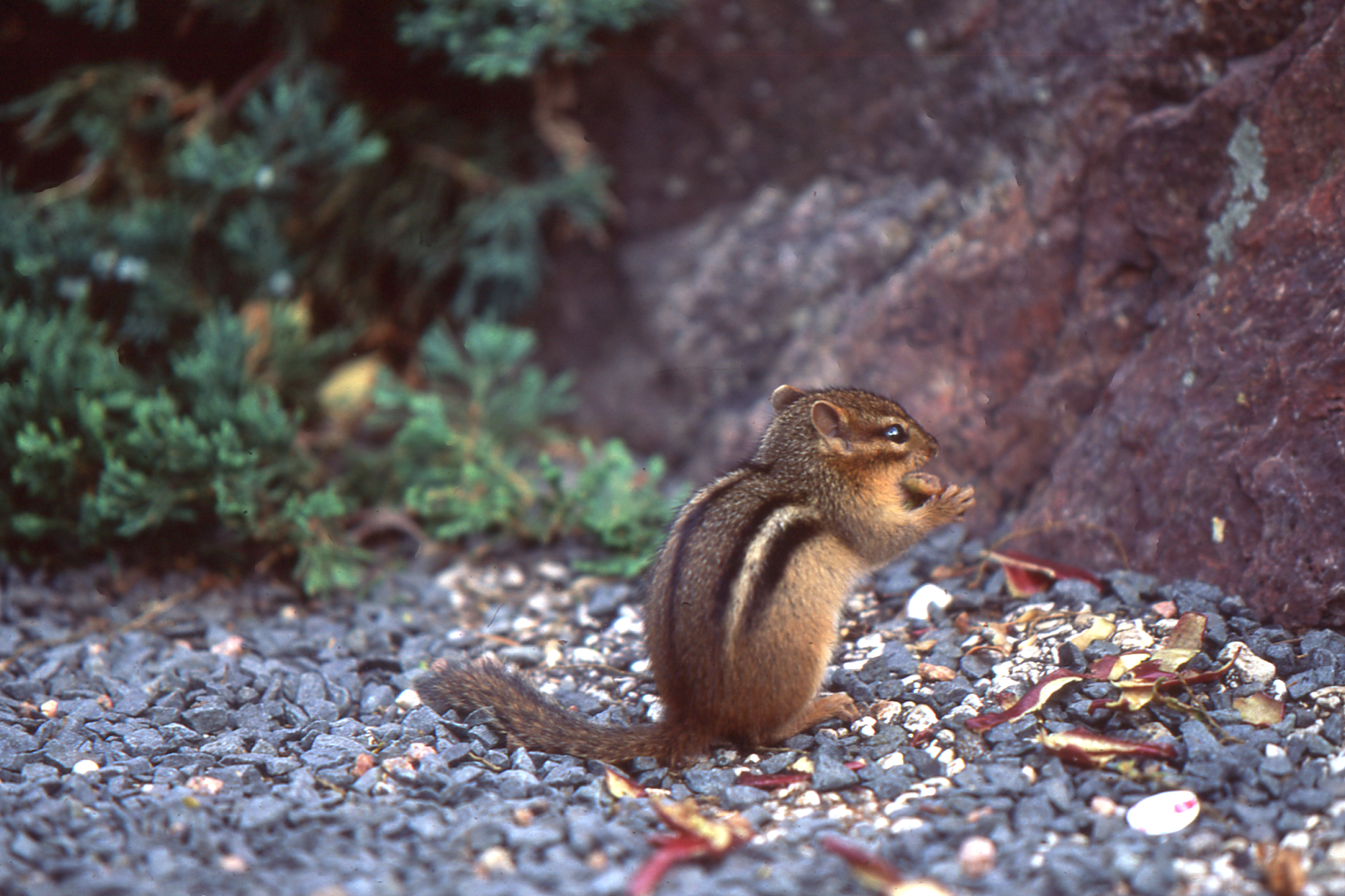
Eatern Chipmunk, Tamias striatus, by DonArnold, c-1999

Species are either obligate or facultative hibernators depending on when they enter a period of dormancy.  Obligate hibernators use seasonal cues.   When days start to shorten, indicating a change in season, these species will enter hibernation regardless of outside temperatures or amount of available food.  Facultative hibernators use environmental cues.  When it becomes too cold or food starts to become scarce, these species will enter hibernation to conserve on their energy use.  All species that spend time in hibernation eat larger amounts of food in autumn to build up brown fat.  These fat reserves provide the quick energy needed for activities upon awakening.

Skunk by Christa Gampp, c-2012

Species in hibernation may waken occasionally.   Animals have been observed waking to use a toilet area and/or to nibble on cached food supplies.  Chipmunks can be observed with fat cheeks in autumn, busily creating food caches located in burrows found under the frost line in the same area where their summer nest is located.  Although this reason for waking is not well understood, one theory is that waking may stimulate energy use followed by the ability to sustain a longer sleep period.  Another theory postulates that periodic eating of small amounts of food sustains the immune response system.

Woodchuck by Paul VanDerWerf, c-2015

Torpor is a similar process that involves the same physical modifications as hibernation, but in smaller quantities.  Body temperatures and heart rates will be lower by ten to fifteen percent, and animals using this strategy will wake more often, engaging in activities several times throughout the cold period.  Skunks enter their dens as daytime temperatures sink below freezing, and their heart and respiration rates slow.  Their sleep may last from a few days to a few weeks.  They will leave the den to forage for food in between these naps.  Many birds enter torpor on a daily basis, at night or on very cold days.  Their decreased physiological activity allows them to conserve body fat overnight so it is available for quick energy production the following morning to continue daily foraging activities.  On cold nights, black-capped chickadees can maintain body temperatures twelve degrees lower than normal.  This allows the body to use 30% less stored fat.

Wood Frog by Tom Benson, c-2015

Brumation is the term used for torpor in ectotherms.  Ectotherms obtain their body heat from the environment and include reptiles, amphibians and fish.  Most of these species must live where the temperatures always stay above freezing.  Many frogs and turtles bury themselves in mud at the bottoms of ponds, or dig holes deep into the ground, well below the frostline.  Their breathing and heart rate slow and they can get oxygen from air trapped in the cavity or surrounding mud.  Snakes will often den together in groups of a dozen to several hundred individuals in a den below the frostline.  The wood frog is an exception because it can tolerate freezing temperatures.  A chemical contained in each cell in its body  acts as antifreeze to protect the cell from damage that could be incurred if solid ice should form inside the body.  Thirty five to forty five percent of the body may freeze, stopping the heart and respiration, but it will thaw with warming temperatures.  The wood frog may freeze and thaw several times in one season.  All ectotherms may wake on warmer days in mid-winter and leave their dens to find water and nutrients.

Yellow-Jacket Wasp by Dog-WalkDigital, c-2011

In late autumn, before temperatures turn cold, some insect species enter diapause, a period of suspended development.  Some spend winter here in underground burrows, under bark or leaf litter, or in holes drilled into woody plants.  Many have the same cellular chemistry as wood frogs, with each cell having a  chemical antifreeze to prevent damage from ice formation.  For bumblebees and yellow jacket wasps, only the new queens survive, spending the winter in an underground burrow until spring.  Bees spend the longest time in any form of hibernation, often five to six months underground.

Bumblebee by DonArnold, c-2020

Strategies to survive cold periods are important as parts of the normal annual cycle.  Zoos attempt to provide habitat that can accommodate these needs.  Cold-adapted animals in northern climates  remain outdoors for winter as part of a healthy life cycle.  The risks involved with cold periods include the need to meet nutrient demands by storing fat or food caches, having energy in reserve to forage when warm weather arrives, and having enough water to hydrate throughout the cold period.  Climate change and warm days in the middle of winter are another threat that is not easily quantifiable.  Animals may wake and start to move about during warming episodes, but may not find any food available, wasting energy and water. 

We can help by following some simple guidelines: leave animals and habitats undisturbed during cold months; offer food sources for animals during warmer periods (i.e. extra seed if temperatures get above  freezing); learn more about the habitats in your neighborhood to protect them from disturbance and fragmentation and learn more about climate change and the negative effects caused by it.  Here are a few books you may find interesting: “Animals That Hibernate”, a children’s pictorial by Larry Dane Brimner;  “Do Not Disturb”, a children’s reader by Margery Facklam;  “Winter World” by Heinrich Bernd.

Moon Phases

The Full Harvest Moon occurred last night at 6:31pm, but you can still observe it for the next couple of days.  The moon takes 29.53 days to complete one full orbit around the earth.  During that time it passes through eight phases, each lasting a little less than 4 days.  A phase is determined by where each of three bodies are positioned: the sun, the moon, and the earth.  The angle of the moon from each of the other two determines what phase of the moon we will see.  What we see of the moon is due to sunlight reflected from the surface of the moon back to the earth.

Moon, Smokies National Park by DonArnold

The moon does not rotate as it proceeds along its orbit around the earth, so we are always looking at the same side of the moon.  There is an excellent presentation of how the phases of the moon are seen from earth provided at: https://www.timeanddate.com/astronomy/moon/location.html.  The phases include:

  1. New Moon:  the moon is between the earth and the sun, so no light is reflected back to the earth and the moon is not visible. 
  2. The Waxing Crescent is visible as the moon moves eastward and an observer starts to see a small slice of the moon’s surface.  As the visible crescent grows larger each night, it is called waxing which means to increase gradually.
  3. First Quarter is when the moon is one-quarter of the way around its orbit.
  4. The Waxing Gibbous Moon is more than half full but not totally full.
  5. The Full Moon shows us the completely lit side that faces the earth
  6. The Waning Gibbous Moon is still more than half lit, but waning refers to a gradual decrease in the visible side.
  7. The Third Quarter Moon is when the moon is three-quarters of the way around, now located on the other side of the night sky.
  8. The Waning Crescent phase shows the remaining small slice of the moon before it once again moves to a New Moon and the lighted surface is no longer visible to an observer.

As you can see from the presentation on the web site above, the moon’s orbit is elliptical, but sometimes it is closer to earth, sometimes farther.  The path that it follows is called the Metonic Cycle, and it is repeated every 19 years.  It was discovered in 432 B.C. by the Greek astronomer, Meton of Athens.  Due to slight variations in the moon’s travel as well as the slowing rotation of the earth, the cycle may be off by 1 day in some 19-year periods and then return to the same day in other periods.

When there are two full moons in a month, we call the second one a Blue Moon.  Blue Moons occur once every two to three years.  This month, the Blue Moon will appear on Halloween night, an occurrence that will not happen again for another 19 years.  The exact time of the Blue Moon will be October 31, 2020 at 9:49 am.

Moonscape, Aug95 by DonArnold

Folklore from Native Americans, settlers, and indigenous people of western Europe has introduced many other names for each of the monthly full moons throughout the calendar year:

  • January – Wolf Moon: Native Americans believe that wolves hunt around villages on cold winter nights and howl at the full moon.
  • February – Snow Moon: This marks the month of the heaviest snowfalls.
  • March – Worm Moon: As the ground thaws, earthworm start to appear.  Settlers colonizing early U.S. areas also call this the Lenten Moon, marking the last full moon of winter.
  • April – Pink Moon: Spring rains bring wildflowers into bloom including an herb called ‘moss pink’ or ‘wild ground phlox,’ Phlox subulata.
  • May – Flower Moon: It marks the spring time bloom.
  • June – Strawberry Moon: Strawberries are only ripe for a short period at this time of year.
  • July – Buck Moon: It marks when antlers covered in velvet are first seen on mature bucks.
  • August – Red Moon: Due to the haze caused by high humidity, the moon takes on a red tinge.
  • September – Harvest Moon: The full moon that occurs closest to the autumnal equinox when the sun’s trajectory crosses the equator and nights become longer than days.
  • October – Hunter’s Moon: Now is the time for hunting fattened deer for winter stores.  Hunter’s Moon is an important feast day for Native Americans and most of western Europe.
  • November – Beaver Moon: It marks the time to set traps for beaver, before winter freezes all of the waterways.
  • December – Long Night’s Moon: At this time of year, the moon has the longest and highest trajectory above the horizon.

All solar bodies including stars, planets and moons have gravity.  Gravity extends outward from every solar body for some distance depending on the mass of each solar body and how far two bodies are apart.  The moon’s gravity pulls at everything on the earth, effectively stretching the earth toward the moon and squashing the earth at right angles to the moon.

As water is also pulled and squashed, a bulge in the world’s oceans develops on the side of the earth facing the moon as well as on the opposite side.  The earth rotates under each bulge, and high tide occurs as the bulge passes over a shoreline.  Thus, there are two high tides each day.

As the earth rotates under the oceans, friction with the water slows down the earth’s rotation a fraction of a second each century.  This does not really affect us, but in 100 million years, a day will last 30 minutes longer.  At the same time, the moon’s orbital speed is increasing a fractional amount.  In that same 100 million years, the moon will spiral ever farther from the earth, and it will be an average of 3000 kilometers (1864 miles) farther away from the earth.  As we look into the past, these same effects have been present since the moon was created some 4.5 billion years ago. 

An example of the effect this friction has had on earth and the moon comes from a study of coral reefs.  A coral reef is made up of millions of tiny animals called polyps.  Each day, polyps deposit a layer of calcium to a coral reef.  Scientists have been able to count the layers of calcium to determine the age of a reef, including fossilized coral from the Devonian period.  When counting the layers of fossilized coral, the number of layers present is much higher than the sum total of days in that period.  We can account for this difference by calculating how much faster the earth was rotating in the past.  The results show us that a day in the Devonian period lasted about 22 hours, and there were 400 days in a year accounting for the extra layers of calcium in the fossilized coral.

Moonscape, Jun87, by DonArnold

Luna, from the Latin lucere, meaning to shine was the Roman goddess of the moon, animals and hunting.  Her symbol is a crescent  ☾.  The word luna and the word moon were used in common language for many hundreds of years to describe our neighboring satellite.  In 1919, the first meeting of the newly formed International Astronomical Union was held, and the name was standardized to “moon”.  This month we will experience all phases of the moon, including a Harvest Moon and a Blue Moon.  You can track moonrise, moonset and phases by date and time, plus lots of other lunar information, from the Time and Date website.  I hope you find Halloween to be an enjoyable and interesting time this year.

Clouds

As I sit outside and watch all those gray and white dragons and trains float by, I wonder what makes up a cloud, as they billow and move lazily past me, forever changing shape.  As we observe clouds, they provide weather information, shade, moisture, and sometimes entertainment.

Hole-punch altocumulus cloud, by DonArnold

Clouds are made from water and particles of both organic and inorganic matter. These may include dust, pollen, soot, and smoke.  Humidity is the amount of water vapor present in the air.  Air can hold a certain amount of water at any given temperature and warmer air can hold more water than cooler air.  When the temperature reaches the point where the air is 100% saturated, the water condenses onto these particles.  When massed together by the billions, the particles and water together form clouds.  The droplets are so small that they are kept aloft by air turbulence and wind.

Clouds come in many shapes and are found at different levels in the atmosphere.  Basic cloud types include cumulus, stratus, and cirrus.  Cumulus clouds are dense, fluffy piles with rounded tops usually formed from the rising of warm over cooler air.  Stratus clouds appear as a flat and featureless blanket or sheet, in varying shades of gray from nearly white to very dark.  Cirrus clouds, found at very high altitudes, are made of ice crystals, appearing as narrow bands or thin, feathery patches.

Cirrostratus clouds, by DonArnold

Cloud names may be combined to describe additional characteristics.  Cirrostratus clouds appear as several layers of narrow bands, while stratocumulus clouds appear as many fluffy forms compressed together into a large sheet of clouds.  Prefixes added to cloud names include alto signifying middle level altitudes, and nimbo or nimbus signifying clouds with precipitation. 

Cumulonimbus cloud, by DonArnold

In Illinois, we average 167 days each year with some type of cloud in the sky.  We can tell quite a bit about the immediate weather by simply looking at the clouds.  Cirrus clouds are an indicator of fair weather.  If cirrus clouds are getting thicker, this indicates that a warm front is approaching, bringing the possibility of precipitation, followed by clearing skies and warming temperatures.  Stratus clouds are associated with overcast skies and relatively stable air masses.  They may form fog or light precipitation, but are not associated with heavier storms.  Cumulus clouds that do not grow very tall are an indication of fair weather.  But, if cumulus clouds should start to grow, the atmosphere is unstable and pushing those droplets to greater heights.  This may lead to light or heavy rain depending on the growth rates and heights of the clouds.  Altocumulus clouds in the morning may well lead to precipitation in the later parts of the day or evening.

Cumulus clouds, by DonArnold

There is an average of 2,000,000,000,000 (two trillion) gallons of water in the atmosphere over Illinois at any given moment, and clouds may return this water to the ground in several different forms of precipitation.  Rain is liquid water formed as droplets between 1/10″ and 1/4″ in diameter.  Snow is when water vapor freezes inside a cloud into a crystalline form and falls through a cold air mass.  Sleet is formed when snow from a higher, colder altitude, falls through a warm layer of air, turning to liquid rain followed by a cold layer near the surface refreezing the water into small ice crystals.  Freezing rain falls as liquid water, but lands on a surface that is cold enough to have the rain drops freeze into ice as they hit.  Hail is made from many layers of ice that accumulate on a falling particle.  As the particle falls through each layer of atmospheric clouds, more water attaches and freezes to form each layer of ice. 

Most clouds form in upper layers of the atmosphere, but fog is also a type of cloud.  It forms when the air temperature immediately above ground level falls to the dew point temperature, and water vapor condenses on any particles in that air mass.  Fog usually forms when there is little or no movement of air at ground level, or it quickly dissipates.  Fog can create a surreal, almost magical scene, while at the same time conditions may become quite dangerous depending on where the fog appears and its density.

Stratus clouds, rain&rainbow, by DonArnold

Clouds can also make fantastic art and can spur our imagination.  Artists throughout the past several hundred years have painted and photographed many varying forms providing character and depth to many works of art.  There are even artists today who create real clouds indoors for our fascination and enjoyment.  Take some time and get outside yourself to observe this wonderful imagination-inspiring scientific phenomena.

Wildlife Photographer

At one time, I wanted to be a professional wildlife photographer.  But not just any wildlife.  After all, I like snakes.  Several years ago, Joe & Mary Ann McDonald offered an ‘advanced’ workshop, inviting just five photographers to come to their farm for three days to shoot pictures of some very unusual reptile species.  Most of the subjects were either venomous or large and difficult to handle, or both.  It was educational, fun, a little wild and very exciting.

The animals were flown in from all over the world and brought out to the farm by a professional handler.  They were kept in pens, boxes or cages in the McDonalds’ basement for the week while they rested, before continuing their travels to zoos and other institutions worldwide.  Each day, seven of us, Joe, Mike (the handler), and five photographers would head out to Joe’s studio located in a separate 40’x40′ building out back.  The studio had racks of equipment in back, room for everyone to sit, whiteboards and a large area in front for a lecturer or for someone to demonstrate equipment and techniques.

Egyptian Banded Cobra, Naja haje by DonArnold
Transpecos Copperhead, Agkistrodon contortrix by DonArnold
Formosan Cobra, Naja naja by DonArnold

A display area was created by placing an eight foot square table in the front of the room.  As each new animal was brought out, the table was swept clean and then filled with plants, soil, rocks and/or sand representative of the natural areas where you would find that animal in the wild.  Each animal was placed into the scene and given some time to get comfortable.  For each subject, the first round of shots lasted 5 minutes, and everyone was to shoot from across the room with long lenses.  For the second round, each photographer would have 2 minutes to shoot from as close up or as far away as he wanted from the scene. 

Puff Adder, Bitis arietans, by DonArnold
Massassauga Rattlesnake, Sisturus catenatus by DonArnold

There were a few tortoises and some lizards, but the exciting part of the shoot was the rattlesnakes, vipers, and cobras.  One of our discussions was about what to do in case an animal got off the table.  We learned that tortoises and lizards would generally head for the nearest dark corner to hide from us.  But the snakes might have other ideas about defense and escape.  Rattlesnakes and most vipers strike horizontally, just a few inches off the ground, so climbing the equipment racks at the back of the room was a good escape route.  Adders and cobras strike upward, which was where the rooms windows came in handy.  As Joe said, “remember to tuck and roll when you hit the ground outside”.  Fortunately, there were no incidents during any of the more than twenty times Joe offered this workshop.

This workshop provided the opportunity to get my dream shot, a picture that I had always wanted as a wildlife photographer, but thought I would never have a ‘safe’ opportunity to get.  Outside of the studio, Joe had a small pond, about 30 x 40 feet, that was from several inches to about six feet deep.  There were logs and rocks at one corner and plenty of swimming room.  I lay on my belly in the pond with my camera on a tripod in front of my face so the lens was no more than an inch above the water surface.  There were a couple Dwarf Caiman, a Spectacled Caiman, and an American Alligator in the pond with me.  As they swam by me and toward me, I was able to get the shot with only the nose and eyes of the predator coming right at me.  They swam around me as well, and were just as curious about me as I was about them.  They bumped their noses along the length of my body as I lay underwater, starting at my ankle and continuing all the way to my shoulder.  Alligators, crocodiles and caiman have thousands of touch-sensitive organs, called integumentary sensory organs, in their faces and all along the rest of their body.  Their snout is much more sensitive than human fingertips allowing the animal to investigate objects as well as detecting different levels of water pressure.  These were well fed, Mike told me when he let them go in the pond…

Dwarf Caiman, Paleosuchus palpebrosus by DonArnold
American Alligator, Alligator mississippiensis by DonArnold

There are dozens of photography workshops offered online, in schools, and by private photographers and studios.  Whether you are an aspiring professional or a weekend hobbyist, I highly encourage you to try one or more of these.  Start small with a single day or go big on a multi-week nature adventure.  Get online and learn a few new techniques that you can take out to your backyard and have fun with on your own.  There are many exciting opportunities waiting for all.

DewDew Dew-Dah

How’s the weather outside today?  Are you feeling a little warmer than you would like?  Have you seen the weather forecast, and do you really know what all those numbers mean? 

The simplest is temperature which is a measurement of the heat content of the air.  The two popular scales are Celsius and Fahrenheit.  Both have two defined points:  the freezing point of fresh water at sea level is 0°C / 32°F, and the boiling point of fresh water at sea level is 100°C / 212°F.  Note that the Fahrenheit scale, created in 1724 based on experiments carried out at that time by Polish physicist Danielle Gabriel Fahrenheit, is commonly used today in only four countries including Belize, Myanamar, Liberia and the United States, and only for non-scientific applications. 

Another popular number shown on most weather predictions is either heat index or wind chill.  If the apparent temperature, the “it-feels-like” number, is higher than the actual temperature, it is shown as heat index; if it is lower, it is shown as wind chill.  The heat index is derived from temperature and relative humidity and indicates heat gained between the human body and the atmosphere.  The wind chill is derived from temperature and wind speed and indicates heat lost between the human body and the atmosphere.

The human body removes heat by perspiring and letting drier air wick heat away.  When the relative humidity is high enough that perspiration does not evaporate, then there is no cooling effect.  The human body begins to absorb heat from the atmosphere and is in danger of suffering a heat related illness.  As heat or relative humidity rises, the combination becomes more dangerous.  The National Weather Service has published the heat index shown here:

The wind chill index is derived from temperature and wind speed, and indicates heat lost between the human body and the atmosphere.  Wind chill formulas vary greatly worldwide, but since 2001, the U.S., Canada and the U.K. have agreed on a standardized formula that uses the following assumptions: the wind is striking a bare face on a person walking 3mph into a 3mph headwind at an actual temperature of 10°C / 50°F or lower.  As the actual temperature falls or the wind speed rises, the wind chill falls and the danger of a cold related illness increases.  The National Weather Service has published the wind chill index shown here:

When reading a weather report, humidity and relative humidity are two terms often used interchangeably.  However, humidity, properly called absolute humidity and expressed in grams, is the amount of water vapor, by weight, in a cubic meter of air.  This measurement is rarely used outside of scientific experiments.  Another term is dew point temperature, a number that is considered by most meteorologists to be a better indicator of moisture in the air than relative humidity.

Relative humidity is the amount of water vapor in the air relative to the maximum amount of water vapor that air can hold at a given temperature.  As the temperature rises but the water content remains the same, relative humidity drops because warmer air can hold more water vapor than cooler air.  This means that if the air temperature is 80°F at noon and 84°F at 2:00 pm, but the water vapor content is constant, relative humidity will be lower at 2:00 pm even though the air is not any drier.  And what we “feel” is the actual amount of moisture, i.e. the absolute humidity, in the air.  So, while the relative humidity is dropping, it does not “feel” more comfortable.

The dew point temperature is also an indicator of how much water vapor is in the air, as well as how it “feels” to us.  Dew point is calculated by the use of a hygrometer, a polished metal mirror that is cooled until water vapor in the air starts to condense on the surface.  The temperature when condensation first starts is the dew point temperature. 

When the outside air temperature cools down to where it is the same as the dew point, water condenses to form fog at surface levels, clouds at levels aloft, or a film of dew on surfaces.  The larger the spread between temperature and dew point, the more comfortable we feel because as the temperature rises and the dew point remains constant or falls, the air becomes drier.

Humidity can make you feel uncomfortable whether you are in shade or sun, whether it is windy or calm, or whether you are acclimated to heat or not.  As the dew point gets higher and closer to the actual temperature, we start to feel that humidity; we start to feel ‘sticky’.  Remember, a person gets cool by perspiring, and no matter what the actual temperature, we can only get cool when perspiration can evaporate which only happens when air is not already saturated.  A dew point greater than 65 is uncomfortable to most people.  Dew point temperatures above 70 indicate unstable air conditions that may lead to severe weather.

All of this and more is included in the science of biometeorology; the study of weather and its effects on the human body.  I will look at additional aspects of this science in later columns.  To locate these numbers, take a look at your favorite weather website, or try one of the following:

www.weather.com   The Weather Channel   Today, Hourly, 10-day   Temp, clouds, wind speed & direction, chance of precip, heat index, windchill, humidity, UV index
www.accuweather.com  Accuweather  Hourly, Daily, Radar, Air Quality   Temp, clouds, wind speed & direction, Humidity, UV, DP
www.wunderground.com   Weather Underground   Hourly, Daily, Historical   Temp, clouds, wind speed & direction, chance of precip, heat index, windchill, humidity, DP, pressure
www.weather.gov   National Weather Service / NOAA   Current, Daily Forecast, History   Temp, clouds, wind speed & direction, humidity, pressure, DP
www.weatherbug.com   Weatherbug   Current, Hourly, 10-day    Temp, clouds, wind speed & direction, heat index, windchill, humidity, DP
https://www.wsdot.com/traffic/passes/snoqualmie/   Snoqualmie Current Weather    My favorite ski area 🙂

Snake Monitoring

Some days I spend hours grabbing snakes!  As a snake monitor, I am one of several stewards in this area leading groups that monitor snakes.  Our goals are to learn what species live here, their population size, and what areas they inhabit.  We are using this data, as well as other related information, to assist in making habitat management decisions. 

Capturing a garter snake, by DonArnold

Wildlife monitoring activities for any species are designed based on prior knowledge of when and where a species may be found and what kinds of activities we might observe. For snakes, we identify possible sites based on several factors: being away from human activities, having access to food, water, and shelter for overnight and bad weather.  We set out numerous snake boards. A snake board is a piece of rubber, wood or metal approximately two square feet in size and heavy enough that it will not be moved by wind or animals.  A line of these are laid out in the observation area, about one every 8-10 yards.  I use three boards at each of my dozen or so sites, but there can be 1 to many used. 

Storeria dekayi, Midland Brown Snake by Janice Sommer, 2018

Snakes are ectotherms, meaning they must obtain heat from their surroundings.  Snakes require heat to perform any action including moving, hunting and digestion.  Snake boards are generally placed in sunny areas.  This creates a spot where a snake can spend a few safe and sheltered hours absorbing heat that will allow them to hunt, eat and digest a meal.  When they are warm enough, they will leave the board area, complete their hunting or other movements.  They usually spend the night under rocks or logs in a close-by and safe place and return again the next day.

Snake Monitoring Entry

Monitors usually work in pairs.  When we visit a site, we will record date, time, and weather conditions.  One monitor lifts the board and both monitors capture any snakes that are present, placing them into a soft, cloth bag.  As each snake is removed from the bag, we record the species, weight, length and any identifying marks.

Several pictures are taken of each one, and then they are released.  They usually disappear quickly into the underbrush, but may not go far and may return to the board after we are gone.  Observations are made at least weekly, and are varied by time of day or weather conditions in order to have data across a wide spectrum of factors.

We have a wide variety of questions, and we are always adding more to the list.  Identifying what data to collect to provide answers, helps determine and refine our procedures.  Questions range from statistical to curious such as what snakes do we find in DuPage County, where do they live, what do they eat, can they swim, what restoration activities affect them and how, what management practices need to take them into consideration.  Collected data is used by scientists, teachers and stewards as we learn more about our own environment and how to manage its health.