

As I sit outside and watch all those gray and white dragons and trains float by, I wonder what makes up a cloud, as they billow and move lazily past me, forever changing shape. As we observe clouds, they provide weather information, shade, moisture, and sometimes entertainment.

Clouds are made from water and particles of both organic and inorganic matter. These may include dust, pollen, soot, and smoke. Humidity is the amount of water vapor present in the air. Air can hold a certain amount of water at any given temperature and warmer air can hold more water than cooler air. When the temperature reaches the point where the air is 100% saturated, the water condenses onto these particles. When massed together by the billions, the particles and water together form clouds. The droplets are so small that they are kept aloft by air turbulence and wind.
Clouds come in many shapes and are found at different levels in the atmosphere. Basic cloud types include cumulus, stratus, and cirrus. Cumulus clouds are dense, fluffy piles with rounded tops usually formed from the rising of warm over cooler air. Stratus clouds appear as a flat and featureless blanket or sheet, in varying shades of gray from nearly white to very dark. Cirrus clouds, found at very high altitudes, are made of ice crystals, appearing as narrow bands or thin, feathery patches.
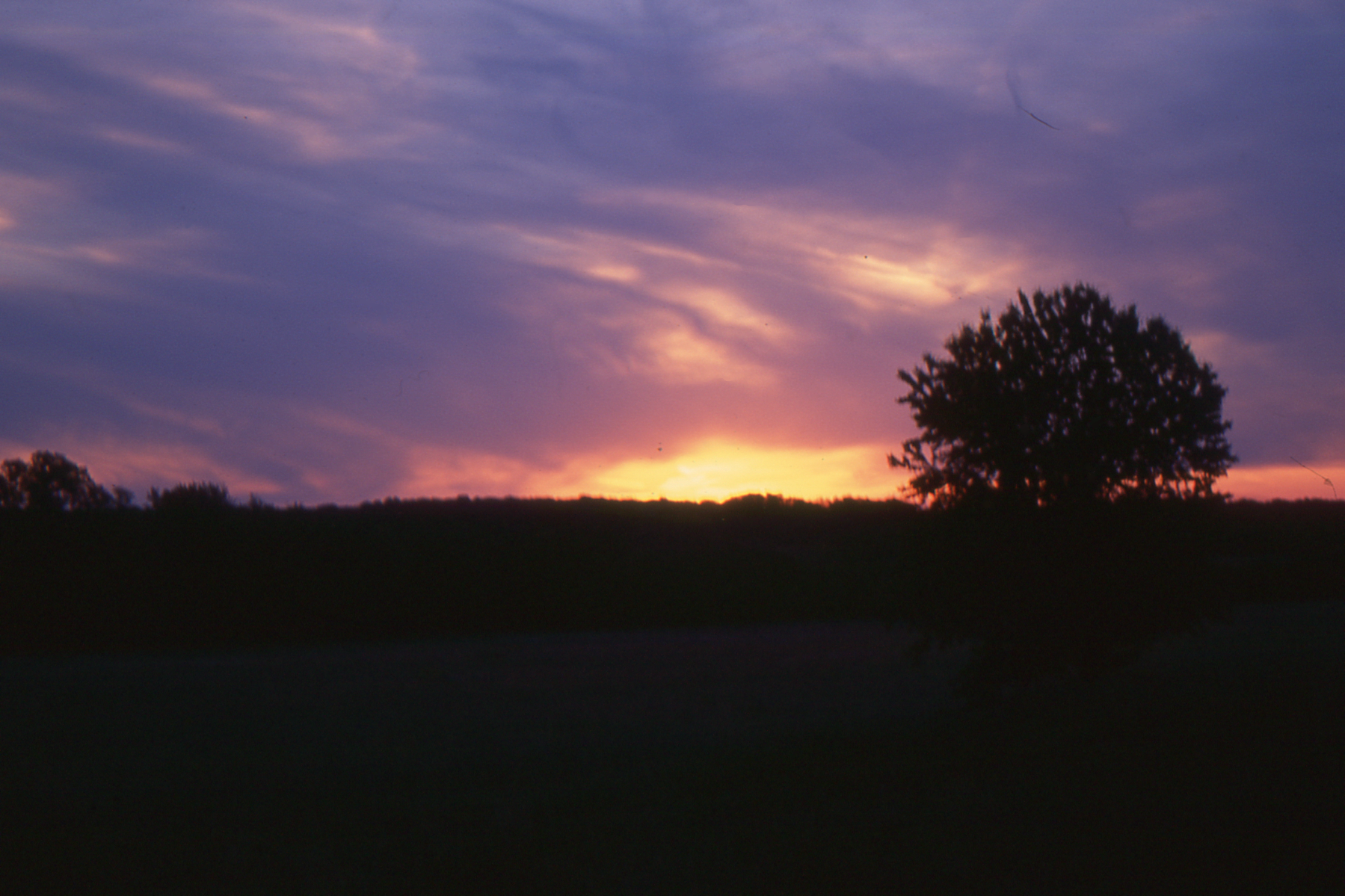

Cloud names may be combined to describe additional characteristics. Cirrostratus clouds appear as several layers of narrow bands, while stratocumulus clouds appear as many fluffy forms compressed together into a large sheet of clouds. Prefixes added to cloud names include alto signifying middle level altitudes, and nimbo or nimbus signifying clouds with precipitation.

In Illinois, we average 167 days each year with some type of cloud in the sky. We can tell quite a bit about the immediate weather by simply looking at the clouds. Cirrus clouds are an indicator of fair weather. If cirrus clouds are getting thicker, this indicates that a warm front is approaching, bringing the possibility of precipitation, followed by clearing skies and warming temperatures. Stratus clouds are associated with overcast skies and relatively stable air masses. They may form fog or light precipitation, but are not associated with heavier storms. Cumulus clouds that do not grow very tall are an indication of fair weather. But, if cumulus clouds should start to grow, the atmosphere is unstable and pushing those droplets to greater heights. This may lead to light or heavy rain depending on the growth rates and heights of the clouds. Altocumulus clouds in the morning may well lead to precipitation in the later parts of the day or evening.

There is an average of 2,000,000,000,000 (two trillion) gallons of water in the atmosphere over Illinois at any given moment, and clouds may return this water to the ground in several different forms of precipitation. Rain is liquid water formed as droplets between 1/10″ and 1/4″ in diameter. Snow is when water vapor freezes inside a cloud into a crystalline form and falls through a cold air mass. Sleet is formed when snow from a higher, colder altitude, falls through a warm layer of air, turning to liquid rain followed by a cold layer near the surface refreezing the water into small ice crystals. Freezing rain falls as liquid water, but lands on a surface that is cold enough to have the rain drops freeze into ice as they hit. Hail is made from many layers of ice that accumulate on a falling particle. As the particle falls through each layer of atmospheric clouds, more water attaches and freezes to form each layer of ice.
Most clouds form in upper layers of the atmosphere, but fog is also a type of cloud. It forms when the air temperature immediately above ground level falls to the dew point temperature, and water vapor condenses on any particles in that air mass. Fog usually forms when there is little or no movement of air at ground level, or it quickly dissipates. Fog can create a surreal, almost magical scene, while at the same time conditions may become quite dangerous depending on where the fog appears and its density.

Clouds can also make fantastic art and can spur our imagination. Artists throughout the past several hundred years have painted and photographed many varying forms providing character and depth to many works of art. There are even artists today who create real clouds indoors for our fascination and enjoyment. Take some time and get outside yourself to observe this wonderful imagination-inspiring scientific phenomena.
Discover more from Discover-Nature
Subscribe to get the latest posts sent to your email.
