Spiders

Spiders are omens of good luck, and the bigger they are, the more luck for you.  If you see a spider on Halloween, it means that a deceased loved one is watching over you.  According to folklore, spiders have mystical powers with their ability to spin both physical and magical webs.  The name spider is from “spinder” a reference to its spinning ability.  The Greek goddess Arachnea was jealous of her rival, the goddess Athena and challenged her to a silk spinning contest.  When Arachnea lost, Athena turned her into a spider destined to spin silk forever.   There are more than 600 species of spiders in Illinois with about 60 of those common to northern Illinois.  Let’s take a closer look at spiders and their abilities.

Spiders are part of the largest phylum of animals on earth: arthropods, which include crustaceans, insects, myriapods (millipedes and centipedes) and arachnids (spiders, scorpions, mites and ticks).  Spiders are characterized by having eight legs and two body parts, the cephalothorax and the abdomen, connected by a narrow portion called the pedicel.

Spider & Web by Brian Rogers, c-2014

We may characterize the cephalothorax as the head, with the spider’s face in front, mouth at the bottom, and all eight legs attached to its underside.  Internally, the cephalothorax contains the venom gland, the brain and the sucking stomach.  At the top of the face  are six to eight simple eyes arranged in two rows from left to right.  Each eye is a single lens, but all can detect color, movement, shape and size.  Below the eyes are two vertical jaws lined with teeth and tipped with fangs.  The fangs are used to inject both poison to disable and kill a victim and enzymes to break down a victim’s internal tissue to a liquid form.  Located below the jaws is another pair of appendages called pedipalps.  These are used when holding prey and feeding and are used in mating on fully grown adult males. 

The abdomen contains all remaining organs including heart, intestines, book lungs and trachea, ovaries and silk glands.  The abdomen may be long and thin or large and bulbous and is often colorfully marked.  These distinctive colorings are useful for species identification.  At the very back of the abdomen are three pairs of spinnerets.  Each one attaches to an internal silk producing gland.  Silk is a liquid mixture of proteins, which when exposed to air, dries immediately to a threadlike, elastic material.  It can be stretched up to three times its original length, and the tensile strength is greater than that of solid bone.  Each gland may produce a different type of silk.  The spider uses silk, both sticky and non-sticky strands, to form webs.  A web may be designed as a sheet, a funnel, a circular orb or in an irregular jumble of strands.  Other uses for silk are for wrapping prey for later consumption, creating the outer covering of an egg sac, or to create a shelter.  Silk is used in two ways for movement.  One is to create a dragline, which a spider attaches to an anchor point, such as a tree limb or house eave, and uses it to lower themselves.  The second movement, used by immature spiders to leave home, is called a balloon string.  The young spider points its abdomen skywards and shoots out a set of three threads in a triangle pattern designed to catch the wind and fly them to new territory.  Ballooning usually takes the spider several inches or feet to the next branch, but it has been known to transport a spider over many miles.  The last use is to create a sperm web, which I will discuss below.  Silk is reusable, and all spiders consume their webs after each use, returning the proteins to liquid form available to be re-used within minutes.

All spiders are predators and hunt for food.  Favorite foods include other arthropods as well as other spiders.  Adult females are considerably larger in size than adult males who must impregnate the female without getting eaten.  When males reach sexual maturity, the ends of their pedipalps enlarge to form a sperm holding chamber.  A sperm web is formed from silk and sperm is laid on this web to be taken up into the pedipalps where it is stored until needed.  To avoid being eaten, males will court a female to clearly establish his intentions.  For species with poor eyesight, the male will walk onto a female’s web using an intricate pattern of vibrations that indicates he is not prey.  For species with good eyesight, the male will get in front of the female and perform a courtship dance or combination of poses. 

Crab Spider in Yellow by Judy Gallagher, c-2016

Once the female accepts the male, his sperm must be deposited from each pedipalp into the epigynum, an opening on the bottom of her abdomen leading to the ovaries.  He will climb on the back of her abdomen, reach around and deposit sperm from both pedipalps  and leave.  Males may mate with more than one partner, but most will die shortly after mating.  Eggs are produced and fertilized during the summer, then deposited in an egg sac.  The egg sac may be carried around by the female or attached to the edge of her web.  Egg sacs may contain from one to several hundred eggs.  Eggs will hatch within a few weeks, depending on the species.  Spiders are born blind but will grow functioning eyes within several days of hatching.  The young stay close to the egg sac to use it for nourishment until they can see and begin to hunt for themselves.  The young will molt from four to twelve times, growing functional eye tissue, fangs and spinnerets during subsequent molts.  Any lost body parts, such as a leg, can also be regrown during a molt, however once they are adults, they will never molt again.  The molting process normally takes several months and many species will spend their first winter between molts, having their final molt during spring of the following year.

Following the first or second molt, juveniles are able to feed themselves and will begin to hunt on their own.  As predators, they quickly find that other spiders make good meals, and cannibalism in large hatches is a reality.  In general, spiders are either active hunters, typically found in species with good eyesight, or web weavers, typically those species with poorer eyesight.  For web weavers, all prey is caught in a web.  Prey thrashes about getting more entangled until the prey tires.  Spiders can tell from the vibrations at which point they can safely move in and using their fangs, inject venom to further subdue and kill the victim.  At the same time, enzymes are also injected to break down internal tissues into liquid form.  Active hunters will lie in wait or chase down prey.  Many active hunters use coloration to blend in with flowers and other vegetation while hunting.  Some species, including crab spiders in our area, can change their body colors to match different flower colors.  Spiders eat all meals in a liquid state and have powerful stomach muscles that pull all liquids into their stomach.

Crab Spider in White by Michael Figiel, c-2016

All spiders produce venom.  In northern Illinois, there are only two species that may pose a serious threat to humans.  They are the Brown Recluse, Loxosceles reclusa and the Northern Widow, Latrodectus variolus.  Both of these species are native to areas farther south and are not commonly found in northern Illinois.  It is thought that they only occur when brought into an individual home from elsewhere.  Spiders, in general, including these two species, are not known to bite unless provoked.  Most spiders live an average of one to two years, although some species in the tropics may live up to 20 years.  Their most effective predators are found among wasps.  Two wasp families will repeatedly sting the spider until it is paralyzed, then drag it off to their nests.  Instead of eating the spider, the wasps lay an egg on the spider’s abdomen, and when the egg hatches, the larva will feed on the still living spider until it dies and the wasp pupates.  Other predators include fish, frogs, toads, salamanders and other spiders.  Spiders are one of our gardens most beneficial inhabitants, eating many of the garden’s numerous flower and vegetable pests. 

Winter is the time of least activity, but warmer days or when the sun is providing radiant warmth, you can observe spiders being active even on top of the snow.  Most overwinter in leaf litter, under bark or in hollow logs or crevices.  If they decide to move inside with you and you prefer they didn’t, they can easily be captured with a paper cup and a lid (3×5 cards work well) and released outdoors.  However, they will do a good job patrolling insect pests, including aphids on indoor plants, as well.  There are many good books and websites to get more information.  A couple of my favorites include “Good Garden Bugs” by Mary M. Gardiner, Ph.D.;  “Spiders of the North Woods” by Larry Weber, part of the North Woods Naturalist Series; and a video of ballooning on the Science  Magazine website found at watch-ballooning-spider-take-flight.

Hibernation

Days are getting shorter and temperatures are starting to cool.  We are well into autumn, and it is time for animals to prepare for winter when it will become difficult for them to keep warm and find food.  There are several approaches to living through winter: growing thicker fur coats, travelling south to follow the quickly retreating warmer temperatures, and sleeping in until warmer, sunlit mornings prevail.  Animals that “sleep-in” are actually going through a period of dormancy.  It can last from a few weeks to several months, but there are some general conditions that must be met.  Almost all species will need a home that consistently stays above freezing, and each animal must have enough energy to last through the dormancy period.  There are four categories of dormancy including hibernation, torpor, brumation, and diapause.  Let’s take a look at these methods and some species that use each.

Hibernation is a process that involves a significantly lower body temperature, and decreased heart, respiration, and metabolic rates.  Species that are true hibernators can live for long periods of time with very low energy use.  Woodchucks, also known as groundhogs, hibernate up to five months each year in the northern areas of the eastern U.S.  They have a normal heartbeat of 80 beats per minute which is reduced to about 5 beats per minute; their normal body temperature is reduced from 98°F to 38°F; and their breathing rate goes from 16 times per minute to twice a minute.  The woodchuck also exhibits reductions in other growth areas including teeth, which normally grow 1/16″ weekly and are kept under control by the grinding action when they eat. 

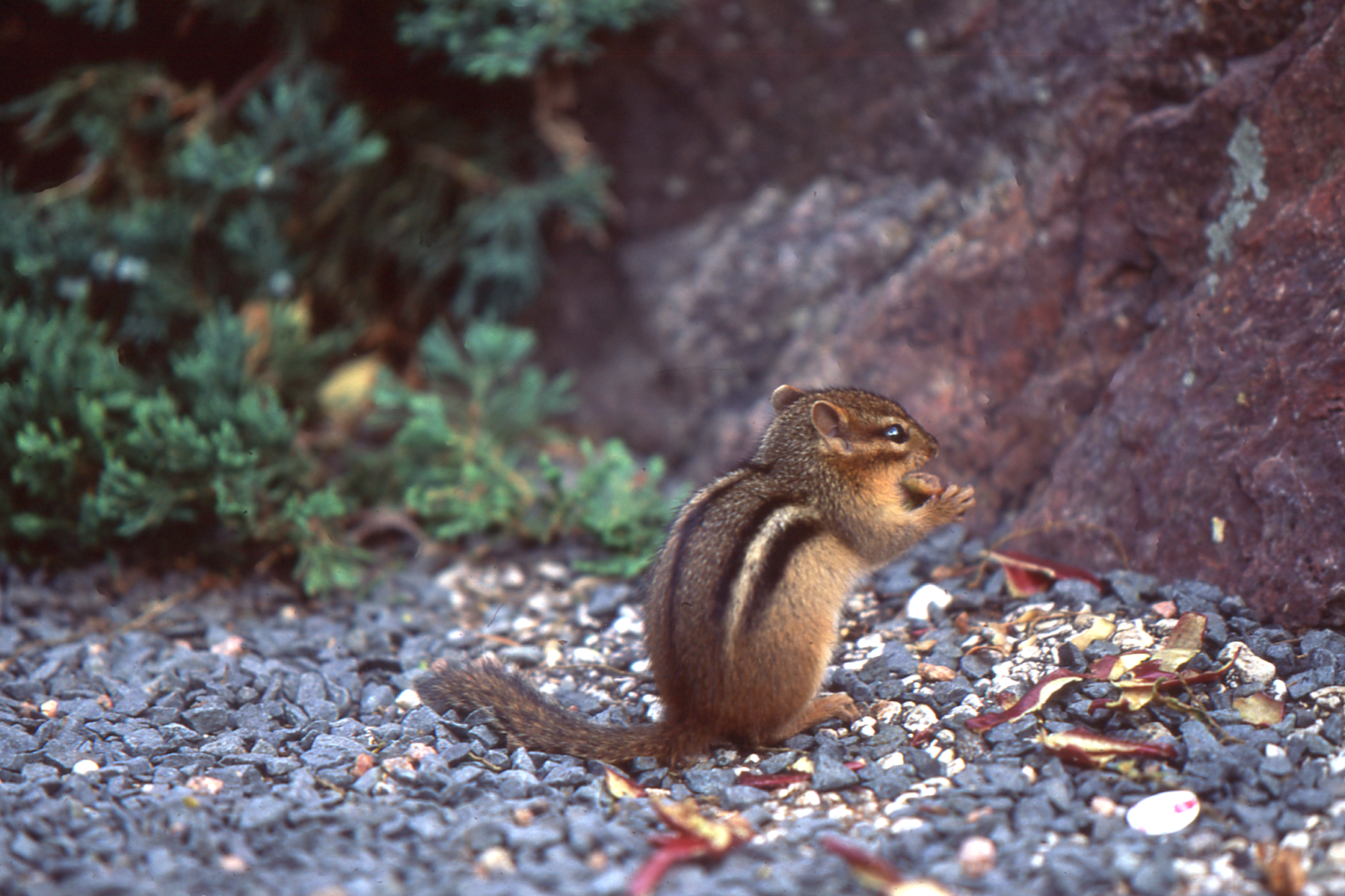
Eatern Chipmunk, Tamias striatus, by DonArnold, c-1999

Species are either obligate or facultative hibernators depending on when they enter a period of dormancy.  Obligate hibernators use seasonal cues.   When days start to shorten, indicating a change in season, these species will enter hibernation regardless of outside temperatures or amount of available food.  Facultative hibernators use environmental cues.  When it becomes too cold or food starts to become scarce, these species will enter hibernation to conserve on their energy use.  All species that spend time in hibernation eat larger amounts of food in autumn to build up brown fat.  These fat reserves provide the quick energy needed for activities upon awakening.

Skunk by Christa Gampp, c-2012

Species in hibernation may waken occasionally.   Animals have been observed waking to use a toilet area and/or to nibble on cached food supplies.  Chipmunks can be observed with fat cheeks in autumn, busily creating food caches located in burrows found under the frost line in the same area where their summer nest is located.  Although this reason for waking is not well understood, one theory is that waking may stimulate energy use followed by the ability to sustain a longer sleep period.  Another theory postulates that periodic eating of small amounts of food sustains the immune response system.

Woodchuck by Paul VanDerWerf, c-2015

Torpor is a similar process that involves the same physical modifications as hibernation, but in smaller quantities.  Body temperatures and heart rates will be lower by ten to fifteen percent, and animals using this strategy will wake more often, engaging in activities several times throughout the cold period.  Skunks enter their dens as daytime temperatures sink below freezing, and their heart and respiration rates slow.  Their sleep may last from a few days to a few weeks.  They will leave the den to forage for food in between these naps.  Many birds enter torpor on a daily basis, at night or on very cold days.  Their decreased physiological activity allows them to conserve body fat overnight so it is available for quick energy production the following morning to continue daily foraging activities.  On cold nights, black-capped chickadees can maintain body temperatures twelve degrees lower than normal.  This allows the body to use 30% less stored fat.

Wood Frog by Tom Benson, c-2015

Brumation is the term used for torpor in ectotherms.  Ectotherms obtain their body heat from the environment and include reptiles, amphibians and fish.  Most of these species must live where the temperatures always stay above freezing.  Many frogs and turtles bury themselves in mud at the bottoms of ponds, or dig holes deep into the ground, well below the frostline.  Their breathing and heart rate slow and they can get oxygen from air trapped in the cavity or surrounding mud.  Snakes will often den together in groups of a dozen to several hundred individuals in a den below the frostline.  The wood frog is an exception because it can tolerate freezing temperatures.  A chemical contained in each cell in its body  acts as antifreeze to protect the cell from damage that could be incurred if solid ice should form inside the body.  Thirty five to forty five percent of the body may freeze, stopping the heart and respiration, but it will thaw with warming temperatures.  The wood frog may freeze and thaw several times in one season.  All ectotherms may wake on warmer days in mid-winter and leave their dens to find water and nutrients.

Yellow-Jacket Wasp by Dog-WalkDigital, c-2011

In late autumn, before temperatures turn cold, some insect species enter diapause, a period of suspended development.  Some spend winter here in underground burrows, under bark or leaf litter, or in holes drilled into woody plants.  Many have the same cellular chemistry as wood frogs, with each cell having a  chemical antifreeze to prevent damage from ice formation.  For bumblebees and yellow jacket wasps, only the new queens survive, spending the winter in an underground burrow until spring.  Bees spend the longest time in any form of hibernation, often five to six months underground.

Bumblebee by DonArnold, c-2020

Strategies to survive cold periods are important as parts of the normal annual cycle.  Zoos attempt to provide habitat that can accommodate these needs.  Cold-adapted animals in northern climates  remain outdoors for winter as part of a healthy life cycle.  The risks involved with cold periods include the need to meet nutrient demands by storing fat or food caches, having energy in reserve to forage when warm weather arrives, and having enough water to hydrate throughout the cold period.  Climate change and warm days in the middle of winter are another threat that is not easily quantifiable.  Animals may wake and start to move about during warming episodes, but may not find any food available, wasting energy and water. 

We can help by following some simple guidelines: leave animals and habitats undisturbed during cold months; offer food sources for animals during warmer periods (i.e. extra seed if temperatures get above  freezing); learn more about the habitats in your neighborhood to protect them from disturbance and fragmentation and learn more about climate change and the negative effects caused by it.  Here are a few books you may find interesting: “Animals That Hibernate”, a children’s pictorial by Larry Dane Brimner;  “Do Not Disturb”, a children’s reader by Margery Facklam;  “Winter World” by Heinrich Bernd.

Backyard Birds

Our backyard bird feeders have seen a big jump in activity over the past two to three weeks, and I am filling the feeders at least once a day.  We have three feeders out all year: include mixed nuts, fruits & seeds, black oil sunflower seeds, and thistle.  In winter, we add a fourth feeder with a variety of suet types.  There is also a birdbath, heated in winter, in addition to the small pond behind our house.  The heated birdbath guarantees fresh water all year, even when the pond freezes.  We also have plenty of cover for the feeders with two large Austrian pine trees and a small multi-stem Amelanchier tree.  There are plenty of other bushes and trees on neighboring properties, all within 50-70 yards of our feeders.  Our garden plants provide berries and seeds from sunflowers, coneflowers, Amelanchier tree and honeysuckle vine.

Interconnected backyard habitat by DonArnold-c
Sheltered birdbath by DonArnold-c

The bird species we see change from season to season as summertime birds migrate south at this time of year and winter birds move into the area to take their places.  Food sources change, winter shelter requirements are different, and water availability becomes much more important when freezing temperatures arrive.  Within the last few weeks, I have noticed that many of the summer resident birds have left the area including the house wren, chipping sparrow, killdeer, ruby-throated hummingbird, green heron and great egret.  A few may still be sticking around until it gets really cold, but most individuals have already headed south to follow the warmer temperatures.

Red Bellied Woodpecker, by DonArnold
Mourning Dove by DonArnold
House Finch in flight by DonArnold

Year-round residents include red-bellied woodpecker, house finch, mourning dove, black-capped chickadee, white-breasted nuthatch, northern cardinal and American goldfinch.  But, we are already starting to see some winter only residents at our feeders including dark-eyed junco and purple finch.  These two species spend their breeding season farther north, but return to this area during winter as they move around in search of food.  All of the birds visiting our backyard in the winter will eat seeds, although some of the insect foragers are still checking out our trees and garden soils.  The red-bellied woodpecker and white-breasted nuthatch scurry over the trunk and limbs of our two Austrian Pines checking out all of the crevices and nubs and knobs.  Goldfinches primarily eat thistle seed, but can also be observed on many coneflowers in the garden.  The mixed nuts and fruit blend attracts the white-breasted nuthatch, the red-breasted nuthatch, and the red-bellied woodpecker.  I have observed all of the species, at one time or another, eating black oil sunflower seeds.  Most species are comfortable with the perches available on the different feeders, although the mourning dove is mainly a ground feeder, scavenging for dropped seed along with squirrels and ducks and the occasional skunk.

Cardinal, female by DonArnold
Cardinal, male by DonArnold

We tend to think that birds live in nests.  However, nesting is primarily a breeding season activity, encompassing early spring to mid-summer in our area.  Many of the birds in our backyards spend winter periods as close to food sources as possible.  Habitat in our area includes several distinct micro-environments offering differing levels of protection and accessibility.  Medium sized shrubbery, thick with many small stems and twigs, is used by sparrows, finches and other small birds.  Evergreen trees and bushes provide cover for cardinals and mourning doves.  Large oak, linden and maple trees are favored by woodpeckers and nuthatches.  Areas of tall, thick grasses may be used by all species during daytime foraging activities.  All of these habitats provide shelter from wind, cold and predators. 

Chickadee by DonArnold
Goldfinch by DonArnold

Water availability is another prime concern for over-wintering species.  Birds need water every day to maintain a healthy metabolism to keep their body temperature and hydration level normal.  They use water in the process of preening their feathers to maintain an outer covering that is waterproof and provides good insulation for their bodies.  They will travel long distances to find open water.  If none can be found, they may resort to eating snow, if that is available.  We provide a heated birdbath which I fill at least once a day and clean every two to three days.  Dozens of birds visit each day and it can be one of the highlights of bird observation in our own backyards.  Providing food, water and shelter for the birds in our neighborhoods can provide a daily dose of rich and rewarding fun for your family. 

White Breasted Nuthatch by DonArnold

If you are looking for ways to get further involved, consider looking into all of the information and citizen science opportunities at the Cornell Lab of Ornithology.  Their Project Feederwatch (click on name to link to URL) offers a fun way to observe and report on action at your own backyard bird feeders. 

Autumn Leaves

Autumn officially began just a few short weeks ago, but we are already able to observe the changing colors and leaf fall in the woods.  There is much about nature that we can appreciate at this time of year, with observation and a little help from books, blogs and research.

Hackberry, Celtis occidentalis by DonArnold

Leaves on trees produce food for the rest of the tree.  They do this by a process called photosynthesis which combines carbon dioxide, water, pigments and energy to create sugars and oxygen.  The sugars are used to feed the rest of the tree.  The oxygen is a by-product that is released into the surrounding atmosphere.  The various pigments include chlorophylls, which allow a plant to absorb energy from light; carotenoids, which also assist in energy absorption; and xanthophylls, which protect the photosynthesis process from the toxic elements of light.  All of these pigments give leaves certain colors.  During spring and summer, chlorophylls are present in the highest concentrations, and they give leaves their green color.  In autumn and winter, as the number of hours of light per day gets shorter, the photosynthesis process slows down and finally ceases.  The amount of chlorophyll decreases and color from the other pigments starts to show through.  Carotenoids are orange and yellow, while xanthophylls are yellow and brown.  Another pigment that is only present when there is more sugar being produced than used by the plant is anthocyanin, and it colors the leaves red and purple.

Colors in autumn may be brilliant in some years, or more muted in other years.  This intensity is determined by the weather conditions during late summer and autumn.  Carotenoids and xanthophylls are always present in the leaves during food production season.  Dry periods in late summer reduce the amount of sugar being produced.  Thus, the red and purple hues from anthocyanin may be muted or not present at all, allowing more of the orange, yellow, and brown pigments to be displayed.  Colors may be more muted with less moisture in the leaves and the length of time the leaves remain on the tree may be shortened.  

White Ash, Fraxinus americana, by DonArnold

Color is also affected by temperature.  When days are warm and sunny, leaves produce a lot of sugar.  At night, in cooler weather, leaf veins constrict and limit the amount of sugar flowing to the rest of the plant, thus creating an excess of sugar remaining in the leaves each day.  This is when we see lots of red and purple hues from anthocyanins displayed.

While leaves are falling, trees are preparing for spring in other ways.  During senescence, that time of year when leaves grow old, carbohydrates, nitrogen, sulfur, phosphorous and potassium are reabsorbed by the tree in great quantities from the leaves.  None of these elements are lost, but they are stored in twig, stem and root tissues.   They will be used in springtime to fuel the beginning of the next year’s growth. 

Another way for a tree to get a head start on next year comes from bud growth.  Buds are formed in late summer or early fall, and are covered with modified leaves called bud scales.  These will seal them against the cold and wet weather of winter.  Most of the buds that you can observe are leaf buds containing tightly packed, immature leaves.  In spring, when the weather gets warm enough for sap to start flowing, these buds will unfold into the first leaves of spring.  Larger size buds may be flower buds, depending on the species and age of the tree.  Flower buds do not change much in the winter months, but they will grow a bit larger as we get near bud burst in spring.  You may also observe terminal buds, found at the ends of branches.  Oak trees, as well as other species, add length to existing branches when these buds begin their spring growth. 

There are numerous good field guides about trees available, but I would like to mention four  that I use.  “Winter Tree Finder” by May Thielgaard Watts and Tom Watts instructs you in how to look at a twig and its structures.  Then the book guides you through an examination of a twig to identify the genus and species of deciduous trees in winter.  “Trees of Illinois” by Linda Kershaw is another book organized using keys with excellent pictures of leaves, buds and fruit for each species, along with ranges and characteristics of each.  “The Tree Identification Book” by George W.D. Symonds provides a wide variety of black and white photographs for every part of a tree including thorns, leaves, flowers, fruit, twigs, buds, bark and needles.   Peterson Field Guides presents “Ecology of Eastern Forests,” with chapters describing the plants and animals encountered in different types of forests, and how they all function together.  Other chapters talk about how forest patterns change with the various seasons. 

Moon Phases

The Full Harvest Moon occurred last night at 6:31pm, but you can still observe it for the next couple of days.  The moon takes 29.53 days to complete one full orbit around the earth.  During that time it passes through eight phases, each lasting a little less than 4 days.  A phase is determined by where each of three bodies are positioned: the sun, the moon, and the earth.  The angle of the moon from each of the other two determines what phase of the moon we will see.  What we see of the moon is due to sunlight reflected from the surface of the moon back to the earth.

Moon, Smokies National Park by DonArnold

The moon does not rotate as it proceeds along its orbit around the earth, so we are always looking at the same side of the moon.  There is an excellent presentation of how the phases of the moon are seen from earth provided at: https://www.timeanddate.com/astronomy/moon/location.html.  The phases include:

  1. New Moon:  the moon is between the earth and the sun, so no light is reflected back to the earth and the moon is not visible. 
  2. The Waxing Crescent is visible as the moon moves eastward and an observer starts to see a small slice of the moon’s surface.  As the visible crescent grows larger each night, it is called waxing which means to increase gradually.
  3. First Quarter is when the moon is one-quarter of the way around its orbit.
  4. The Waxing Gibbous Moon is more than half full but not totally full.
  5. The Full Moon shows us the completely lit side that faces the earth
  6. The Waning Gibbous Moon is still more than half lit, but waning refers to a gradual decrease in the visible side.
  7. The Third Quarter Moon is when the moon is three-quarters of the way around, now located on the other side of the night sky.
  8. The Waning Crescent phase shows the remaining small slice of the moon before it once again moves to a New Moon and the lighted surface is no longer visible to an observer.

As you can see from the presentation on the web site above, the moon’s orbit is elliptical, but sometimes it is closer to earth, sometimes farther.  The path that it follows is called the Metonic Cycle, and it is repeated every 19 years.  It was discovered in 432 B.C. by the Greek astronomer, Meton of Athens.  Due to slight variations in the moon’s travel as well as the slowing rotation of the earth, the cycle may be off by 1 day in some 19-year periods and then return to the same day in other periods.

When there are two full moons in a month, we call the second one a Blue Moon.  Blue Moons occur once every two to three years.  This month, the Blue Moon will appear on Halloween night, an occurrence that will not happen again for another 19 years.  The exact time of the Blue Moon will be October 31, 2020 at 9:49 am.

Moonscape, Aug95 by DonArnold

Folklore from Native Americans, settlers, and indigenous people of western Europe has introduced many other names for each of the monthly full moons throughout the calendar year:

  • January – Wolf Moon: Native Americans believe that wolves hunt around villages on cold winter nights and howl at the full moon.
  • February – Snow Moon: This marks the month of the heaviest snowfalls.
  • March – Worm Moon: As the ground thaws, earthworm start to appear.  Settlers colonizing early U.S. areas also call this the Lenten Moon, marking the last full moon of winter.
  • April – Pink Moon: Spring rains bring wildflowers into bloom including an herb called ‘moss pink’ or ‘wild ground phlox,’ Phlox subulata.
  • May – Flower Moon: It marks the spring time bloom.
  • June – Strawberry Moon: Strawberries are only ripe for a short period at this time of year.
  • July – Buck Moon: It marks when antlers covered in velvet are first seen on mature bucks.
  • August – Red Moon: Due to the haze caused by high humidity, the moon takes on a red tinge.
  • September – Harvest Moon: The full moon that occurs closest to the autumnal equinox when the sun’s trajectory crosses the equator and nights become longer than days.
  • October – Hunter’s Moon: Now is the time for hunting fattened deer for winter stores.  Hunter’s Moon is an important feast day for Native Americans and most of western Europe.
  • November – Beaver Moon: It marks the time to set traps for beaver, before winter freezes all of the waterways.
  • December – Long Night’s Moon: At this time of year, the moon has the longest and highest trajectory above the horizon.

All solar bodies including stars, planets and moons have gravity.  Gravity extends outward from every solar body for some distance depending on the mass of each solar body and how far two bodies are apart.  The moon’s gravity pulls at everything on the earth, effectively stretching the earth toward the moon and squashing the earth at right angles to the moon.

As water is also pulled and squashed, a bulge in the world’s oceans develops on the side of the earth facing the moon as well as on the opposite side.  The earth rotates under each bulge, and high tide occurs as the bulge passes over a shoreline.  Thus, there are two high tides each day.

As the earth rotates under the oceans, friction with the water slows down the earth’s rotation a fraction of a second each century.  This does not really affect us, but in 100 million years, a day will last 30 minutes longer.  At the same time, the moon’s orbital speed is increasing a fractional amount.  In that same 100 million years, the moon will spiral ever farther from the earth, and it will be an average of 3000 kilometers (1864 miles) farther away from the earth.  As we look into the past, these same effects have been present since the moon was created some 4.5 billion years ago. 

An example of the effect this friction has had on earth and the moon comes from a study of coral reefs.  A coral reef is made up of millions of tiny animals called polyps.  Each day, polyps deposit a layer of calcium to a coral reef.  Scientists have been able to count the layers of calcium to determine the age of a reef, including fossilized coral from the Devonian period.  When counting the layers of fossilized coral, the number of layers present is much higher than the sum total of days in that period.  We can account for this difference by calculating how much faster the earth was rotating in the past.  The results show us that a day in the Devonian period lasted about 22 hours, and there were 400 days in a year accounting for the extra layers of calcium in the fossilized coral.

Moonscape, Jun87, by DonArnold

Luna, from the Latin lucere, meaning to shine was the Roman goddess of the moon, animals and hunting.  Her symbol is a crescent  ☾.  The word luna and the word moon were used in common language for many hundreds of years to describe our neighboring satellite.  In 1919, the first meeting of the newly formed International Astronomical Union was held, and the name was standardized to “moon”.  This month we will experience all phases of the moon, including a Harvest Moon and a Blue Moon.  You can track moonrise, moonset and phases by date and time, plus lots of other lunar information, from the Time and Date website.  I hope you find Halloween to be an enjoyable and interesting time this year.